
Tata Communications Plans $450M AI Fibre Network Across India, Funded From Cash Flow
Tata Communications plans $450M for a 10,000 km AI fibre network in India, funded from operating cash flow, with completion scheduled by FY2036.
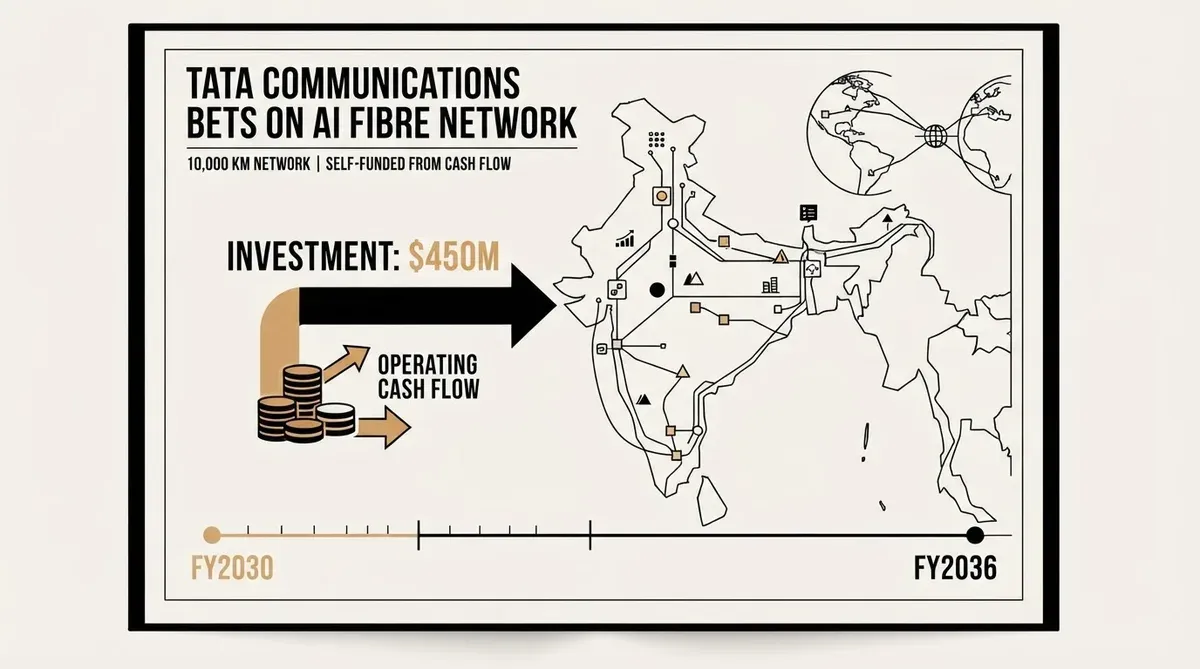
MUMBAI / LONDON (BYTEVYTE) Can a self-funded fibre backbone hold up better than debt-financed AI infrastructure? Tata Communications has disclosed in a stock exchange filing that it will spend about $450 million, or roughly Rs 4,350 crore, on a 10,000 km AI fibre network linking India's data-centre hubs. The company says operating cash flow will pay for the build, which runs through seven fiscal years.
The first corridor connects Mumbai, Pune, Hyderabad and Chennai. Later phases extend to India's east coast and to western data-centre clusters. The first long-haul leg joins Mumbai and Chennai, both of which have undersea cable connections. The network is aimed at cloud providers, financial institutions and multinational offshore operations. Total capacity is planned to grow from 1.25 petabits per second to 6 Pbps, a 4.8-fold increase, with completion scheduled between financial years 2030 and 2036.
What the spending buys
The company cites a market opportunity of more than $1 billion. That figure puts the $450 million outlay at under half of the company's own estimate. The material reviewed does not independently verify the opportunity size. It also does not break out annual spending, the cost of individual phases, or expected revenue per petabit, so the investment cannot yet be measured against returns.
Capacity is the more consequential number. Nearly quintupling capacity means the backbone must be filled with demand that is not yet visible in the available material. The phasing over seven years will show whether capacity comes online before paying customers do.
Self-funding versus the neocloud debt model
Debt-funded neocloud operators borrow against compute and data-centre capacity. Their build-outs therefore depend on refinancing terms, which can tighten quickly. Tata Communications plans to pay from operating cash flow, so this project avoids that refinancing exposure.
The trade-off is that every rupee spent on fibre draws from the same cash pool that funds existing operations. Spending at this scale could strain cash flow and the company's debt profile in the near term. The announcement does not quantify that strain.
Long-lived assets suit this approach. Fibre routes can earn returns over decades, which reduces the pressure created when asset lives and debt maturities do not line up, a pressure that weighs on leveraged operators. That advantage holds only if traffic arrives on schedule. The available material does not disclose the company's current debt, its operating cash generation, or the payback assumptions behind the plan.
Testing the 2030 to 2036 timeline and demand
A seven-year schedule leaves room for a slow ramp. It also means the demand case goes unproven for most of the build. The material names target customer types, but it does not name signed customers or anchor contracts.
Two figures carry the case, and both are the company's own. The $1 billion-plus opportunity is an internal estimate. The 6 Pbps target is a plan, not capacity in service. The material gives no interim milestones, so outside observers will have to test both claims as each phase is completed. Until then, the timeline rests on assumptions about demand that have not been shown.
The material does not name rival long-haul builders or compare unit costs. It does show a contrast in model. Tata Communications is building owned fibre on its own cash. Neocloud rivals are building compute capacity with borrowed money. The two may compete for the same AI capacity buyers in India, even though they draw on different sources of funds.
Costs for nearby residents and the environment
The filing covers connectivity. It does not address power generation or cooling, so it discloses no energy or water use. The hubs the network links are where many AI data centres draw heavy loads. Many new facilities of this kind run on on-site gas turbines, which are loud for nearby residents. Gas-fired power produces CO2 emissions, and cooling these sites uses large volumes of water. A backbone that nearly quintuples capacity links more of these hubs and extends the reach of those local costs. Neither the company's disclosure nor the coverage reviewed here gives energy, emissions or water figures, so the build cannot yet be weighed against them.
Why this matters
Tata Communications is betting that owned, cash-funded infrastructure can carry AI demand where leveraged neocloud operators face tighter credit. The bet is tested by whether the 6 Pbps target and the $1 billion-plus opportunity hold up through phased delivery to financial year 2036.
While we strive for accuracy and rigor, ByteVyte can make mistakes. Readers are advised to verify all information independently and conduct due diligence before making decisions based on this reporting. We accept no liability for errors, omissions, or decisions made in reliance on this content.
Sources
TATA COMMUNICATIONS LTD - Form 20-F - FY2008
TATA COMMUNICATIONS LTD - Form 20-F - FY2012
AI-generated image.
Related Articles
- OpenAI AT&T Partnership Puts the Carrier in the AI Distribution Seat
- 2026 hyperscaler capex hits $697B as AI race turns to debt
- TAR's $1 Billion Valuation Bets That Off-Grid Power for AI Data Centers Beats the Queue
✔Human Verified
Researched and cross-referenced against primary sources by the Bytevyte editorial team. This article was generated with the assistance of artificial intelligence and reviewed by the Bytevyte editorial team.