
Temporal Series E: $550M Raise Doubles Valuation to $12.55B
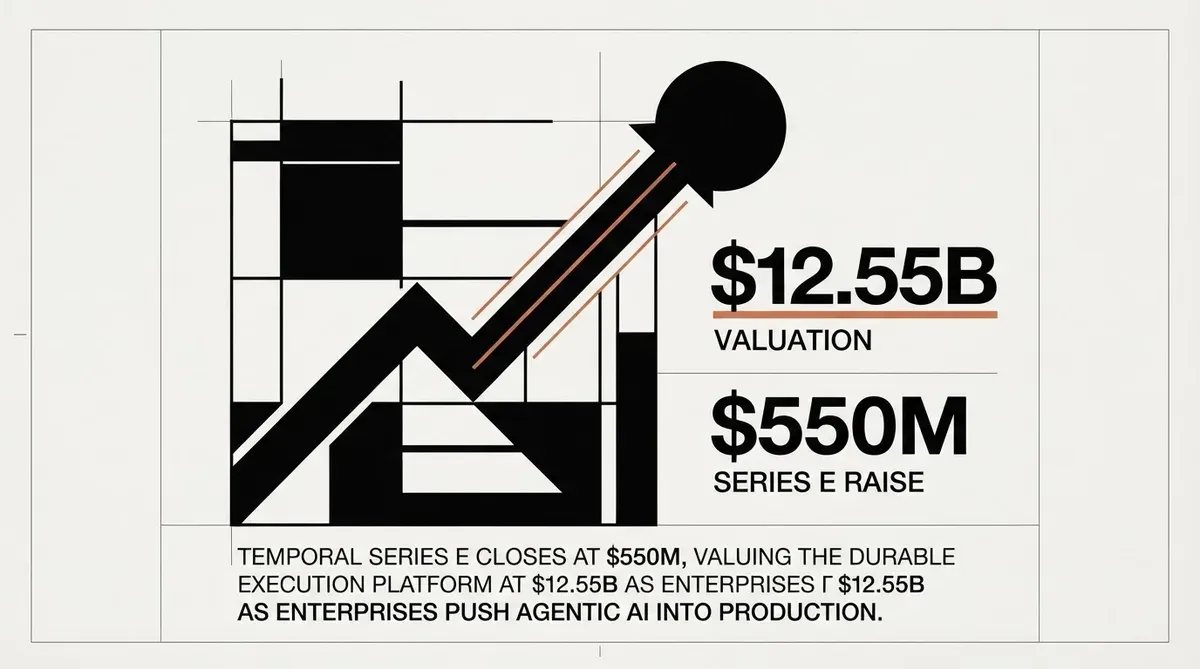
Temporal has closed a $550 million Series E that values the Bellevue, Washington-based software company at $12.55 billion, more than double the roughly $5 billion valuation it carried in February. The Temporal Series E round was announced on 14 September 2026 and was co-led by Lightspeed alongside Wellington Management, Growth Equity at Goldman Sachs Alternatives and Tiger Global, with additional participation from T. Rowe Price and SV Angel.
The company sells durable execution, a runtime that keeps multi-step, long-running AI agent workflows stateful, retryable and recoverable. Temporal describes the platform as the reliability layer beneath AI applications, and it says the new capital will fund expansion of operations and scale its open-source-to-enterprise funnel.
The raise caps a rapid repricing. Temporal's valuation sat near $5 billion in February, and seven months later the Series E puts it at $12.55 billion. That jump tracks a broader shift in enterprise AI spending, away from model experimentation and toward the infrastructure that keeps AI systems running once they leave the demo stage.
What Durable Execution Solves
Agentic applications behave differently from conventional software. A single task can span dozens of calls to a language model, a database and third-party APIs, and it may run for minutes or hours before finishing. An interruption in the middle of that sequence leaves the system in an ambiguous state: some work completed, external side effects already triggered, no clean point to restart from.
Durable execution addresses that by persisting the state of a workflow as it progresses. When a step fails, the engine retries it and resumes from the recorded checkpoint instead of replaying the whole job. Temporal's argument to engineering leaders is that this turns an AI reliability problem into a systems problem that existing operational tooling can absorb, so failures, restarts and long runtimes become routine conditions rather than incidents.
Durable execution differs from ordinary retry logic in scope. A retry library inside an application can repeat a failed call, but it loses its memory when the process exits, which makes it a poor fit for work that has to continue across deployments or machine restarts. Persisting state outside the application is what allows a workflow to hold its place after the runtime that started it disappears.
Engines in this class generally work by recording an event history for each execution. Completed steps are written to durable storage, and if the process dies, the engine replays the history and skips the steps that already finished. Side effects such as a payment or an outbound email have to be isolated so a replay does not trigger them twice, which is why checkpointing is paired with conventions for idempotent operations.
Building that machinery in-house is possible, and most engineering teams try it first. The usual result is a bespoke state machine that handles retries for one workflow and breaks when a second team needs the same guarantees against different failure modes. A shared runtime moves that work into platform infrastructure, where it is maintained once and reused across applications.
The distinction carries commercial weight. Teams that move an agent from a prototype to production find that probabilistic models fail in ways deterministic code does not, and the cost of those failures lands on the business process rather than on the model. Selling recovery guarantees separately from model access is the business Temporal is building, and the Series E gives it more room to make that case to large buyers.
Why the Valuation Moved
| Investor | Role in the Series E |
|---|---|
| Lightspeed | Co-lead |
| Wellington Management | Co-lead |
| Growth Equity at Goldman Sachs Alternatives | Co-lead |
| Tiger Global | Co-lead |
| T. Rowe Price | Participant |
| SV Angel | Participant |
The syndicate is unusually broad for a late-stage infrastructure round. Four firms share lead status and two more joined as participants, which spreads concentration risk for any individual investor and suggests that demand to join the round exceeded the allocation on offer.
The arithmetic is simple. Raising $550 million at a $12.55 billion valuation implies that new investors took roughly 4% of the company, leaving the existing cap table largely intact while adding capital at a price more than twice the February level.
Two of the participants sit outside the venture mainstream. Wellington Management and T. Rowe Price both manage public-market portfolios, and their presence in a private software round puts a company that has not listed in front of investors who usually take positions after an IPO. Their involvement reflects how far infrastructure spending on AI has moved from an early-stage bet to a category that long-only money will underwrite.
What the Temporal Series E Buys
Temporal has attached the raise to two goals: expanding its durable execution platform operations globally and converting open-source adoption into enterprise contracts. The first is a footprint exercise. The second is the harder problem, because a widely used open-source project does not convert into revenue on its own.
Enterprise contracts in this category are won on operational guarantees rather than features. Buyers want uptime commitments, defined support response times, compliance documentation and the option to run the software inside their own cloud. Those functions scale with people, which is why a company with a mature open-source project still needs outside capital to grow revenue.
The Temporal Series E is therefore a distribution investment as much as a product one. The company's model gives developers a free entry point and charges the organisations that need guarantees, so the round buys sales capacity, support coverage and regional presence rather than a new engineering roadmap.
Competitive pressure is a second reason to raise now. Categories that attract this much capital invite entrants, and a company holding the leading position in durable execution can convert a round into hiring, regional coverage and enterprise credibility faster than a challenger can match.
Why Reliability Is Being Priced
The round doubles as category marketing. By naming durable execution as the reliability substrate for agents, Temporal argues that a distinct infrastructure layer sits between model providers and the applications built on top of them, and that it should own that layer. The framing has a budget consequence: if durable execution counts as AI platform spend rather than developer tooling, the market it addresses grows with every enterprise that moves an agent into production.
The demand signal is specific. Agentic workloads that reach production must survive failures, restarts and runtimes measured in hours, and their recovery behaviour has to be deterministic enough to trust with real transactions. Workflows that run for days outlive the processes that started them, so the runtime has to persist across deployments and infrastructure changes.
Those are the points where infrastructure budgets concentrate once a deployment is signed off, rather than at the model layer that consumes most of the attention.
The timing of the announcement closes a short loop. Reports of Temporal's fundraising plans surfaced about a month before the company confirmed the terms on 14 September 2026.
A valuation of $12.55 billion rests on agent workloads continuing to move into production. If enterprises stall at the pilot stage, demand for the layer beneath those workloads slows with them, and the company would have to grow into a number that doubled in seven months.
Why this matters
The Temporal Series E puts a price on reliability rather than intelligence. The company does not sell models, and its revenue grows as more AI work moves into environments where a failed step carries a real cost. For enterprises weighing agent deployments, that makes a dedicated reliability layer a line item to budget for rather than an engineering detail. For the next cohort of agent tooling startups, it sets a comparison point: investors are now funding the supporting infrastructure at a scale that assumes the production transition happens.
AI-generated image.
Related Articles
- Temporal's $12B valuation puts durable execution at AI core
- Modal Labs Reaches $4.65B Valuation to Expand Serverless AI Infrastructure
- AlphaSense Enterprise AI Funding Reaches $350 Million as Valuation Hits $7.5 Billion
✔Human Verified
Researched and cross-referenced against primary sources by the Bytevyte editorial team. This article was generated with the assistance of artificial intelligence and reviewed by the Bytevyte editorial team.