
The AI Pacing Slowdown Repriced Compute Contracts, Not Chip Orders [Update]
Dario Amodei asked the AI industry to hit the brakes, and the market delivered a rapid education in what that actually reprices. The AI pacing slowdown triggered by his 12 September essay moved from a safety argument to a balance-sheet question in about 48 hours: semiconductor shares fell hard, and buyers started separating the cadence of frontier training from the size of the capacity commitments stacked on top of it. No hyperscaler has revised its 2026 capital-expenditure guidance, and that silence is now the most contested data point in the trade.
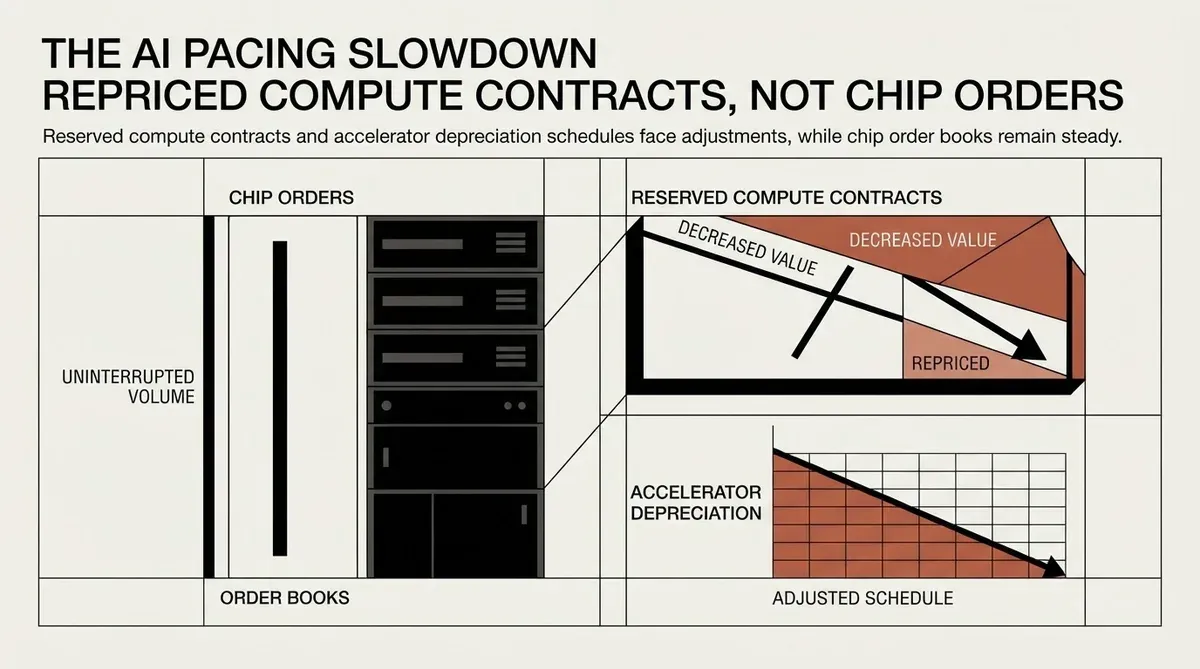
As we previously reported, the pacing push had already forced a repricing of the AI compute trade. The new development is where that repricing lands. It sits in the assumptions beneath the order books, which are still full: reserved-capacity commitments and the three-to-five-year depreciation schedules attached to accelerator fleets. Those two line items are where a slower cadence turns into a number on a balance sheet.
The Tape Sold the Wrong Names
The 14 September session produced the clearest evidence yet that this is a positioning unwind rather than a demand signal. The fall order ran opposite to each company's exposure to AI accelerator demand.
| Name | 14 Sept 2026 move | Price |
|---|---|---|
| Intel | -7% | $95.96 |
| AMD | -6% | $486.80 |
| NVIDIA | -3% | $212.50 |
| iShares Semiconductor ETF (SOXX) | -6% | n/a |
| Invesco QQQ Trust | -2% | n/a |
Intel, the least exposed of the three to AI accelerators, lost the most. NVIDIA, the most exposed, lost the least. The iShares Semiconductor ETF dropped 6% while the Invesco QQQ Trust slipped 2%, which places the selling squarely inside chips rather than across the broader Nasdaq gauge.
The cross-border pattern matched. The Philadelphia chip index fell 5.2%, Micron 5.4% and AMD 4.5%, the Nasdaq 100 slid 1.2% to a six-week low before paring losses, and South Korea's KOSPI closed 3.3% lower. Korea, Japan and Europe all sold chip exposure first, which is what a supply-chain repricing looks like rather than a single-name event.
Set that tape against the Reuters account of investor nervousness over the AI-led rally, and the drawdown looks like money leaving a crowded position while the capex numbers still stand.
Where the AI Pacing Slowdown Actually Bites
The second-order exposure is more revealing than the chip tape. Power, cooling, electrical-equipment and site-development suppliers carry order books priced off hyperscaler capital-expenditure plans that have not yet been revised. According to Reuters, AI capital spending is expected to approach $800 billion in 2026, with Microsoft, Alphabet, Amazon, Meta Platforms and Oracle carrying the bulk of that outlay.
Those plans rest on two assumptions that a slower frontier cadence can genuinely disturb. The first is that reserved capacity is worth signing years ahead of need. The second is that an accelerator bought today holds enough value across a three-to-five-year depreciation window to justify the commitment. Neither assumption breaks simply because a lab slows down. Both wobble when the industry's own chief executives publicly ask for the slowdown.
Memory suppliers sit on the same fault line. Micron's 5.4% decline arrived in the same session as Intel's 7%, even though high-bandwidth memory sells into inference servers as much as into training racks. When one narrative moves an entire supply chain at once, the pricing error usually sits in the correlation rather than in the demand curve.
Why the AI Pacing Slowdown Is Not Smaller Spending
Bernstein has drawn the distinction that much of the sell-side commentary missed, arguing that a pacing slowdown does not necessarily imply a spending slowdown. Its reasoning is structural: Amodei proposes moving frontier development from extremely fast to only somewhat fast, and compute demand is increasingly driven by inference workloads rather than frontier training runs.
Anthropic's own behaviour supports that reading. The company is deploying AMD's MI450 GPUs under a disclosed partnership while committing to embedded third-party evaluators with employee-level access and a contractual right to publish findings without editorial control. Pacing, as Amodei defines it, means checkpoints where specific capabilities must demonstrate certified alignment properties before proceeding, plus possible limits on training compute and on internal use of AI to improve AI.
Those mechanisms would change how compute is bought rather than how much of it is bought. Certified capability checkpoints stretch project timelines and push budgets toward evaluation, interpretability and verification work. Caps on training compute shift the mix from large training clusters toward inference fleets that serve paying customers. The stated payoff is one to two extra years for alignment and verification research, time that has to be funded from somewhere inside the same capital envelope.
The Coordination Problem Sitting Under the Contracts
Amodei's proposal runs in three steps: embedded evaluators with access comparable to internal risk teams, coordination among frontier labs in democratic countries on shared safety standards and limits on unchecked progress, and eventual engagement with authoritarian governments graded across four levels, from banning narrow dangerous uses such as bioweapons through mandatory pre-release testing to speed limits on recursive self-improvement. He concedes that the second step may require antitrust relief to be lawful.
For enterprise buyers, the antitrust detail is the practical one. Capacity contracts are signed with a small group of hyperscalers, and any arrangement that coordinates standards across competitors invites legal scrutiny before it invites procurement changes. Amodei also frames a lead over authoritarian powers as a precondition for pacing inside democracies, which keeps pressure on domestic compute supply even under a slower cadence.
The Trade-Off, Stated Plainly
Two positions are now competing. The first holds that a pacing slowdown is a leading indicator of demand destruction, and that anything priced off a training cadence should be written down. The second holds that pacing reallocates spend rather than removing it.
The evidence favours the second, with one caveat. Inference demand keeps utilisation high on fleets already deployed, so near-term revenue for accelerator vendors is not at risk from a pacing call alone. The exposure sits further out, in the residual value of hardware bought on the assumption that each generation would be superseded on a fixed schedule. If frontier cadence stretches, refresh cycles stretch with it. A single year added to a replacement rhythm moves an accelerator from mid-life to late-life inside the same depreciation window, and that arithmetic lands on the buyer's income statement, not on the vendor's order book.
Buyers have an interest in shortening commitments. If the cadence that justified a five-year reservation now looks like a three-year one, the rational response is to purchase optionality: shorter terms, smaller initial volumes, and more inference capacity bought on demand.
That is why the tape matters less than the contracts. Investors have repriced the shares. The enterprises carrying the commitments have not yet repriced the commitments. The gap between the two is the story: a share price can move in a single session, while a five-year reservation has to be renegotiated line by line.
What to Watch
Three markers will settle the argument. Watch whether any hyperscaler revises 2026 capital-expenditure guidance at the next earnings round, which would move the story from sentiment into spending. Watch the duration of new reserved-capacity agreements, since shortening terms would confirm that buyers are hedging cadence risk rather than demand. And watch whether embedded third-party evaluators and the enterprise safeguard frameworks Anthropic is building with customers become procurement requirements, which would turn a safety proposal into a line item.
Until one of those moves, the chip drawdown reads as a repositioning event. The sharper question is whether the AI pacing slowdown changes the terms on which the $800 billion outlay gets committed, more than whether it shrinks that outlay.
Why this matters
The pacing essay cut no orders, but it did something more durable: it turned AI spending from a technological inevitability into a governance choice. That shift is what reprices reserved capacity and depreciation schedules, because both are bets on a schedule that the industry's own leadership has now publicly asked to slow. For enterprise buyers, the practical move is to price cadence risk into contract duration rather than assume the buildout is either intact or over.
See our earlier coverage: Anthropic's Pacing Push Forces a Repricing of the AI Compute Trade
AI-generated image.
Related Articles
- Anthropic's Pacing Push Forces a Repricing of the AI Compute Trade
- Lab Chiefs' AI Development Slowdown Calls Just Repriced the Buildout
- Short-Term AI Compute Contracts Signal a Spot-Pricing Regime
✔Human Verified
Researched and cross-referenced against primary sources by the Bytevyte editorial team. This article was generated with the assistance of artificial intelligence and reviewed by the Bytevyte editorial team.