
The ElevenLabs $22 Billion Valuation Hinges on an Undisclosed Gross Margin
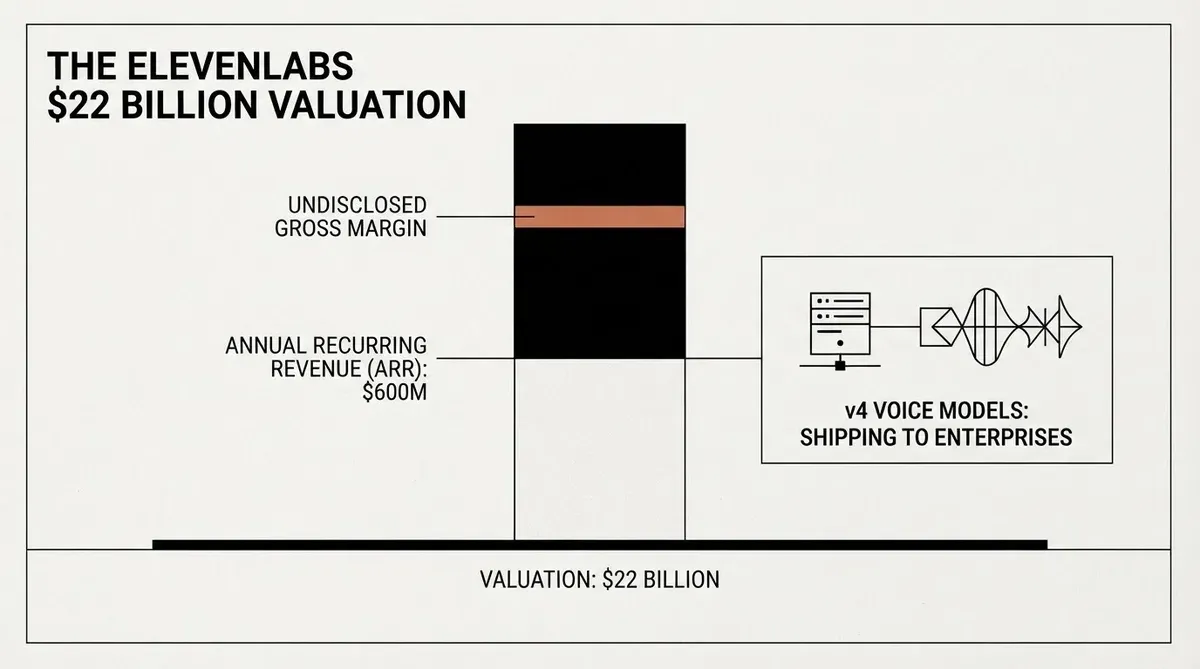
ElevenLabs is carrying a reported $22 billion valuation, roughly double where it stood earlier in 2026, and the company says its annual recurring revenue is pacing at $600 million. Days before that figure surfaced, ElevenLabs shipped Eleven v4 and Eleven v4 Turbo on September 28, 2026, adding finer emotional control, inline audio tags and coverage of more than 90 languages. I think the ElevenLabs $22 billion valuation is the least informative element of this story, and the two numbers the company still will not publish are the ones that decide whether it becomes a durable public company.
Begin with what the $22 billion is. It comes from tender-offer talks rather than a priced primary round. In a tender offer, existing holders sell to incoming buyers at a negotiated price, the company may raise no new capital at all, and the transaction can be small relative to the headline it generates. That makes the figure a decent read on buyer appetite and a poor proxy for what an underwriter could clear in a listing.
The revenue line itself is not in question. ElevenLabs started 2026 at a run rate near $330 million and has since crossed $600 million, an increase of more than 80% inside three quarters. More than 55% of that revenue arrives from large enterprise clients, a mix most four-year-old software companies would take in a heartbeat.
The Numbers Behind the Headline
| Metric | Value |
|---|---|
| ARR run rate, start of 2026 | ~$330 million |
| ARR run rate, September 2026 | $600 million+ |
| Reported valuation, earlier 2026 | ~$11 billion |
| Reported valuation, September 2026 | $22 billion |
| Enterprise share of revenue | More than 55% |
| Gross margin | Not disclosed |
Two rows in that table do the heavy lifting. The enterprise share tells you the revenue is contracted and repeatable, which is what a public-market buyer wants to see. The blank row tells you what it costs to produce, which is what determines whether that revenue deserves a software multiple or a media multiple.
Consider what an enterprise voice contract involves. A bank or an airline rolling out an agent that answers real customers needs security review, data-residency terms, uptime commitments and rights to the cloned voices it deploys. None of that appears in a self-serve API call, and all of it adds cost and headcount on the vendor side.
What v4 Actually Changes
The product release is more consequential than the financing chatter, because it targets the specific problems that keep voice agents out of production. Eleven v4 Turbo is built for low-latency conversational agents, with roughly 100 to 150 milliseconds of median inference latency, and it can begin speaking before the agent has finished composing its answer.
That second capability is the more interesting one. Conversational systems break down in the gaps: the pause where a caller wonders whether the line dropped, or the overlap where the agent talks over a person who has already started answering. An architecture that streams speech before the language model completes its turn attacks that gap directly, and it is the difference between a demo that delights and a phone line that callers tolerate.
Elsewhere, ElevenLabs has cut the audio required for voice cloning to 10 seconds while improving identity consistency across generations. The models accept inline audio tags for directing delivery or sound effects, and they handle IPA phoneme notation, which gives production teams control over how names and technical terms are pronounced instead of hoping the model guesses right.
Deployment timelines are the other half of this. A model that works from ten seconds of reference audio and takes direction through inline tags shortens the path from script to finished voice track, which matters for teams producing localized content at volume. The same tooling lets a support organisation launch an agent in a new language without recruiting a native-speaking voice actor for every script revision.
Language coverage expanded from 70 to more than 90. That is the cheapest growth lever the company has: the same model, the same sales motion, and a wider set of markets where a deployment can go live. Eleven v4 and v4 Turbo are available in ElevenAgents, ElevenCreative and through the API, and ElevenLabs is tripling credits for Creator-tier plans and above through October 12.
That credit promotion deserves a second look. Discounting usage on the self-serve tier while courting large enterprises is a deliberate mix shift, and it hints that the API tier is where price pressure is sharpest. When a promotional multiple lands alongside an enterprise push, the promotional tier is usually the one the company expects to defend on price rather than on capability.
Why the ElevenLabs $22 Billion Valuation Hinges on Margin
Here is the hole in the bull case. ElevenLabs has not disclosed its gross margin, and expressive speech at this scale is not cheap to serve. Every minute of generated audio consumes GPU time, and the low-latency variant trades compute for responsiveness by design. Enterprise contracts layer compliance, custom voice work and support obligations on top of that compute bill.
The strongest counter-argument runs like this: speech synthesis has been commoditizing, free and open-weight models handle the bulk of simple narration, and a buyer who only needs a robotic readout has no reason to pay anyone. If that is true, why would the ElevenLabs $22 billion valuation hold?
My answer is that free models take the bottom of the market and simultaneously cap the price of the middle. The paid tier is defended by latency guarantees, cloning consistency, breadth of language coverage and contractual cover for the voices being used, and those are real engineering and legal moats. A moat around the top of the market does not stop the rest of the market from resetting the price every buyer anchors to, though, and the self-serve API tier is where incremental margin is easiest to earn and easiest to lose.
So the ElevenLabs $22 billion valuation is a bet on margin, and margin is the one number the company has not published. A reported $22 billion against $600 million in annual recurring revenue implies roughly 37 times ARR. Multiples in that band have historically been reserved for businesses with software-grade gross margins near or above 80%, and ElevenLabs has not put that figure on the table. Growth at this pace can carry a rich multiple for a while, but the arithmetic only works if the cost of serving a minute of speech falls as fast as the price of one does.
There is a quiet risk inside the enterprise mix as well. Large clients negotiate harder, demand more customization and renew on their own timetable. A book that is more than half enterprise is resilient in a downturn and slower to expand than self-serve usage, because each new dollar requires a procurement cycle rather than a credit-card upgrade.
What would change my mind? A disclosed gross margin above 75% with enterprise concentration holding, evidence that the Turbo latency advantage survives at high concurrency rather than only in a demo, and renewal data from the enterprise cohort. What keeps me cautious is the structure of the deal behind the headline: tender offers are how early employees and backers take money off the table, and they are frequently a step on the road to a listing rather than a substitute for one.
That reading carries a consequence for anyone evaluating the sector. If ElevenLabs lists within the next year or two, its prospectus becomes the first detailed public look at the unit economics of enterprise voice AI, and it will set the reference multiple that every competitor raises against. Until then, buyers are pricing a private company on a private number that nobody outside the cap table has audited.
Why This Matters
Voice is becoming a default interface for customer service, and the company with the largest enterprise footprint sets the pricing floor everyone else negotiates against. That makes the undisclosed gross margin a number the whole sector will eventually have to price. ElevenLabs has the demand. Whether it has the margins is the question the $22 billion headline quietly skips.
Sources
Eleven v4: Our most expressive text-to-speech AI model yet
AI-generated image.
Related Articles
- Venice AI Unicorn Valuation: $65M Series A and Profitability
- ElevenLabs Launches Music v2 with Dynamic Mid-Track Genre Shifting
- Baseten Targets $11 Billion Valuation to Scale AI Model Inference Platform
✔Human Verified
Researched and cross-referenced against primary sources by the Bytevyte editorial team. This article was generated with the assistance of artificial intelligence and reviewed by the Bytevyte editorial team.