
TypeSafe AI Valuation Hits $7.5B: Testing the Usage Claims Behind Jev
TypeSafe AI raised $870M at a $7.5B valuation led by a16z. We test whether Jev's usage claims hold up against revenue and contract evidence.
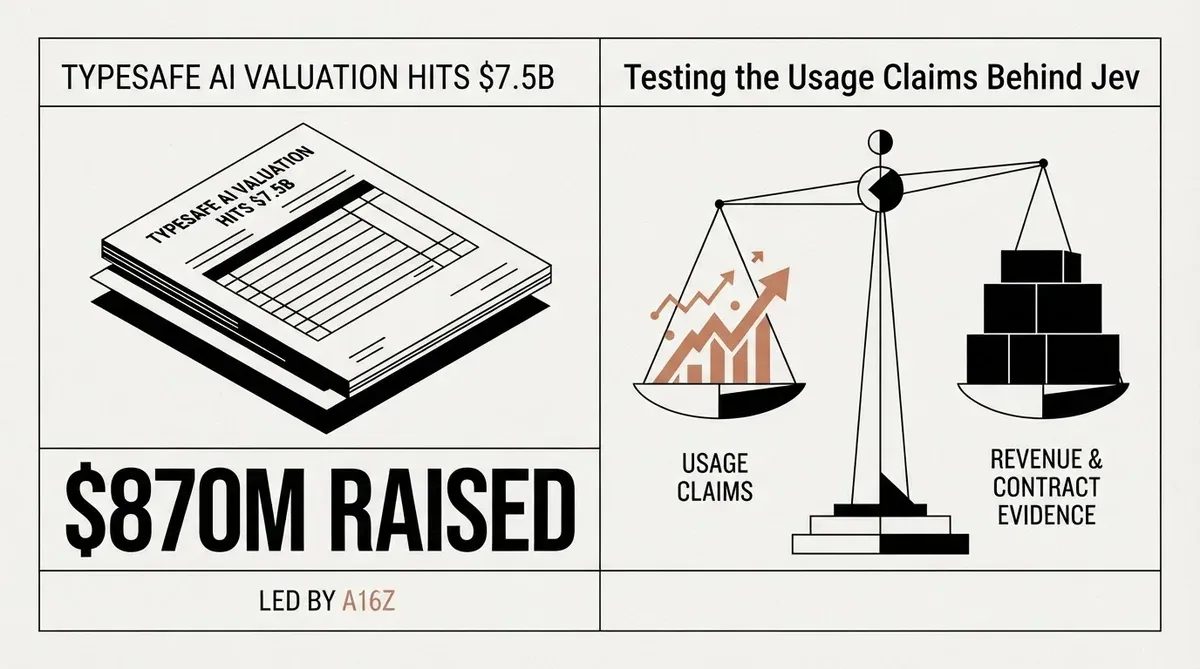
TypeSafe AI has announced that it raised about $870 million at a $7.5 billion valuation, with Andreessen Horowitz leading the round. The company develops Jev, a non-text AI model that came out of stealth about 24 days before the funding was announced on October 9, 2026. Reported seed pricing of roughly $200 million puts the new valuation at about 37 times the earlier mark. The central question is whether the usage evidence behind that price holds up.
What the TypeSafe AI round contains
The Series A also includes Sequoia Capital, the existing investor DCVC and a group of angel investors. Public coverage names Diogo Almeida, Erik Gafni and Sasha Sheng as founders. Reporting on the round also names several Andreessen Horowitz partners, including Jennifer Li, Sarah Wang, Martin Casado, Marc Andreessen and Ben Horowitz, as the firm's public voices on the deal. The round is private, so no SEC filing or audited financial statement is available to confirm the terms.
Jev differs from the large language models that dominate the market. Public descriptions say it does not generate text. It outputs probabilities, which positions it as a decision-model tool for software that needs structured predictions rather than chat responses. That design choice matters for buyers because it defines the workloads where Jev can compete and the workloads where general chat models remain the default.
What the usage numbers show, and what they do not
Secondary coverage, from outlets with low source-verification scores, describes rapid uptake. Some of these reports cite one million users. The reviewed material contains no company statement defining what a "user" is, and it offers no definition of an "adopting firm." A free trial, a developer API key and a paid enterprise seat would all count as adoption under a loose definition, so the one-million figure cannot be read as paid usage.
The launch timeline is consistent across sources. Jev reportedly launched on September 15, 2026, and the funding announcement followed 24 days later. Visibility on social media can drive trials quickly, but trial volume does not show whether those trials turned into recurring production use.
Revenue, contracts and token economics: the missing evidence
The reviewed sources do not report annual recurring revenue, gross margin, contract values or customer counts that can be checked against a filing. The company has not published pricing per token or per prediction in the material available, so there is no basis for estimating unit economics. Without those figures, the $7.5 billion valuation rests on usage signals rather than on revenue multiples.
The gap becomes clearer through comparison. A company with a $7.5 billion valuation and a $200 million seed price is priced for rapid scale. At that level, a few hundred enterprise contracts at modest annual value would not justify the multiple by themselves. The number would need either a large volume of paid API calls or multi-year enterprise commitments, and the sources show neither.
Some reports also conflict. One aggregator's listing, cited in the reviewed material, gives the round as $8.7 billion and the valuation as $75 billion. Those figures do not match the other reports. Publication timing also differs. Some outlets describe the Bloomberg report as arriving on a Friday, while others place the closing on a Thursday. This article uses the $870 million and $7.5 billion figures that appear in multiple independent sources, and it treats October 9, 2026 as the reported date.
Trade-offs for buyers and investors
For enterprise buyers, a non-text model that outputs probabilities offers a cleaner fit for scoring, routing and risk workflows than a text-generating model. The cost is integration work. Systems built around text prompts and chat interfaces cannot switch to probability outputs without changes to downstream logic, testing and monitoring. Teams evaluating Jev would need to measure accuracy against their own data rather than rely on adoption counts.
For investors, the trade-off lies between conviction in a new model category and the risk of paying for growth that has not yet appeared in revenue. The $870 million raise equals about 11.6 percent of the $7.5 billion valuation, so the round is a minority stake. The capital is sized to fund expansion of compute, staff and sales. That spending can convert attention into contracts, but it also raises the bar for the company to show durable customer retention over the next several quarters.
Two groups face different exposure. Buyers who sign multi-year commitments carry the risk that a young vendor changes pricing or roadmap after the raise. Early investors and angel backers hold a paper markup, but their returns depend on the same unproven conversion from trials to paid use. A short pilot with defined success metrics limits that exposure for both groups, while a large prepaid contract shifts it to the buyer.
Before committing budget, a procurement team should request four items from the vendor:
- A written definition of an active user and an adopting firm
- Per-prediction pricing and volume tiers for Jev
- Customer references describing production workloads rather than pilots
- Accuracy benchmarks run on the buyer's own data
The verdict is that the valuation is a bet on future conversion, not a reflection of audited traction. The available evidence documents launch speed, investor interest and a differentiated product design. It does not document revenue, contract size or per-unit pricing. Until those figures emerge, the claim that Jev is a widely adopted enterprise product should be treated as unverified.
Readers tracking the company should watch three items: whether TypeSafe AI publishes customer counts with a defined adoption metric, whether it discloses pricing for Jev usage, and whether named enterprises describe production deployments rather than pilots. Those disclosures would show whether the usage claims behind the $7.5 billion price can be checked.
Why this matters
The round shows how quickly investors will price a new model category when early usage looks strong. For decision-makers, the practical test is whether Jev's probability-based output fits a workload they already run. Revenue, contract terms and token pricing will show whether the $7.5 billion valuation is supported.
AI-generated image.
Related Articles
- Venice AI Unicorn Valuation: $65M Series A and Profitability
- OpenEvidence Rejects $20B, Betting on Specialized AI
- Crusoe $30 billion valuation puts contracted GPU revenue to the test
✔Human Verified
Researched and cross-referenced against primary sources by the Bytevyte editorial team. This article was generated with the assistance of artificial intelligence and reviewed by the Bytevyte editorial team.