
Unitree IPO Prices at 219x Earnings as Humanoid Robotics Gets a Daily Market Test [Update]
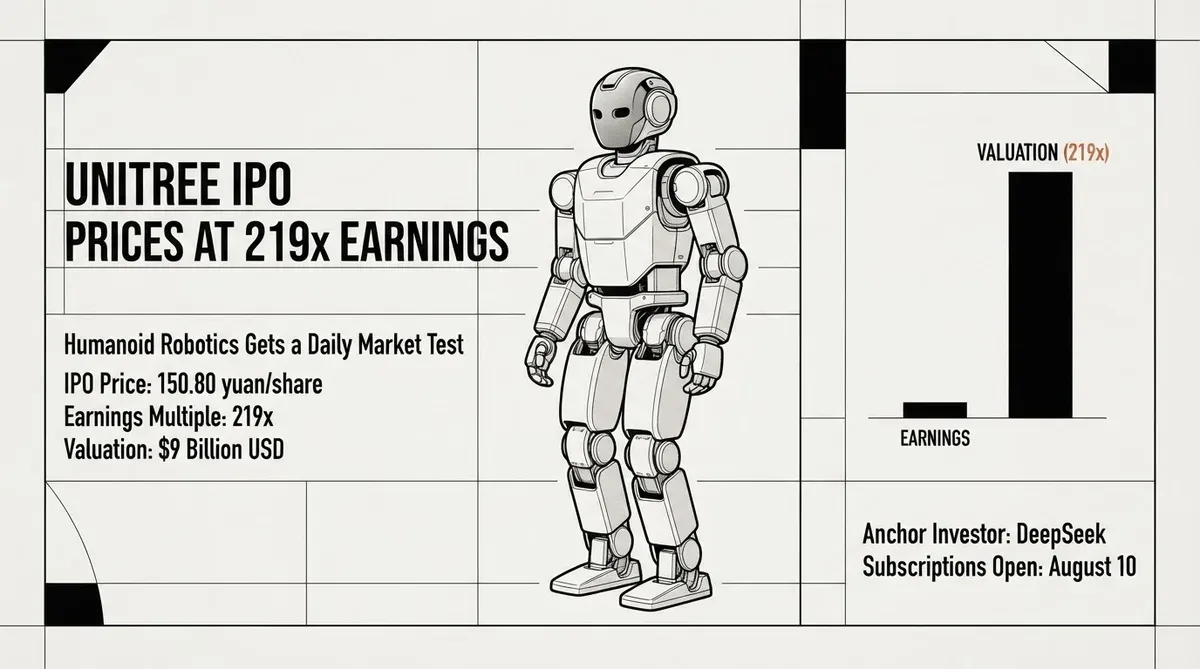
Unitree IPO pricing has put a public price on a scaled humanoid robot maker for the first time. The Hangzhou company fixed its listing on Shanghai's technology-focused STAR Market at 150.80 yuan per share on Thursday, August 6, valuing the business at roughly 61 billion yuan, or about $9 billion. The offering covers 40.45 million shares, equal to 10% of the company's enlarged capital, and is expected to raise about 6.10 billion yuan ($904 million), with net proceeds near 5.92 billion yuan.
The listing makes Unitree one of the first humanoid robot manufacturers to trade publicly in China, and it moves a sector that has run on private rounds into a daily-priced market. As we previously reported, the deal was built from the start to create the category's first valuation benchmark; Thursday's price gave that benchmark a number the market will reset every session.
The final price cleared what the underwriting banks had sketched. CITIC Securities, which sponsors the deal, had projected a post-listing valuation above 50 billion yuan, and CCB International had outlined a re-rating band of 60 billion to 100 billion yuan, with an optimistic case near 109 billion yuan. The 61 billion yuan outcome sits in the upper half of that range. It also exceeds the original ambition: Unitree entered the process targeting roughly $618 million at about $5.9 billion, and the final raise of about $904 million lands roughly 46% above that, a sign of firm demand into the close.
The figure that will dominate the debate is the earnings multiple. Unitree priced at 219.23 times trailing profit against an industry average of 38.56, so the deal carries about 5.7 times the typical sector rate. On revenue, the stretch is comparable: 61 billion yuan is roughly 36 times the 1.7 billion yuan the company booked in 2025, which means buyers are paying for years of growth that have not happened yet.
The record behind that premium is real but short. Revenue quadrupled in 2025 to 1.7 billion yuan, humanoid robots became the company's largest business segment, and more than 5,500 units shipped during the year. Unitree is also profitable, which makes it the first scaled humanoid maker with positive earnings to trade publicly, a distinction that matters when the sector's other benchmarks are private and loss-making.
Unitree says the proceeds will fund robot software and hardware development, new products, and a manufacturing base, with the remainder going to R&D and international expansion. The company has also pushed into premium consumer hardware, listing a bionic robot at up to 990,000 yuan, about $146,000, as it tries to open the home market. At that price point the consumer bet is really a bet on future cost declines. Tesla's Optimus is scheduled to reach mass production this year, so the home-market push runs head-on against a rival with far larger manufacturing scale.
The most consequential detail for the AI industry sits on the shareholder register. DeepSeek paid 140.8 million yuan, about $20.8 million, for 933,399 shares in the strategic placement, a 2.31% stake held under a 36-month lock-up with a subscription cap of 155 million yuan. The price works out to the same 150.80 yuan per share that public investors will pay, so DeepSeek accepted the retail price plus a three-year hold, and its stake equals roughly 2.3% of the offering.
Alongside the investment, the two companies agreed to jointly develop AI models for humanoid robots centered on embodied intelligence. That pairs China's best-known low-cost AI lab with its most visible robot maker, and it gives Unitree a path to cheaper model deployment than licensing general-purpose systems, consistent with DeepSeek's record of cutting model costs. DeepSeek is separately raising an $8 billion round, so the stake is one piece of a broader move into hardware by a company known for making software intelligence cheap, and a template for how Chinese AI labs may integrate with robot makers.
The pact reflects where the AI industry's center of gravity is moving. Software models have reached the point where their next big commercial surface may be physical: embodied intelligence, the term the two companies use, covers robots that perceive and act in the real world. For DeepSeek, a stake in a robot maker with shipped volume is a way to move its models out of data centers and into products; for Unitree, the deal secures an AI partner at a moment when robot intelligence is the main cost and differentiator.
Buyers also inherit specific exposures. US sales accounted for 13.3% of 2025 revenue, and the prospectus names tariffs and export controls as direct threats to that channel, which contrasts with proceeds earmarked for international growth. The multiple makes the exposure starker: priced at the industry average of 38.56 times earnings, the same profit base would support a valuation roughly one-sixth of the IPO's $9 billion. Every quarter of growth shortfall, and every trade policy headline, will now move the stock directly.
What the Unitree IPO Multiple Is Really Pricing
At 219 times trailing earnings, nearly all of the value sits in future years, so the first few quarterly reports will carry unusual weight. The metrics to watch are delivery volumes against the 5,500-unit 2025 base, gross margin as the manufacturing base comes online, and the order book for the humanoid line that now dominates revenue. The 10% float also leaves supply thin relative to demand, which can amplify price moves in either direction once continuous trading begins.
The listing also tests a question the sector has not answered: whether humanoid robots can move from impressive demonstrations to dependable economics. Unitree has more operating history than most, but a 219x multiple prices in near-flawless execution of the scale-up, and the STAR Market will now deliver a verdict on that assumption every trading day.
For the rest of the industry, the listing changes how value is argued. Private humanoid companies have been valued on funding rounds and model claims; after this deal, each of them will be measured against a public price supported by shipped hardware and disclosed financials. That is a stricter standard than the opaque valuations attached to companies like Figure, whose roughly $39 billion private valuation has no comparable revenue base. It also gives public investors a direct position in a category previously reserved for venture capital, and it will set the terms for the next funding round of every startup in the field.
Online subscriptions open August 10, with payment due August 12, and the stock trades under ticker 688836 on the STAR Market shortly afterward. The first closing price of the Unitree IPO will be the market's initial verdict on whether 219 times earnings is a floor or a ceiling for the humanoid robot sector.
Why this matters
The Unitree IPO turns humanoid robotics into a numbers business rather than a narrative one. For investors and strategists, the terms of the bet are explicit: revenue growth must stay near triple-digit annual rates for the 219x multiple to hold, and tariff or export-control headlines will move the stock. DeepSeek's anchor stake signals that China's AI champions are integrating software and hardware vertically, a structural shift that will shape the embodied-AI competition.
AI-generated image.
Related Articles
- Unitree IPO Creates the First Public Valuation Benchmark for Humanoid Robots
- Humanoid Robotics IPO Hype Masks Unitree Profit Crisis
- AgiBot Hong Kong IPO Targets Up to $6.4 Billion as Robotics Rivals Queue Up
✔Human Verified
Researched and cross-referenced against primary sources by the Bytevyte editorial team. This article was generated with the assistance of artificial intelligence and reviewed by the Bytevyte editorial team.