
Waymo Las Vegas Autonomous Rides Go Live as a Three-Way Robotaxi Race Begins
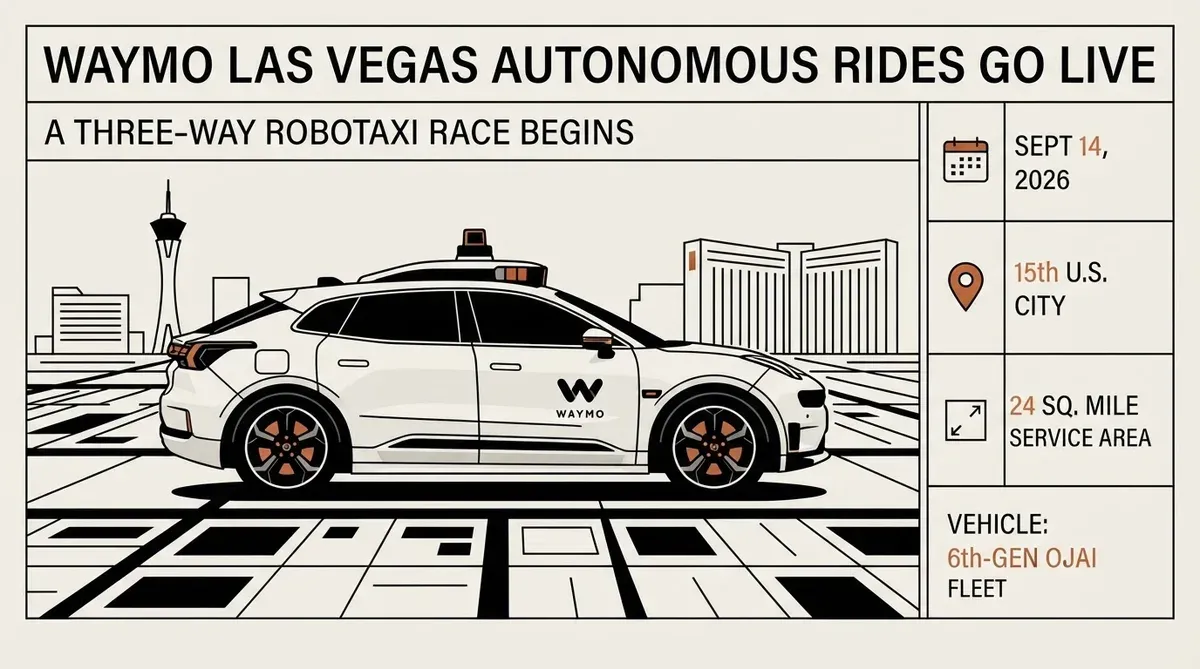
Waymo has begun carrying members of the public in fully autonomous vehicles in Las Vegas, its 15th US city and the first where its Waymo Las Vegas autonomous rides share a state permit with two rival robotaxi fleets. Public service opened on September 14, 2026, with access released in stages to a waitlist that had passed 100,000 residents and visitors.
The opening service area covers about 24 square miles, stretching from Boulder Junction through the Las Vegas Strip to Sahara Avenue and linking Spring Valley with Winchester. Rides are provided mainly by the Ojai, an all-electric vehicle that runs Waymo's sixth-generation Waymo Driver. Waymo says it has now completed tens of millions of commercial fully autonomous trips across 15 major US cities.
The safety comparison Waymo promotes is a lower rate of serious-injury crashes than human drivers. That figure comes from the company's own records rather than an independent audit, which makes it a useful benchmark and an incomplete one at the same time.
Inside the Waymo Las Vegas Autonomous Rides Zone
The size and shape of the Waymo Las Vegas autonomous rides zone carry more information than the launch date. Twenty-four square miles lets Waymo concentrate vehicles on the Strip corridor and a few adjoining districts instead of covering the whole metropolitan area. Dense, well-mapped streets with repetitive traffic patterns are cheaper to support than a sprawling suburban grid, and a compact footprint keeps pickup times defensible while the local fleet is still small.
Demand is likely to outrun supply at first. More than 100,000 people had joined the waitlist before the first public trip, a queue that is large relative to a service area of that size. Releasing access in stages works as a throttle: it prevents a first-day surge from wrecking wait times and gives Waymo room to add vehicles as utilisation data comes in.
The boundary also decides who benefits. The Strip portion serves visitors, who generate short, high-frequency trips between hotels and venues. The stretch connecting Spring Valley to Winchester reaches residential neighbourhoods, so the launch is not purely a tourist product. Riders in those districts gain a driverless option without crossing the city to find one.
Coverage of roughly 24 square miles sets expectations in another way. Trips that begin and end inside the zone are straightforward; journeys that cross the boundary sit outside the service for now. That limit shapes how residents in Spring Valley and Winchester use the product, and it caps how much of the city's daily travel the fleet can absorb at this stage.
Waymo's expansion now follows a repeatable template: open a waitlist, launch inside a bounded zone, then widen coverage as utilisation stabilises. Fifteen cities and tens of millions of trips suggest the template travels. Las Vegas is the first test of it in a market where licensed competitors are already waiting behind the same gate.
The vehicle choice adds a hardware dimension. Pairing the Ojai with the sixth-generation Waymo Driver puts Waymo's current system generation into public service along a high-traffic visitor corridor, where pedestrians, event traffic and hotel pickups create conditions that are harder to predict than a quiet residential street.
Las Vegas officials, including the mayor, have backed the rollout as part of a wider push for cleaner and smarter transit, and the all-electric Ojai fleet fits that argument. Local political support reduces the market-by-market permitting friction that autonomous operators have to manage as they expand.
Nevada's Permits Set Up a Three-Way Contest
The regulatory groundwork came first. Last month the Nevada Transportation Authority unanimously approved applications that let three operators charge for rides around Las Vegas: Waymo, Tesla Robotaxi, and Aviari Services, a Carson City-based subsidiary of Uber. A state licence to charge and a city-level public launch are separate gates, and Waymo is the first of the three to clear the second.
One distinction is easy to miss. Because the state permit covers paid service, Las Vegas rides are commercial from the first day rather than part of a free pilot phase. Revenue per trip, not only trip volume, becomes a measurable quantity in this market from the outset, which is why the companies involved treat the permit and the public launch as separate milestones.
That gap gives Waymo a measurable head start. Tesla Robotaxi and Aviari hold the legal right to charge passengers but have not opened public service in the city, so each week Waymo carries riders is a week of trip data, rider feedback and street-level visibility that its rivals are not collecting in the same market.
The shared regulator adds a second effect. One authority overseeing three fleets in a single metropolitan area will accumulate operating records for each operator on comparable terms. That is a different kind of scrutiny than a single-operator market, where safety claims rest almost entirely on the operator's own disclosures, and it gives Nevada a basis for comparing performance that no individual company controls.
The unanimous approval of all three applications also signals that the state wants multiple providers rather than one incumbent. That posture turns a regulatory decision into a competitive design choice, and it makes Las Vegas a reference case for other states weighing how many robotaxi permits to issue and on what terms.
I take this launch seriously for that reason, and not because of the city count. The strongest counter-argument is that fifteen markets and tens of millions of trips are numbers Waymo chooses to publish, and neither proves that the business earns a profit or that the technology handles every road condition. Both points hold. What changes in Las Vegas is the structure of the market, not the size of the milestone.
Waymo is now operating publicly in a city where two competitors already hold the legal right to do the same thing, under a single state authority that will see all three files. That is a competitive test rather than an expansion trophy. If Waymo's head start survives the next few months, the advantage compounds through data and habit. If Tesla Robotaxi and Aviari start carrying passengers within weeks, the 15th city becomes the first genuine three-way robotaxi race in the country.
Competition in Las Vegas will not be settled by map size alone. All three permitted operators answer to the same state authority and serve the same metro, so differences in pickup reliability, coverage and price will become visible to riders within months of each launch.
The economics remain the open question. A bounded zone with a long waitlist can post healthy utilisation and still lose money on each trip once vehicle depreciation, remote assistance and depot costs are counted. Waymo has not published per-market financials, so Las Vegas will be judged first on whether the service area grows and second on whether the waitlist converts faster than the fleet expands.
For operators and investors, the practical questions are narrow. How quickly can a permitted fleet convert to public service? How fast does a bounded zone expand? And does a waitlist of more than 100,000 translate into repeat rides once the novelty fades?
For riders, the facts are simpler. One all-electric fleet, one sixth-generation driving system, roughly 24 square miles of coverage, and a queue of more than 100,000 people waiting for a first ride.
Why this matters
The Waymo Las Vegas autonomous rides move the robotaxi story from technical proof to market competition. For anyone tracking autonomous vehicle adoption, the number to watch is no longer how many cities an operator lists, but how fast a permitted rival turns a licence into paying riders. Nevada has set up that comparison inside one metro, and the answer arrives when Tesla Robotaxi and Aviari either follow Waymo onto the street or fall behind.
AI-generated image.
Related Articles
- Nevada robotaxi permits: Tesla, Waymo, Uber get 8,000 AVs
- Waymo robotaxi expansion reaches Denver, San Diego and Tampa as US network hits 14 cities
- Waymo Ojai robotaxi stockpile nears 1,000 as driverless fleet passes 4,000
✔Human Verified
Researched and cross-referenced against primary sources by the Bytevyte editorial team. This article was generated with the assistance of artificial intelligence and reviewed by the Bytevyte editorial team.