
Z.AI $5 Billion Raise Targets Next-Gen GLM Models as Shares Slide
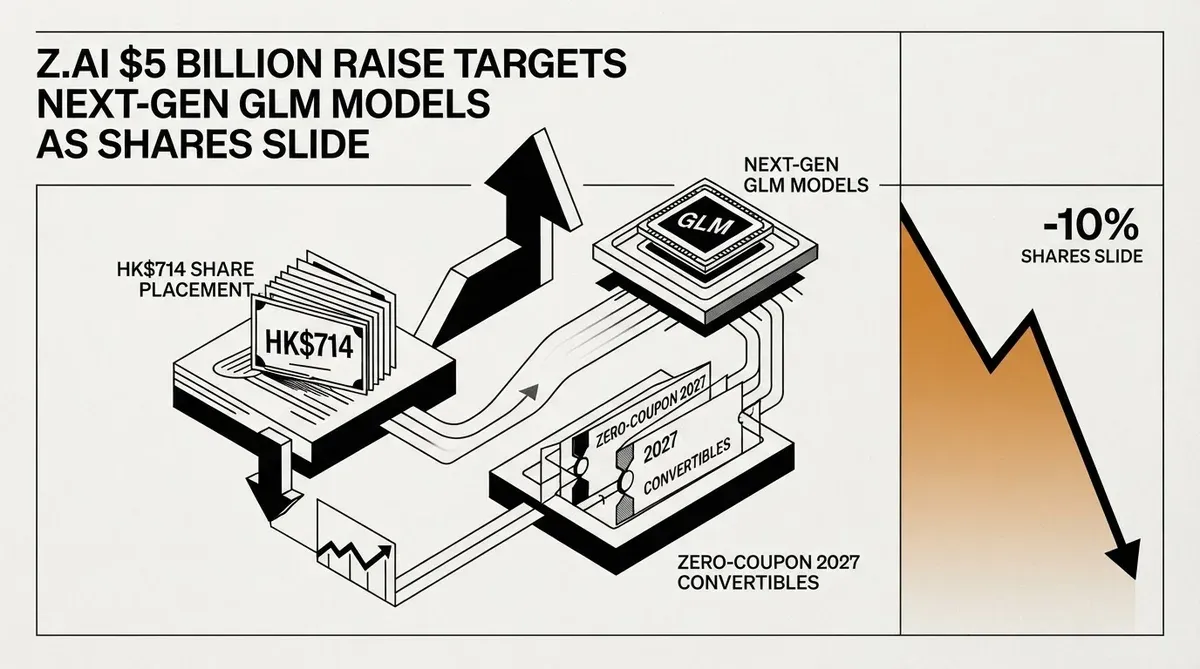
Z.AI has launched a roughly $5 billion fundraising that pairs a Hong Kong share placement with zero-coupon convertible debt, its second major capital raise in two months. The Z.AI $5 billion raise is aimed at next-generation GLM foundation models, a fully self-training system, and the computing capacity needed to train and serve them. Settlement is expected on 16 September 2026, and the equity tranche is priced below the stock's recent close.
The structure is unusual for its size. Z.AI will place up to 21.965 million H-shares at HK$714 each, raising net proceeds of about HK$15.68 billion, according to its Hong Kong Stock Exchange filing. In parallel, the company is issuing RMB 20.14 billion, or roughly $3.016 billion, of zero-coupon convertible bonds due in 2027. Those bonds convert at HK$892.50, and combined net proceeds reach up to about HK$39.27 billion.
Inside the Z.AI $5 Billion Raise
| Component | Size | Key terms |
|---|---|---|
| H-share placement | Up to 21.965 million H-shares | HK$714 per share; net proceeds of about HK$15.68 billion |
| Convertible bonds | RMB 20.14 billion (about $3.016 billion) | Zero-coupon, due 2027; conversion price of HK$892.50 |
| Combined | Up to about HK$39.27 billion (roughly $5 billion) | Settlement expected on 16 September 2026 |
Two numbers in that structure carry the most weight. The conversion price on the bonds sits about 25% above the HK$714 placement price, so bondholders only gain if the equity climbs well past the level at which new shares are being sold today. The bonds pay no coupon at all, which spares Z.AI an interest burden during its heaviest spending period and shifts the entire cost of the debt onto existing shareholders if conversion happens.
Zero-coupon convertibles defer every cash payment to maturity, and a 2027 date is a short window for a stock to travel 25% above the placement price. Z.AI is borrowing against a recovery in its own equity, with the repayment obligation falling due before the end of the decade.
The timing is tied to a calendar detail. Z.AI returned to the market within days of a 60-day issuance lock-up expiring, and the placement could expand its share count by about 10.4%. Two raises that close together indicate the company is not waiting for a more favorable pricing window.
The scale is striking against the company's own numbers. A raise of roughly $5 billion sits several times above a revenue base approaching $1 billion, which puts the capital markets, not customers, in the position of funding the next model generation.
The choice of venue matters as much as the size. Z.AI trades in Hong Kong under the ticker 2513.HK, and the placement taps that offshore shareholder base directly. The filing confirms the new shares are priced below the recent market close, the discount that made a transaction of this size workable for institutional buyers.
Chinese AI developers have been raising research and development budgets, and equity and convertible issuance has become a common route to pay for compute that subscription revenue does not yet cover.
Where the Capital Goes
Z.AI has split the money along three lines. About 60% of combined net proceeds will fund research and development for next-generation GLM foundation models, the Fully Self Training system, large-scale training and production inference, and related computing infrastructure. A further 15% is earmarked for business expansion and strategic investments. The remaining 25% covers working capital, capital structure optimization, and general corporate purposes.
The weighting is the clearest signal in the filing. Directing the majority of a $5 billion raise into training and inference capacity shows where Z.AI sees the binding constraint on its roadmap. Naming a Fully Self Training system among the uses of proceeds also places ownership of the training framework alongside model work in the spending plan, rather than treating the stack as something to license from elsewhere.
A self-training stack changes the cost curve over time. Owning the framework gives Z.AI control over how training runs are scheduled against its own hardware and data pipeline, rather than depending on an outside vendor's roadmap, and that control matters most when training budgets run into the hundreds of millions.
Compute costs across the sector have been climbing, and infrastructure spending has been squeezing profitability for AI developers of every size. A raise of this scale absorbs that pressure without slowing the release cadence. The quarter reserved for working capital suggests Z.AI expects operating costs to stay high while it builds.
The 15% set aside for expansion and strategic investments gives Z.AI room to fund partnerships and go-to-market work alongside pure research. For a company that monetizes through subscriptions and API access, that allocation is what turns model capability into paying accounts.
Enterprise buyers have a stake in how the capacity is used. Compute built with this capital should eventually surface as cheaper or faster GLM inference on Z.AI's API platform, which is where most commercial users meet the models.
Market Reaction and Dilution
Investors responded badly. Z.AI's Hong Kong-listed shares fell more than 10% once the plan became public. Part of that reflects the discount on the new shares: existing holders are being asked to absorb fresh equity priced under the market, with the convertible offering adding a second layer of potential supply.
Convertibles soften the near-term cash cost but not the dilution math. If the stock trades above HK$892.50 before maturity, conversion adds shares. If it does not, Z.AI repays RMB 20.14 billion in 2027 from its own balance sheet.
Both instruments land on the same cap table. The placement adds shares immediately at a discount, while the bonds sit as a claim that turns into equity only if the stock clears HK$892.50. A flat share price leaves Z.AI settling RMB 20.14 billion of debt in 2027 without the equity upside the structure was built to capture.
That trade-off defines the deal. Z.AI secures capital without interest payments and without selling equity at the current level, while bondholders forgo income in exchange for upside that only materializes above the conversion price.
The Business Behind the Raise
Z.AI, known as Zhipu AI outside China until 2025, trades in Hong Kong under the ticker 2513.HK. Its flagship product is the GLM family of open-weights large language models. The current lineup spans GLM-5.3, GLM-5.3-Flash, GLM-5.2, and GLM-5-Turbo, with GLM-5.3 marketed as the flagship that unifies frontier reasoning, coding, and agentic capabilities.
Revenue comes largely from subscriptions. Z.AI sells coding plans starting around $18 per month that route GLM models into developer environments including Claude Code, Codex, ZCode, Kilo Code, Cline, OpenCode, and Clawdbot/OpenClaw. The company has been approaching $1 billion in revenue while releasing its strongest GLM models at no charge, a combination that keeps developer adoption high and pricing pressure constant.
That mix explains the timing. Model releases are frequent, inference demand keeps growing, and a revenue base approaching $1 billion does not yet cover the compute bill for frontier training. The raise buys runway rather than a finished position. Rival developers in China are chasing similar scale, and the funding race among the country's AI labs has widened.
Competition in open-weights models is crowded, and distribution runs through third-party tooling rather than a single first-party application. That approach spreads GLM across the environments developers already use, and it leaves pricing exposed to every other lab shipping comparable weights.
Why this matters
The Z.AI $5 billion raise is a price signal for anyone buying AI capacity. Frontier model development now requires multi-billion-dollar balance sheets, and labs that cannot raise at that scale will compete on narrower ground. Routing 60% of the proceeds into training and inference infrastructure, rather than marketing or acquisitions, shows where Z.AI believes the durable advantage sits.
The risk sits with shareholders who funded the previous round. Two raises in two months, with a share count expansion of about 10.4% attached to the second, test how much dilution Hong Kong investors will absorb from AI developers whose compute costs outrun revenue. Settlement on 16 September 2026 is the next checkpoint, and conversion of the 2027 bonds at HK$892.50 is the one after that.
AI-generated image.
Related Articles
- Z.ai Debuts GLM-5.2 with 1 Million Token Context and Open MIT License
- Alibaba Share Placement: A Record $10.2B Raise to Fund AI
- Z.ai's GLM-5.3 License: Free Weights for Developers, a Revenue Gate for Hyperscalers
✔Human Verified
Researched and cross-referenced against primary sources by the Bytevyte editorial team. This article was generated with the assistance of artificial intelligence and reviewed by the Bytevyte editorial team.