
Zen Technologies AI Defense Platforms: Four New Autonomous Systems Unveiled
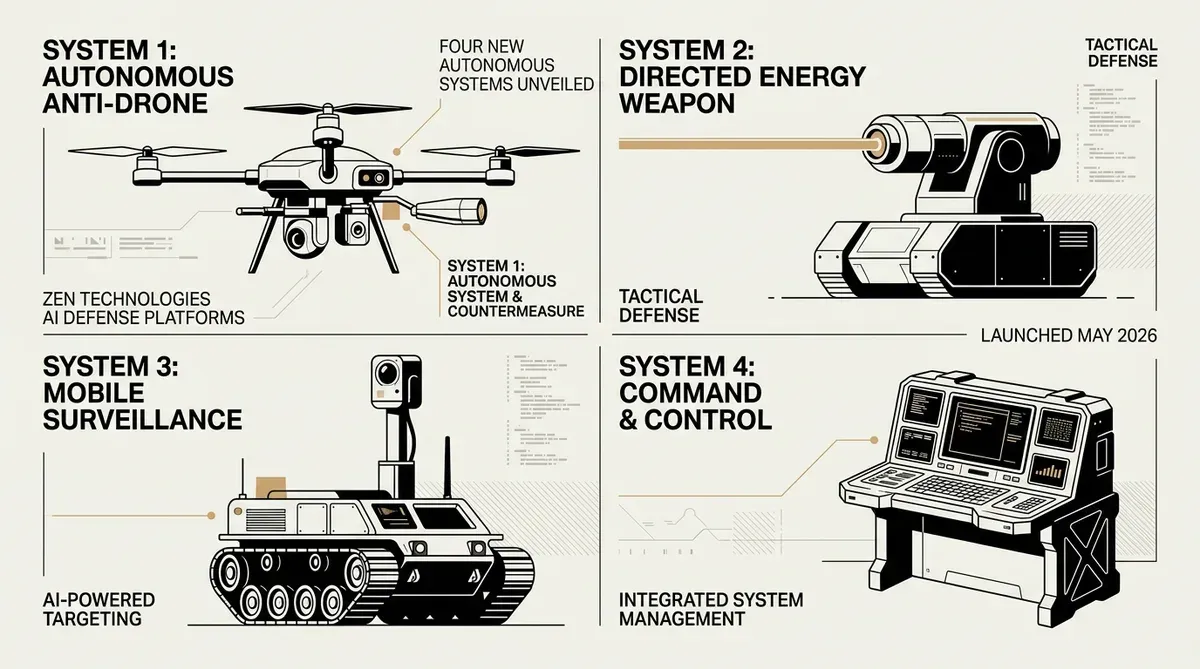
Zen Technologies has launched four new Zen Technologies AI defense platforms designed to modernize kinetic and electronic warfare capabilities. The announcement, made on May 8, 2026, introduces a suite of autonomous systems that utilize localized edge computing to identify and neutralize threats without requiring constant human intervention. This release includes a modular anti-drone system and a Directed Energy Weapon (DEW) optimized for high-speed precision targeting.
The core of these new systems is a decentralized processing architecture. By integrating edge AI directly into the hardware, the platforms can classify threats and execute countermeasures in real-time. This approach reduces the latency typically associated with cloud-reliant or remote-command structures, which is a critical requirement for modern tactical environments where electronic jamming often disrupts communication links.
Advanced Targeting with Zen Technologies AI Defense Platforms
The newly unveiled Directed Energy Weapon utilizes artificial intelligence to track and engage fast-moving aerial threats. Unlike traditional projectile-based systems, the DEW provides a scalable response to swarm attacks, where the cost-per-engagement is lower than conventional missiles. The AI algorithms governing the weapon system are trained to distinguish between friendly assets and hostile targets in complex environments.
A key feature of the Zen Technologies AI defense platforms is their modular architecture. Zen Technologies designed these units to be versatile, allowing for installation on existing armored vehicle fleets or deployment as part of static perimeter security. This flexibility ensures that defense agencies can upgrade current infrastructure with autonomous capabilities rather than replacing entire vehicle platforms.
The modular anti-drone system is specifically tailored for rapid deployment. It combines sensor fusion by merging data from radar, optical, and radio frequency sensors to provide a comprehensive view of the local airspace. The system then uses its internal AI engine to determine the most effective neutralization method, whether through electronic disruption or kinetic interception.
The shift toward autonomous defense systems reflects a broader industry trend where speed and data processing at the edge determine tactical superiority. Zen Technologies is positioning these platforms to address the increasing prevalence of low-cost drone technology in modern conflicts. By automating the detection and neutralization cycle, the company aims to reduce the cognitive load on operators while increasing the success rate of defensive maneuvers.
As of May 2026, the integration of these AI-driven tools into national defense strategies highlights the growing reliance on machine learning for national security. Zen Technologies expects these systems to provide a scalable solution for both mobile units and fixed installations. The company is scheduled to begin technical demonstrations for international partners later this quarter.
While we strive for accuracy, bytevyte can make mistakes. Users are advised to verify all information independently. We accept no liability for errors or omissions.
AI-generated image.
Related Articles
- US Defense Department Partners with Tech Giants to Establish AI-First Military Force
- Nutanix Unveils Full-Stack Platform to Accelerate Autonomous AI Agents
- NVIDIA Launches NemoClaw Open-Source Stack to Secure Autonomous AI Agents
✔Human Verified