
2026 Console Shipments Decline: Prices Jump as Memory Crisis Hits Sony, Microsoft, Nintendo
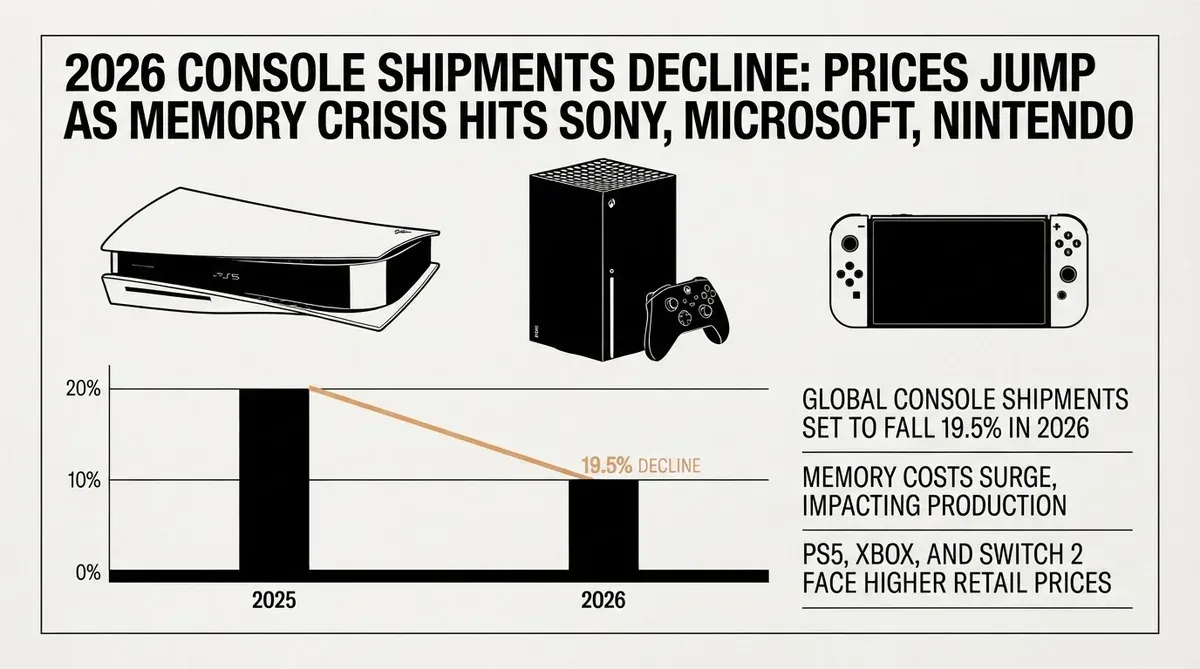
The 2026 console shipments decline is set to be the steepest the gaming industry has seen in years, with S&P Global Market Intelligence Kagan forecasting a 19.5 percent drop to 33.9 million units worldwide. The forecast, published in July 2026, reverses the growth momentum from 2025 when the Nintendo Switch 2 launch pushed shipments up 13.5 percent to 42.1 million units.
The primary cause of this year's contraction is a supply chain crisis in DRAM and NAND flash memory. AI data centers are estimated to consume roughly 70 percent of the world's memory output in 2026, up from 20 to 30 percent in 2022. That diversion has driven conventional DRAM contract prices up by an estimated 90 to 95 percent quarter over quarter in early 2026, with a further 58 to 63 percent increase projected for the second quarter. Console makers have been forced to pass those costs to consumers.
Platform-Level Impact of the 2026 Console Shipments Decline
Nintendo's Switch 2 is forecast to be the best-selling console of the year at 17.1 million units, a solid start for a platform that launched only months ago. Sony's PlayStation 5 is expected to ship 13.2 million units, down from 17.1 million in 2025. Sony raised prices across its lineup in direct response to component cost pressure, bumping the base PS5 from $550 to $650, the digital edition to $600, and the PlayStation 5 Pro from $750 to $900.
Those price hikes have had a measurable effect on demand. Sony sold roughly 17.1 million PS5 units in 2025, and the projected drop to 13.2 million in 2026 is a decline of nearly 4 million units, or about 23 percent year over year. The $150 increase on the Pro model is particularly steep and places the premium console firmly outside impulse-buy territory for most households.
Microsoft faces the toughest road of the three platform holders. The Xbox Series X and Series S combined are forecast to ship just 2.5 million units in 2026, which would be the lowest annual total on record for any Xbox platform. The brand has struggled to match Sony and Nintendo on exclusive software output, and its smaller install base means component cost increases hit per-unit margins harder. A recovery path for Xbox at current pricing levels is difficult to identify in the near term.
When Will the Market Recover
S&P Global's analyst Neil Barbour has indicated that a return to growth depends on component costs easing, which he does not expect before 2028. The forecast projects the market will slide further to 27.1 million units in 2027 before beginning a slow climb back to 37.4 million units by 2030. That full-cycle recovery would still leave annual shipments about 5 million units below the 2025 peak.
The broader electronics market confirms the pattern. PC shipments fell 4.9 percent in the second quarter of 2026, smartphone shipments dropped 11 percent year over year to their lowest level since 2013, and notebook shipments are forecast to decline 13.6 percent for the full year. All point to the same root cause: memory supply is being reallocated from consumer devices to AI infrastructure at a pace the fabrication industry cannot match.
Why This Matters
This 2026 console shipments decline is fundamentally different from the cyclical downturns the industry has experienced before. It is not driven by consumer disinterest in gaming or a lack of compelling software — the Switch 2 launch and the continued strength of the PlayStation library prove that demand exists. The bottleneck is entirely on the supply side, and it is tied to a structural shift in how memory chips are allocated globally. Until new fabs come online and AI's share of memory consumption stabilizes, console prices will stay elevated, and the era of sub-$500 flagship consoles is likely over.
AI-generated image.
Related Articles
- AI Infrastructure Boom Triggers Massive Global Shortage of Memory Chips
- Nintendo Switch 2 Price Hike Confirmed for Global Markets Amid Rising Costs
- Memory Chip Crisis Drives Apple and Microsoft to Raise Prices Up to $300
✔Human Verified
Researched and cross-referenced against primary sources by the Bytevyte editorial team.