
Accounting AI Tools Reach 94% Adoption as U.S. Firms Face Governance Crisis
94% of U.S. accounting teams now use accounting AI tools, but 52% report data breaches as governance lags behind rapid adoption according to Capterra.
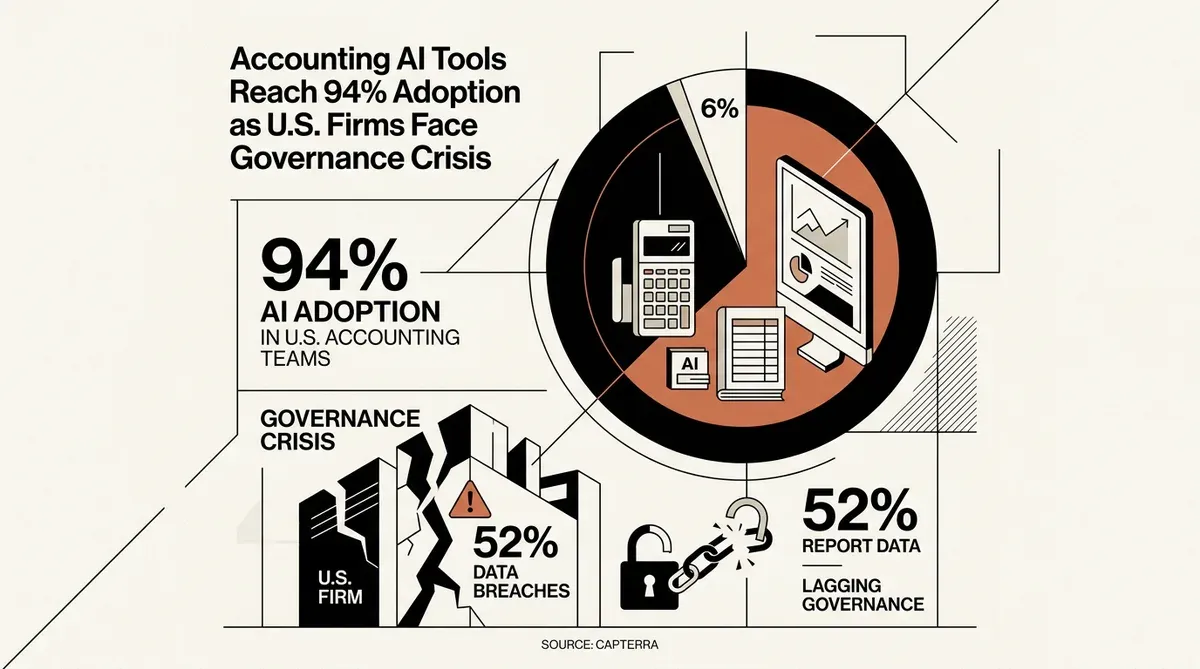
Capterra has released a report indicating that 94% of accounting teams in the United States have integrated artificial intelligence into their daily operations. This widespread adoption of accounting AI tools comes as firms seek efficiency gains, with 89% of organizations reporting a positive return on investment from these technologies. However, the rapid deployment of these systems is currently outpacing corporate governance and long-term software planning, creating significant security and operational vulnerabilities.
The 2026 Accounting Software Trends Report, published on May 17, 2026, highlights a growing disconnect between technology implementation and risk management. While the financial benefits of accounting AI tools are clear to most firms, the speed of adoption has led to measurable consequences. More than half of the surveyed organizations, approximately 52%, have already suffered a financial data breach directly linked to the introduction of new software. These security lapses suggest that many professional services firms are prioritizing rapid deployment over rigorous security protocols.
Security Risks and Governance Gaps
The surge in accounting AI tools usage is also reshaping the labor market within the sector. According to the data, 73% of firms are currently struggling with staff retention as traditional accounting roles evolve to accommodate automated systems. This talent friction is compounded by a lack of structured governance. Many organizations are implementing advanced algorithms without updating their internal policies or providing clear career paths for employees whose primary tasks are now handled by machine learning models.
Strategic planning remains a secondary concern for many leadership teams focused on immediate ROI. The report indicates that the rush to automate is leaving firms exposed to long-term operational risks. Without comprehensive governance frameworks, the integration of AI into sensitive financial workflows may continue to trigger data integrity issues and compliance failures. Firms that fail to balance technical speed with administrative oversight risk undermining the efficiency gains they have achieved through automation.
As of May 2026, the accounting industry stands at a crossroads where the ubiquity of AI is no longer in question, but the sustainability of its implementation is. The next phase of digital transformation in this sector will likely require a shift in focus from simple tool adoption to the development of strong security architectures and human-centric retention strategies. Addressing the 52% breach rate will be a critical milestone for firms looking to maintain client trust in an increasingly automated environment.
While we strive for accuracy, bytevyte can make mistakes. Users are advised to verify all information independently. We accept no liability for errors or omissions.
AI-generated image.
Related Articles
- Enterprises Shift Toward Sovereign AI Amid Rising Geopolitical Risks
- Stanford 2026 AI Index: Adoption Surges, Transparency Falls
- IBM Study: 76% of Global Firms Appoint a Chief AI Officer
✔Human Verified