
Alphabet Details $80 Billion AI Infrastructure Plan and 8th Gen TPU Rollout
Alphabet details its $80 billion AI infrastructure plan, including 8th Gen TPU deployment and a $10 billion investment from Berkshire Hathaway.
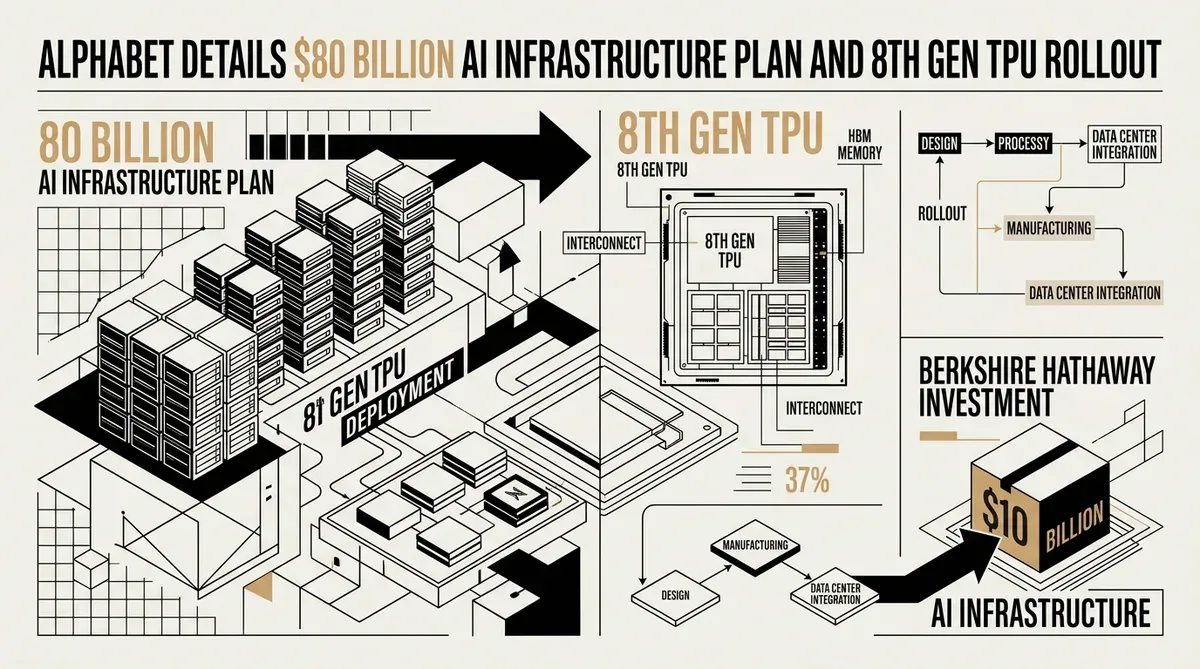
Alphabet has detailed a massive expansion of its technical infrastructure, including a proposed $80 billion equity raise and the deployment of its eighth-generation Tensor Processing Units (TPUs). The funding initiative includes a $10 billion investment from Berkshire Hathaway, signaling strong institutional confidence in the company's long-term AI infrastructure plan. This capital injection supports a projected capital expenditure of $180 billion to $190 billion for 2026, as the company scales its hardware and software capabilities to meet the demands of the agentic AI era.
The hardware foundation of this strategy rests on the new 8th Gen TPUs, designated as the 8i and 8t models. These processors utilize a dual-chip design specifically optimized for autonomous agents and complex reasoning tasks. Alphabet confirmed that these units are currently being deployed across its data centers to power the next wave of generative models, including Gemini 3.5 Pro, which is scheduled for release in June 2026. This hardware-software integration is intended to maintain the company's competitive edge in model performance and cost efficiency.
Strategic Expansion of the AI Infrastructure Plan
The scale of the AI infrastructure plan is reflected in the growth of Google Cloud, which reported a backlog of $462 billion at the end of the first quarter of 2026. This figure suggests sustained enterprise demand for AI-integrated cloud services. By investing heavily in custom silicon and massive data center capacity, Alphabet is positioning itself to handle the high compute requirements of agentic workflows, where AI systems perform multi-step tasks with minimal human intervention.
Beyond core computing, the infrastructure investment extends to autonomous systems. Waymo is set to expand its service to 20 additional cities throughout 2026. The autonomous driving unit currently completes more than 500,000 weekly rides, demonstrating the commercial viability of its technology at scale. The integration of advanced TPUs into the Waymo stack likely contributes to the processing power required for real-time navigation and safety in diverse urban environments.
The financial structure of this expansion, particularly the $80 billion equity raise, indicates that Alphabet is prioritizing aggressive growth over short-term margin preservation. With a capital expenditure target nearly double that of previous years, the company is betting that the transition to an AI-first economy requires a fundamental rebuilding of the global computing stack. The involvement of Berkshire Hathaway provides a significant endorsement of this capital-intensive roadmap.
As of June 2026, the deployment of Gemini 3.5 Pro will serve as a key milestone for the new infrastructure. This model is expected to leverage the dual-chip architecture of the 8th Gen TPUs to deliver faster inference and improved reasoning capabilities. For enterprise decision-makers, the sheer volume of Alphabet's cloud backlog and its hardware roadmap suggest that the company is building the necessary capacity to support large-scale AI deployments for years to come.
While we strive for accuracy, bytevyte can make mistakes. Users are advised to verify all information independently. We accept no liability for errors or omissions.
Sources
Alphabet investor presentation: June 2026
AI-generated image.
Related Articles
- Alphabet Secures Record $80 Billion to Accelerate AI Infrastructure Expansion
- Blackstone and Google Form $25 Billion TPU Cloud Venture
- Google Shifts to Agentic Gemini with TPU 8th Generation and $100 AI Ultra Tier
✔Human Verified