
AMD Taiwan AI Investment: $10 Billion Expansion for Advanced Packaging and Infrastructure
AMD announces a $10 billion AMD Taiwan AI investment to scale advanced packaging for Venice CPUs and Instinct MI450X GPUs by late 2026.
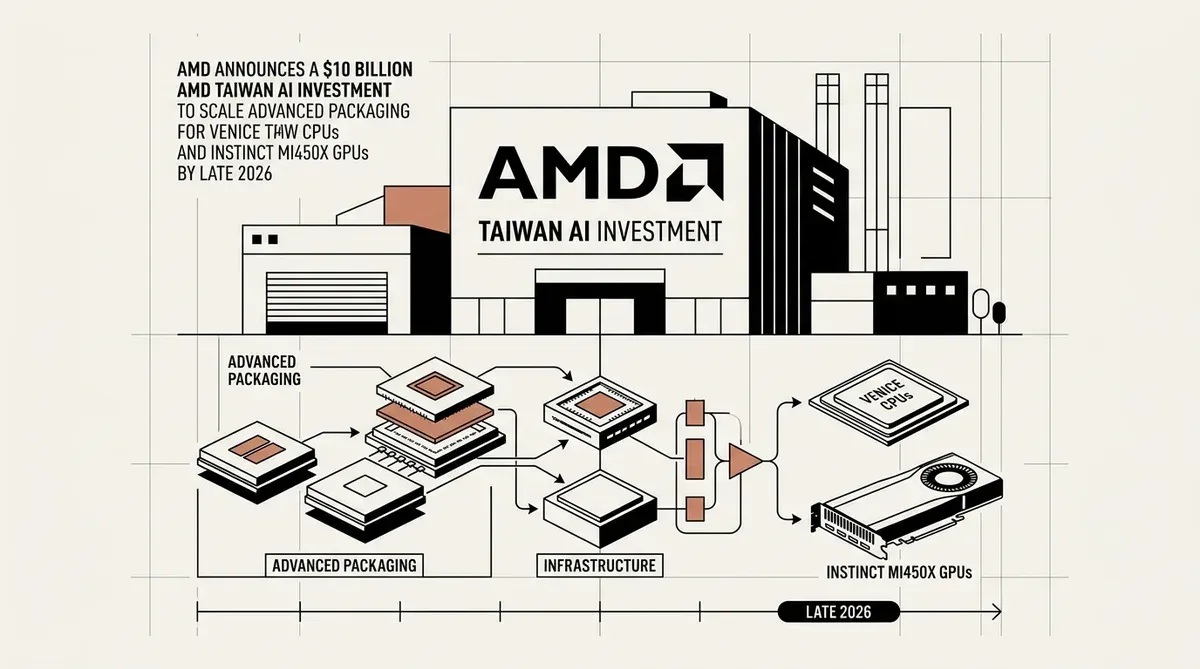
AMD has committed more than $10 billion to expand its presence in the Taiwan technology ecosystem, focusing on advanced packaging and AI infrastructure. This massive investment aims to scale the production of next-generation hardware required for hyperscale data centers. The initiative centers on Elevated Fanout Bridge (EFB) technology, a critical component for the upcoming 6th Gen AMD EPYC processors, known by the codename Venice.
The company announced the investment on May 21, 2026, highlighting a shift toward 2.5D panel-based EFB interconnects. This technology is designed to provide higher interconnect bandwidth and improved efficiency compared to traditional packaging methods. By industrializing this process, the manufacturer intends to create a more cost-effective scaling path for the high-performance computing market.
Strategic Partnerships and Infrastructure
To execute this expansion, the chipmaker is collaborating with several major Outsourced Semiconductor Assembly and Test (OSAT) providers. Key partners in the initiative include ASE, SPIL, and PTI. These partnerships are intended to move 2.5D panel-based packaging from specialized production into large-scale industrial use. The AMD Taiwan AI investment is a significant effort to secure the supply chain for high-end AI silicon.
The new packaging technology will be a cornerstone of the AMD Helios rack-scale platform. This integrated system combines the Venice CPUs with AMD Instinct MI450X GPUs to handle intensive AI workloads. By controlling both the silicon design and the advanced packaging process, the company seeks to optimize the performance of its AI hardware stack.
Market Implications for AI Data Centers
The AMD Taiwan AI investment arrives as demand for AI-specific infrastructure continues to outpace supply. Hyperscale providers are increasingly looking for hardware that offers both high density and thermal efficiency. The EFB technology used in the Venice processors addresses these needs by allowing more complex chiplet designs without the traditional cost penalties of advanced packaging.
Deployment of the Helios rack-scale platform is expected to begin in the second half of 2026. This timeline suggests that the $10 billion investment will start impacting the data center market within the next eighteen months. As the industry moves toward more modular chip designs, the ability to package these components efficiently in Taiwan will be a major factor in maintaining competitive performance levels.
While we strive for accuracy, bytevyte can make mistakes. Users are advised to verify all information independently. We accept no liability for errors or omissions.
Sources
AMD Announces More Than $10 Billion in Taiwan Ecosystem Investments
AI-generated image.
Related Articles
- AMD Debuts Ryzen AI Max+ Pro 495 and Pledges $10 Billion for AI Infrastructure Expansion
- ASE and WUS Invest NT$35 Billion in Taiwan AI Chip Packaging Plant
- Applied Materials and TSMC Partner at EPIC Center to Advance AI Chip Scaling
✔Human Verified