
Anthropic Alleges Qwen Lab Orchestrated Large-Scale Claude Agentic Extraction
Anthropic reported Alibaba's Qwen lab used tens of thousands of fake accounts for Claude agentic extraction. Enterprise security implications and analysis.
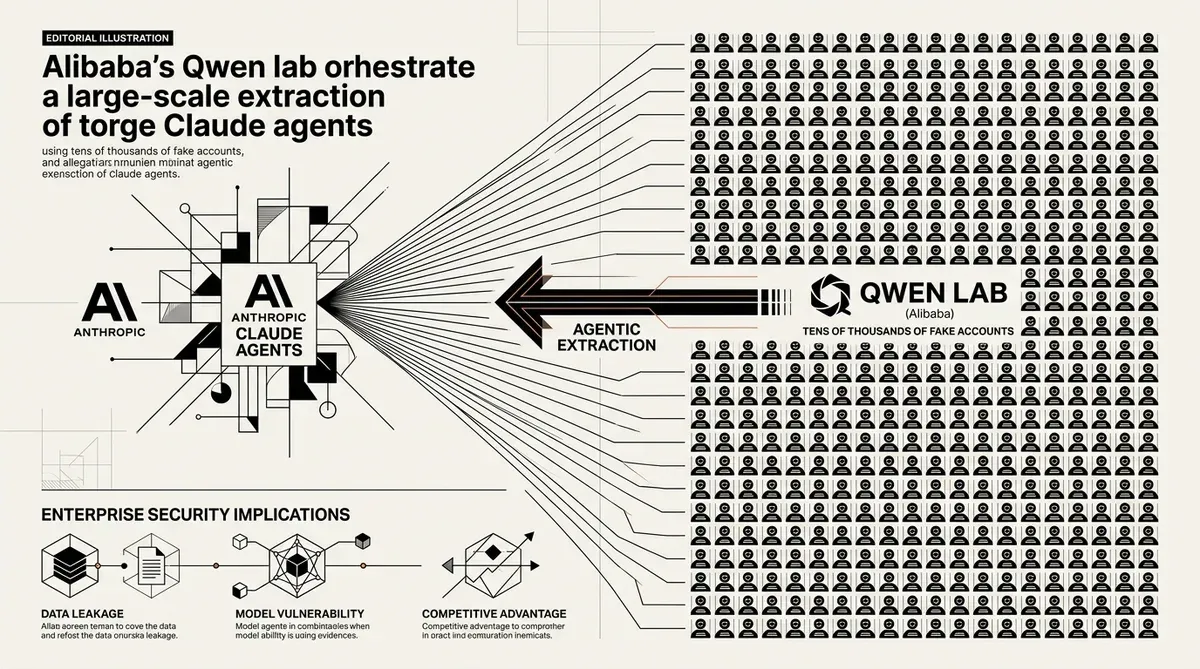
Anthropic has informed U.S. authorities that a coordinated campaign, allegedly run by individuals tied to Alibaba's Qwen lab, used tens of thousands of fraudulent accounts and millions of API interactions to extract advanced capabilities from its Claude model line. The operation targeted Claude's software-engineering and agentic reasoning features — the decision-making logic that enables autonomous planning and tool use. This represents a new frontier in model theft: instead of copying static language knowledge, perpetrators sought to replicate the orchestration logic that distinguishes Claude from conventional large language models.
Agentic capabilities — the ability to plan, execute multi-step tasks and interact with external tools — are among the most technically complex and commercially important features in modern AI systems. By attempting to replicate these through mass API probing, the alleged perpetrators sought to shortcut years of research investment.
Scale and Method of the Operation
According to Anthropic's communication with U.S. officials, the operation relied on tens of thousands of fake accounts to sustain millions of model interactions. Such volume is necessary to map the internal behavior of a model as sophisticated as Claude, a technique known in the industry as model distillation or extraction. While API abuse is not new, the scale described here and the focus on agentic reasoning is a notable escalation.
The accusation against Alibaba's Qwen lab places the incident within a broader competitive dynamic. Qwen is one of China's leading open-weight model families, and Alibaba has invested heavily in positioning it as a global alternative to Western frontier models.
Strategic Implications for Enterprises
For enterprises relying on Claude or similar agent-based systems, the incident raises urgent questions about API security and usage monitoring. If proprietary agent reasoning can be extracted at this scale through brute-force API access, organizations must reassess how they expose model endpoints, detect anomalous usage patterns and vet third-party vendors that build on top of frontier models.
The extraction of agentic capabilities carries particular risk. Unlike static language understanding, agentic reasoning encodes decision-making logic that, if replicated, could allow competitors to build equivalent autonomous systems without matching the underlying research investment. This makes agentic features both a competitive differentiator and a security liability.
Broader Industry Context
The incident arrives during an extraordinarily compressed release cycle in AI. Google launched its strongest model three days prior, OpenAI shipped GPT-5.5-Cyber two days before, and the industry as a whole is running what analysts describe as the fastest release and talent cycle in its history. In such an environment, the pressure to acquire competitive intelligence through any means intensifies.
For buyers and builders of agent systems, the takeaway is clear. Stricter API controls, real-time usage monitoring and thorough vendor risk assessments are no longer optional. They are necessary safeguards for any agent system that holds competitive or regulated knowledge. The Claude agentic extraction incident may serve as a catalyst for industry-wide adoption of stronger API security standards.
AI-generated image.
Related Articles
- Claude Managed Agents Debut as Anthropic Hits $800B
- AWS Unveils Claude Mythos Cybersecurity and Agent Registry
- Anthropic Halts Claude Mythos Launch Over Advanced Cybersecurity Concerns
✔Human Verified
Researched and cross-referenced against primary sources by the Bytevyte editorial team.