
Anthropic Nasdaq IPO: Claude Maker Picks Nasdaq Ahead of October Debut [Update]
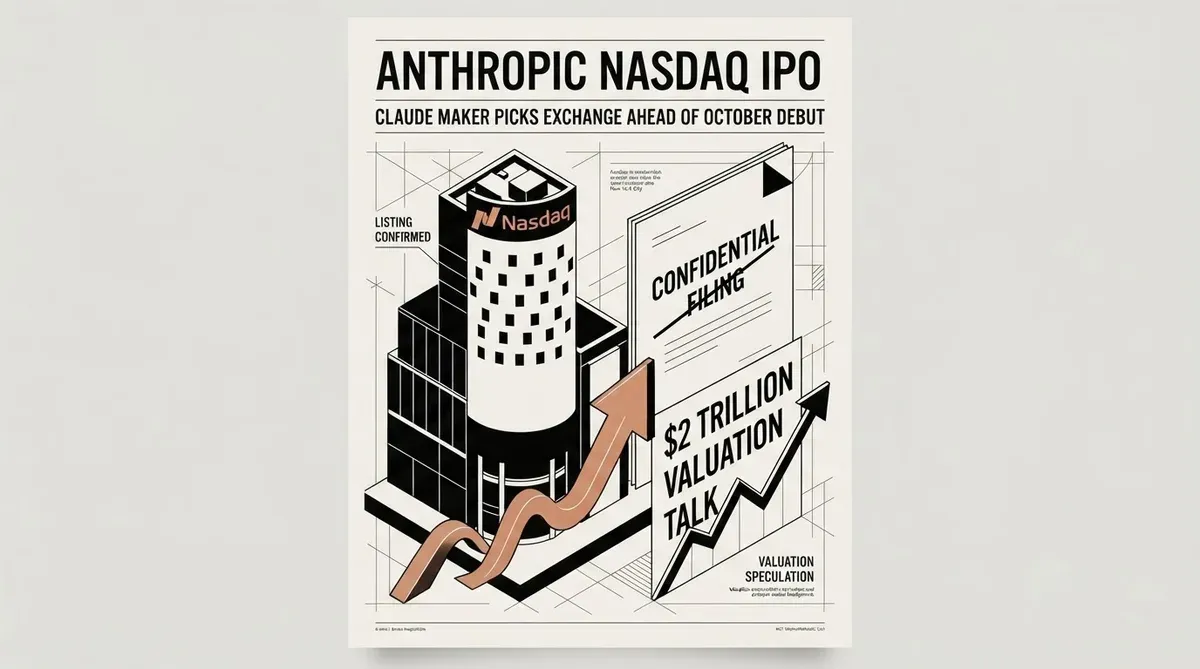
Anthropic will list on Nasdaq, settling the biggest mechanical question in what would be the largest AI market debut to date. The Claude developer is targeting an October listing, and the window is now drifting toward mid-October as its bankers begin arranging investor meetings. The choice was locked in before the trading week that began on 14 September, and it hands Nasdaq a second large technology listing this year. The exchange is the least consequential part of this story. The calendar is the part that carries information, because it forces Anthropic to publish audited numbers on a schedule.
The confirmed details are narrower than the coverage implies. Anthropic handed the US Securities and Exchange Commission a confidential draft S-1 around 1 June 2026, and that document remains sealed. No revenue, margin, or cash-burn figures have been released. As reported, the company is seeking to raise as much as, or more than, SpaceX did in its own listing.
The raise is the second number to watch. A deal of that size does two things at once: it gives employees and early backers a path to convert illiquid equity into cash, and it supplies public markets with a large block of new shares in a single sector. Equity liquidity is a recruiting tool in an industry that pays senior researchers partly in paper, and it matters more the longer private markets stay closed to exits.
Three conditions still govern whether October holds: regulatory review of the offering documents, market conditions, and completion of those documents. Each can move the date by weeks, which is why mid-October reads as a target rather than a commitment. A slip past October has a natural landing spot in early 2027, which would put the deal into a new fiscal year with different market conditions and a changed competitive picture.
The Anthropic Nasdaq IPO Timetable Is the Real Story
Nasdaq's logo on the ticker says where the stock trades. It says nothing about whether the company is worth what its backers hope. The timetable carries more information, because it forces disclosure on a schedule.
The next concrete marker is the shift from confidential to public. A US issuer must make its registration statement public before the roadshow starts, which places a visible filing within weeks of a mid-October debut. That document is where the valuation figure now circulating either earns support or gets marked down.
The public S-1 will also settle questions that have gone unanswered in private: how concentrated the customer base is, how much of revenue is committed to compute contracts, and how the company accounts for long-term infrastructure spending. Those disclosures set the terms of every analyst model written after the listing.
The sequence from here is short and observable. Investor meetings build a demand picture, the public S-1 opens the numbers, the roadshow tests them against real orders, and pricing follows. A mid-October launch also lands in the middle of the third-quarter reporting season, when institutional investors are already rebalancing portfolios and allocating to new issues.
Nasdaq's win is real, and it extends beyond listing fees. SpaceX chose the exchange earlier in 2026, and Anthropic follows, giving Nasdaq two of the year's largest technology deals. The exchange competition for listings this size is fought on relationships rather than price, and winning both in one year gives Nasdaq a position rivals cannot match quickly. The franchise value sits in what comes after: trading relationships with the institutions that will hold the stock, and the data and branding that flow from listing a defining company of the current technology cycle.
| Company | Venue | Status | Target window |
|---|---|---|---|
| Anthropic | Nasdaq | Confidential S-1 filed around 1 June 2026 | October 2026, shifting toward mid-October |
| OpenAI | None chosen | 2026 listing ruled out | No date |
| SpaceX | Nasdaq | Listing secured earlier in 2026 | 2026 |
For Anthropic, the exchange choice also fixes the peer set it will be indexed and compared against, which shapes how analysts model the business from the first day of trading. That is a quieter consequence of the Nasdaq pick than the headline, and a more durable one.
The $2 Trillion Estimate Has No Public Filing Behind It
Valuation estimates near $2 trillion are circulating for Anthropic, and they rest on nothing the public can check. A confidential filing is invisible by design, so the figure is a projection built from private round pricing and expectations about future revenue rather than from audited statements. At that level the company would rank among the largest listed businesses in the United States.
The gap between the estimated valuation and the amount being raised is itself informative. A company valued near $2 trillion that sells a small slice of itself leaves the share price dependent on thin trading, while a larger float gives institutions room to build positions without moving the stock. The offering documents will show how that balance is being struck.
Roadshow bookbuilding converts a projection into a price range. If the public filing shows compute costs taking a larger share of revenue than the estimate assumes, or enterprise contracts converting to cash more slowly, the range comes in below the headline. That risk lands on existing shareholders and on the underwriters who have to clear the book.
Public investors will price what private rounds have largely taken on trust: how much of revenue compute consumes, and how quickly enterprise contracts turn into cash. They will also test whether the release cadence of new Claude models can hold against rivals spending at the same scale. None of those questions has a public answer yet.
As we previously reported, Nvidia's $10 billion anchor stake sits underneath this offering, and commitments of that scale are what public investors read as evidence of demand. It narrows the pricing risk without removing it.
Why OpenAI's Silence Sharpens the Contrast
Days before the venue pick, Sam Altman said OpenAI would not list in 2026, citing AI safety concerns. Anthropic is moving the other way on the same calendar. The divergence is strategic as much as philosophical: one lab is testing public markets as a capital source, while the other stays with private backers and the obligations that come with them.
Customers and prospective hires read the two positions differently. A lab that stays private can promise long-horizon research without quarterly pressure; a listed lab can promise liquid compensation and disclosed financial strength. Anthropic is betting the second pitch is worth the scrutiny.
Anthropic has been weighing the risk environment for AI listings, which is a rational calculation rather than a formality. Regulatory attention on model training, data sourcing, and compute supply makes the disclosure burden heavier for a frontier lab than for a typical software issuer, and keeping the filing confidential preserves room to withdraw if sentiment turns before pricing.
For enterprise buyers, the change is practical. A listed Anthropic reports quarterly, so customers, competitors, and sales teams all read the same numbers about growth and spending. Anthropic PBC's public benefit corporation structure adds a governance question for investors more accustomed to conventional charters, and that structure will draw scrutiny during the roadshow.
Market conditions remain the wild card. A crowded autumn calendar, a rate surprise, or a sharp move in technology shares can push a deal priced to be record-setting into a smaller raise. Anthropic can withdraw before pricing at any point, and the confidential filing means it would do so without a public paper trail.
Two mechanics will shape the stock after listing. Index inclusion depends on eligibility rules that a newly public company does not automatically satisfy, so the first months of trading will run on active investors rather than passive flows. Lock-up expiries will later add supply, and how the shares absorb it will be the first real read on whether the $2 trillion talk was grounded.
Why this matters
Anthropic's Nasdaq selection moves the AI industry's largest capital-markets test from speculation into scheduling. If the October window holds, the sector gets its first public benchmark for what frontier model economics are worth, and every competing lab's fundraising conversation changes alongside it. I would watch the public S-1 above all, because it is the first document in this cycle that forces audited numbers into a debate that has run on estimates.
See our earlier coverage: Anthropic IPO Hinges on Nvidia's $10 Billion Anchor Stake
AI-generated image.
Related Articles
- Anthropic Q2 revenue tops $11.5B as first operating profit reshapes the IPO math
- Anthropic IPO Hinges on Nvidia's $10 Billion Anchor Stake
- Anthropic record IPO could top SpaceX's $86.2B
✔Human Verified
Researched and cross-referenced against primary sources by the Bytevyte editorial team. This article was generated with the assistance of artificial intelligence and reviewed by the Bytevyte editorial team.