
Anthropic record IPO could top SpaceX's $86.2B
Anthropic record IPO plans target a raise matching or topping SpaceX's $86.2 billion, with a public filing possible as soon as the end of August 2026.
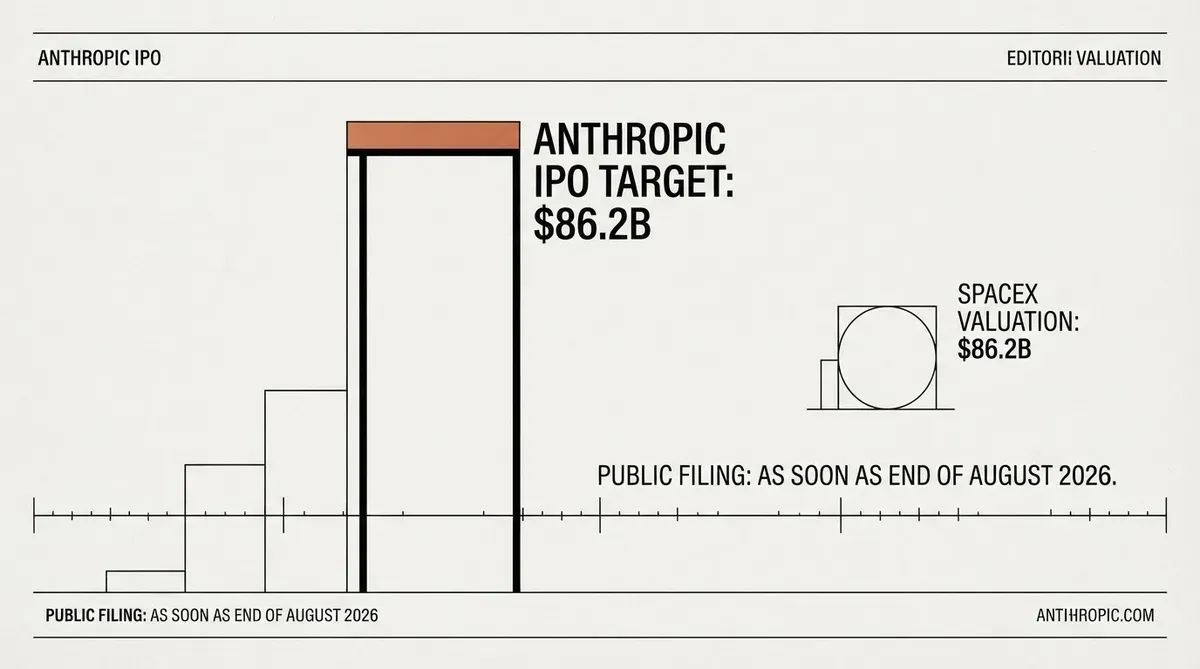
An Anthropic record IPO could match or beat the $86.2 billion share sale SpaceX completed in June, and the company is working toward it. Its registration statement is expected to go public by the end of August. The route to that scale runs through a $65 billion May raise that valued Anthropic at $965 billion, and investor briefings led by CFO Krisha Rao have so far deflected questions about the target valuation.
SpaceX's June listing raised $75 billion, and the overallotment option is expected to push the final total to $86.2 billion, the biggest public share sale in history. Anthropic executives are privately targeting a larger figure, although conversations about the size of the offering are still ongoing and the plans could change before the registration statement goes public. What is not in doubt is the scale: the public offering could end up larger than the $65 billion private round that set Anthropic's current valuation.
Anthropic has already submitted a confidential draft registration to the SEC, and it is expected to list ahead of OpenAI, which has moved its own debut to 2027. The order of arrival carries weight. Anthropic's May round left it valued above OpenAI's $852 billion mark from a $122 billion March raise, a gap of roughly $113 billion, and the first lab to test the public market will set the pricing reference for the one that follows.
| Company | Recent raise | Valuation | Timing |
|---|---|---|---|
| OpenAI | $122 billion | $852 billion | March 2026 |
| Anthropic | $65 billion | $965 billion | May 2026 |
| SpaceX | $75 billion, up to $86.2 billion with overallotment | Not disclosed | June 2026 IPO |
The Case for an Anthropic Record IPO
The financial picture explains both the ambition and the risk. Anthropic posted a net loss of nearly $42 billion in 2025, about five times the $8.3 billion it lost the year before, yet second-quarter revenue climbed past $11.5 billion and the company recorded its first operating profit in that quarter. Revenue for a single three-month stretch now exceeds a quarter of the loss the company booked for all of 2025, the clearest available sign that sales are scaling faster than spending.
That operating profit is an inflection point for a business whose losses ballooned as it scaled training runs and inference capacity. It does not erase the balance-sheet problem: the 2025 net loss dwarfs the prior year's figure by a factor of five. What the quarterly result does is give underwriters a concrete counterweight, because profitability at the operating line is the measure the market uses to judge whether AI revenue growth is real. Few AI startups can point to an operating profit alongside revenue of this size, which is the cleanest distinction between Anthropic and most of the field.
The revenue side is where the story gets easier to tell. At more than $11.5 billion for the quarter, sales already cover a meaningful share of the 2025 annual loss, and the operating profit shows that growth is starting to outpace the cost of running the business. What the company has not shown is whether that pace holds across multiple quarters, which is the difference between a durable trajectory and a single good quarter. The roadshow will have to answer that question without a long public track record to lean on.
A Listing That Tests the Market
An Anthropic record IPO would make 2026 the strongest year for US IPO volume on record, which means the record itself depends on this one deal landing at full size. The offering is being put together by Morgan Stanley, Goldman Sachs, and JPMorgan, a lineup that reflects the underwriting challenge of moving a deal this large. The structure includes a super-voting stock class that keeps control with existing shareholders while the company raises public capital.
The super-voting design is a governance trade-off. It protects the control of early shareholders, but it also limits the influence that new public investors can exert over management, a point that tends to surface in fund questionnaires and proxy analysis after the debut. For a company that has moved from safety-focused research lab to mass-market AI vendor, the structure signals that the founding team intends to keep strategic control through the listing and beyond.
The demand side is the practical constraint. SpaceX's June deal was absorbed quickly enough to put the overallotment in play, and the AI trade has drawn overwhelming interest from investors this cycle. Whether the same appetite extends to a loss-making company at a near-trillion-dollar valuation is the open question that pricing will answer. A raise above $86 billion would push 2026's IPO volume to a record, but a shortfall would leave the year's totals short of that mark as well.
The Trade-Offs Investors Face
Investor demand for AI exposure has been intense, which is what makes a raise of this size plausible. The open variable is valuation. Executives have declined to put a number on the company in recent investor briefings, and the gap between the $965 billion May valuation and an offering that could exceed $86 billion is worth pausing on: the IPO alone would be larger than the private round that set that price. If the offering is priced at the May valuation, an $86 billion raise would sell roughly nine percent of the company; any discount would push dilution higher. SpaceX's record came from a business with long-established commercial operations; Anthropic is asking the market to price a subscription and API business whose operating line only turned positive last quarter.
The absence of a disclosed price range this close to a filing is itself informative. CFO Krisha Rao has been leading the investor briefings, and the decision to hold back the valuation while confirming the timeline suggests the banks are still gauging demand before locking a range. For institutional buyers, the choice is between paying up for the scarcity of a frontier AI asset and waiting for the aftermarket, where the super-voting structure and the loss base could weigh on the multiple.
The stakes of an Anthropic record IPO extend beyond the company itself. A debut above $86 billion would validate the valuations the leading AI labs have accumulated in private markets, and it would put OpenAI in the position of following a higher bar when it lists in 2027. A weak debut would cool the appetite that has carried AI fundraising through recent record rounds. Either way, the timeline is fixed: the company is expected to file publicly by the end of August, which is days away.
The realistic reading is that the size of the raise is still in discussion and the valuation is still undisclosed, but the filing itself is imminent. Investors who want direct exposure to frontier AI are about to get their first chance to buy it at public-market prices, and they will be paying for a growth story whose cost side remains the largest single line in the financial statements. The useful discipline is to judge this listing the way any other would be judged: revenue trajectory, margin direction, and the price paid per dollar of sales, rather than the size of the headline record. The range printed in the public filing, and whether the roadshow holds the $965 billion line, will be the first real test of whether AI revenue growth justifies a record share sale.
Why This Matters
The outcome of this listing sets the reference price for every AI company that follows, starting with OpenAI's planned 2027 debut. For decision-makers, the open question is at what valuation the market clears a business with $11.5 billion in quarterly revenue against a $42 billion annual loss, and what that price implies for the cost of AI capital over the next two years.
AI-generated image.
Related Articles
- Anthropic Q2 revenue tops $11.5B as first operating profit reshapes the IPO math
- Can Anthropic's $2 Trillion IPO Survive Its Own Risks?
- Anthropic Valuation Hits $900 Billion as Firm Surpasses OpenAI in New Funding Round
✔Human Verified
Researched and cross-referenced against primary sources by the Bytevyte editorial team. This article was generated with the assistance of artificial intelligence and reviewed by the Bytevyte editorial team.