
Broadcom AI chip financing: $100B debt plan for Anthropic
Broadcom AI chip financing could reach $100B: a lease-back debt package for Anthropic and other AI firms, with Blackstone and Apollo as lead investors.
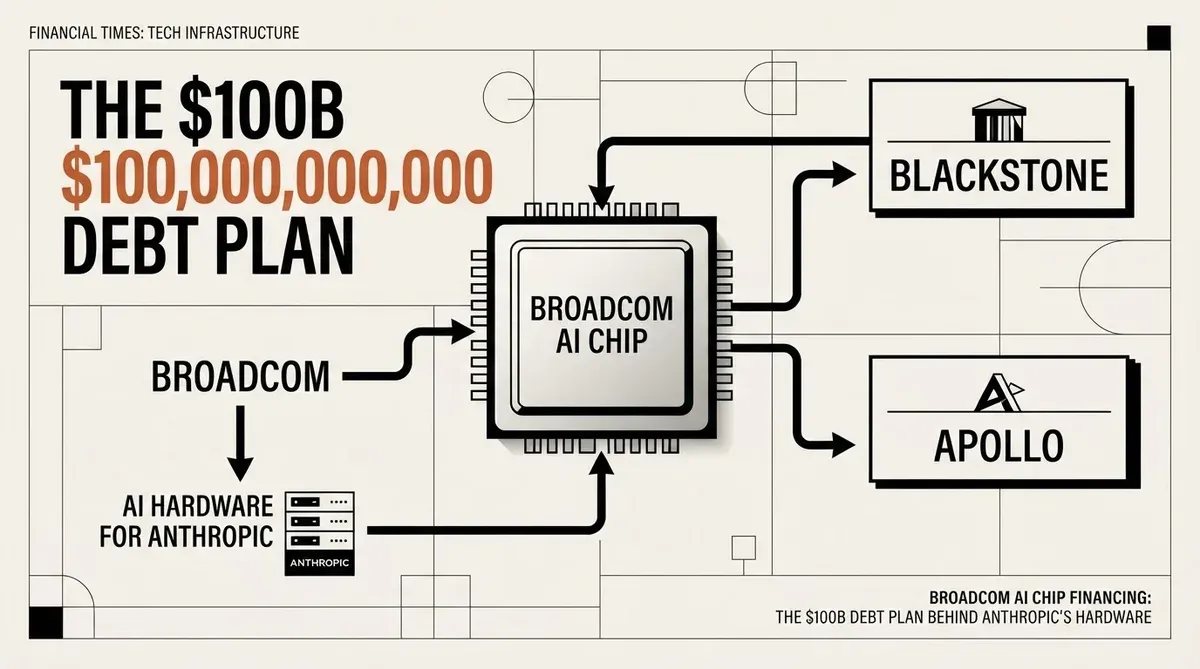
Broadcom Inc. is negotiating a debt package that would start at more than $60 billion and could reach $100 billion, earmarked for AI chips that Anthropic PBC and other technology companies will use. The Broadcom AI chip financing, reported this week, works through a lease-back arrangement. Investors buy the hardware and collect rent from the companies running it, so the debt sits outside Broadcom's main balance sheet.
This is the second time Broadcom has turned to outside capital to pay for AI infrastructure. In June 2026 it launched the AI XPV Platform, a $35 billion partnership set up to support 20 gigawatts of computing capacity by 2028. The new debt package would roughly triple that commitment within three months, the clearest measure of how fast demand for custom AI accelerators is growing.
The final size will depend on lender appetite, with the reported range running from more than $60 billion at the floor to $100 billion at the ceiling. The speed of the assembly is as notable as the number. A transaction of this complexity, built around a special-purpose vehicle, a guarantee, and a lease-back, is rarely put together quickly; this one follows a platform that was announced in June.
Inside the deal structure
The borrowing is being assembled through a special-purpose vehicle and splits into a senior tranche of roughly $60 billion to $70 billion plus a junior tranche of about $30 billion. Blackstone and Apollo Global Management are the two lead investors in the talks. Broadcom may also back part of the senior debt with its own guarantee. That backing is the mechanism that could earn the package investment-grade ratings, and those ratings determine how broadly the bonds can be sold.
The lease-back arrangement is the part that matters most. Instead of borrowing to buy chips itself, Broadcom arranges for investors to own the hardware and charge Anthropic and other AI firms for its use. The debt sits in a vehicle legally separate from Broadcom, so the company's own leverage ratios and credit rating are not directly touched, even though the guarantee means Broadcom stands behind part of the senior debt.
The split between the tranches is itself informative. A senior tranche of $60 billion to $70 billion with a guarantee attached is built to be rated and sold broadly; the junior tranche of about $30 billion is the risk layer, most likely to stay on the books of credit funds such as Blackstone and Apollo rather than reach public buyers. The larger the junior slice, the more cushion it gives the senior holders, and the structure sizes the two layers accordingly.
Why Broadcom is bankrolling its customers
Broadcom's revenue projections explain the ambition. The company forecasts more than $100 billion in AI-related chip revenue next year, and Anthropic alone is projected to account for more than 40 percent of that total, roughly $40 billion. Financing the hardware behind that revenue also ties Anthropic, the largest customer of Broadcom's custom silicon business, into a multi-year compute commitment that is harder to unwind than a purchase order.
The off-balance-sheet structure is the strategic core of the deal. Broadcom grows its accelerator business without letting the spending show up as debt on its own books, and its customers get compute without carrying the capital cost themselves. The trade-off is that the investors holding the hardware carry the residual-value risk: if Anthropic's training load slows or shifts to another silicon partner, the lease payments and the resale value of the equipment both come under pressure.
The guarantee matters for the same reason: the ratings it unlocks. Bonds rated investment-grade can be held by insurers and pension funds that steer clear of riskier credit. The junior tranche has no such support; that is where investors earn their premium for absorbing the first losses.
The deal's economics depend on the spread between what the hardware earns and what the debt costs. Investors collect lease income from the AI labs and pay interest on the bonds, with the difference as their return, so the financing works only while utilization stays high. That makes the whole package a bet on sustained demand for training compute, and it explains why the guarantee is limited to part of the senior debt rather than the entire structure.
The risks worth watching
Concentration is the biggest risk in the structure. One customer, Anthropic, is projected to generate more than 40 percent of Broadcom's AI chip revenue next year, and the same customer's lease payments would service a large share of the new debt. The deal therefore concentrates exposure in a single AI lab at the same time as it scales the financing.
The obvious objection is that the deal is financial engineering dressed up as real demand. The demand-side case has substance: the hardware is tied to compute that Anthropic and other companies have committed to using, the XPV Platform has already established the model, and Broadcom's own revenue forecast for next year is built on the same customers. The counterweight to that confidence is the 2028 deadline on the 20-gigawatt target, which makes the bet visible and measurable. If the buildout slips, the revenue forecast and the lease payments slip with it, and the guarantee means Broadcom absorbs part of the damage.
What the Broadcom AI chip financing signals for AI infrastructure
The broader implication of the Broadcom AI chip financing is about who pays for AI infrastructure. The reported terms leave room for OpenAI to join the arrangement alongside Anthropic, which would turn the vehicle into a shared financing layer for several of the largest AI labs at once. The capital burden of the AI buildout would move further from the balance sheets of the tech companies onto asset managers such as Blackstone and Apollo, who are effectively becoming the bankers of the AI era.
For decision-makers, the practical consequence is that compute is becoming available through third-party financing instead of internal capital budgets. That changes how AI labs plan their cash, and it changes what chipmakers have to promise lenders in return: multi-year commitments, visible utilization, and a revenue mix concentrated in a few names. Broadcom's bet is that the concentration is acceptable because the growth is real; the financing structure makes that bet public, priced, and on the record.
For AI labs, the lease-back model changes the economics of compute in a specific way. Instead of raising equity to buy servers or negotiating credit with chip suppliers, a lab signs a usage agreement with a vehicle that already owns the hardware. The cost shows up as an operating expense, preserving cash for model development and hiring while shifting the depreciation burden to the investors.
The model also puts pressure on chipmakers that have not built financing arms. Broadcom is effectively combining a silicon business with a credit business, and the combination gives it a lever that pure hardware vendors lack: it can guarantee the demand for its own chips by controlling how they are paid for. In a market where the growth constraint is usually capital, that is a structural advantage.
Why this matters
This deal is the clearest signal yet that AI's capital requirements have outgrown the balance sheets of individual companies. The Broadcom AI chip financing sets a template in which lenders, chipmakers, and AI labs share the risk of the buildout, and in which a single customer's training plans can move a hundred-billion-dollar credit. Watch the guarantee terms and the revenue mix as the negotiation proceeds; they will determine whether the structure holds together as advertised.
AI-generated image.
Related Articles
- Google's $150B Anthropic Chip Financing Machine Beats Nvidia on Borrowing Costs
- AI Implementation Services, Not Models, Will Capture the Trillion-Dollar Prize, Blackstone and Anthropic Bet
- General Compute's Inference Chip Loan Opens Financing Path
✔Human Verified
Researched and cross-referenced against primary sources by the Bytevyte editorial team. This article was generated with the assistance of artificial intelligence and reviewed by the Bytevyte editorial team.