
Apple AI realignment: Siri and Vision Pro teams shed 200+ roles
Apple cut 200+ roles across Siri and Vision Pro teams in its Apple AI realignment. What the restructuring signals about Apple's roadmap.
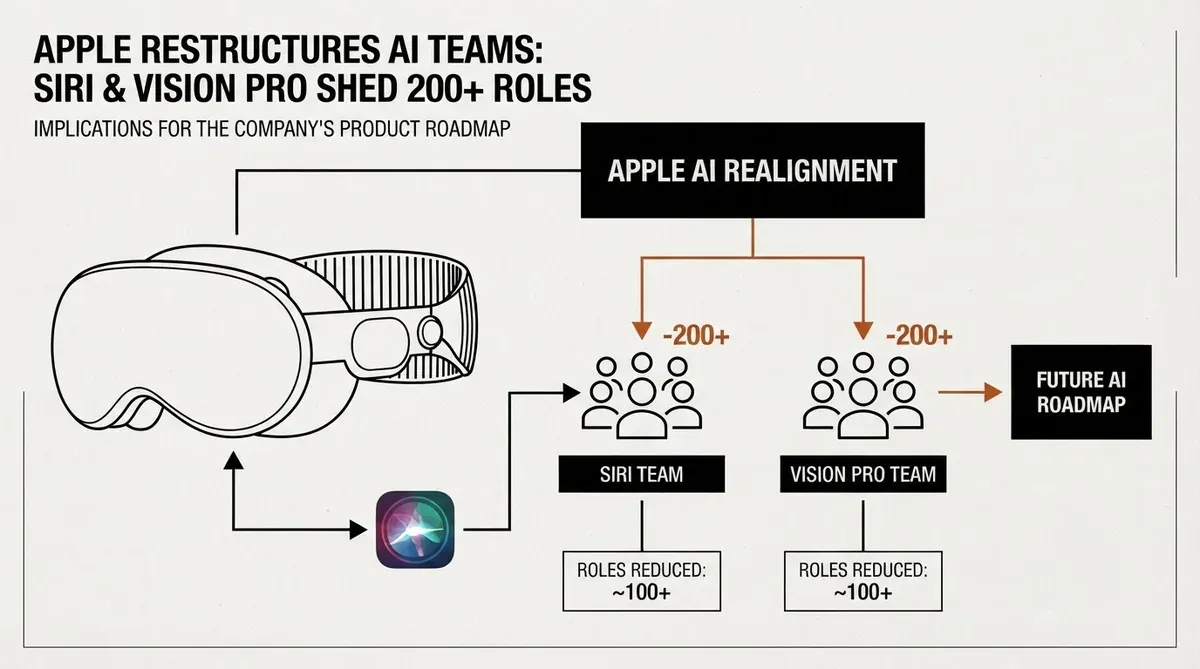
The Apple AI realignment now carries a visible headcount cost: more than 200 roles cut across the Vision Pro, Siri, and software engineering teams. The reductions, first detailed in a Bloomberg report on August 21, split almost evenly. Roughly 100 positions came from the Vision Pro organization, and about 100 from Siri and related software teams. Read together, the cuts follow a single logic: Apple is drawing down mature product lines to concentrate engineering capacity on AI-first successors.
The sharper reversal came in the Vision Pro organization. Apple shut down the headset's gaming unit and scaled back its own Immersive Video productions, steering content work toward third-party developers. MacRumors reports that dozens of the affected employees had worked on immersive video and gaming features. On the software side, the layoffs accompany a move to rebuild Siri around language-model technology. The Intelligent Systems Experience team has also been reorganized, with assistant-related work folded into the company's current AI development priorities.
Apple has acknowledged that some roles are affected. TechCrunch reports that the company is shifting focus away from certain initiatives, and Apple describes the move as a realignment rather than a pure headcount reduction. New positions, the company says, will support updated technical requirements. The net effect is a reallocation of engineering capacity toward AI work and future devices, with both the Siri and Vision Pro organizations absorbing the transition.
The Apple AI realignment in numbers
The reported figures, which Apple has not published as an exact total, give the restructuring a near-even split. Roughly 100 positions came from the Vision Pro organization and another 100 from the Siri and software teams, for a combined 200-plus.
| Group | Reported cuts | What changed |
|---|---|---|
| Vision Pro | ~100 | Gaming team closed; internal Immersive Video production scaled back |
| Siri and software | ~100 | Siri rebuilt around AI models; Intelligent Systems Experience restructured |
| Total | 200+ | New roles to be created for updated technical requirements |
For a company that has historically avoided conventional layoffs in favor of attrition and rehiring, cutting this many roles in a single pass is a meaningful departure. The reductions are small relative to Apple's total headcount, but they are concentrated in two high-profile areas, which is why the Apple AI realignment has drawn attention well beyond the affected teams.
What the cuts say about Apple's roadmap
The most consequential signal is on the hardware side. The next Vision Pro model may not arrive for several years, leaving the current generation on the market without a successor. Closing the gaming team and thinning the immersive video operation in the same window indicates that Apple is not willing to keep funding content and app initiatives at their previous level while the hardware line waits for a refresh.
The decision to pull back from internal Immersive Video production also changes the economics of Vision Pro content. Studios that once competed with Apple's own productions now become the primary source of premium content, while Apple's role shifts toward platform and distribution. That arrangement works only if the third-party pipeline delivers enough volume and quality to keep the headset attractive through a multi-year hardware gap.
The Siri cuts point in the same direction. Rebuilding Siri around language-model technology means the assistant's future is being defined by AI work rather than the device-level systems that carried it for years, and the teams being reduced are the ones whose skills sit outside that new stack. The restructuring of the Intelligent Systems Experience group, in particular, signals that assistant-related work is being consolidated under the new AI priorities instead of being maintained as a separate experience layer.
For consumers, the Siri portion of the restructuring is the more immediate change, because the assistant ships on every iPhone and iPad. The new Siri architecture implies a shift in how users interact with the assistant, toward conversational understanding and generative responses rather than fixed command sets. That is a product-level change with a visible user impact, and it will be felt in every app that relies on the assistant.
Reading the two halves together, the common thread is a move from maintaining mature products to investing in their successors. Vision Pro's gaming and immersive video teams were building content for a platform with a limited audience, while Siri's legacy systems were designed before language models became the default approach to assistant software. Both were high-visibility efforts whose near-term returns no longer justified their staffing levels.
The trade-offs of an AI-first pivot
The restructuring carries visible costs on both sides. Closing the in-house gaming team leaves the Vision Pro's game ambitions dependent on external studios, at a moment when the platform's immersive video pipeline is also being handed to third-party creators. That lowers Apple's fixed content spend today, but it banks on outside developers committing to a hardware line whose next model is not expected for years.
For third-party studios, the message is double-edged. Apple is handing them the content franchise it previously ran in-house, which opens the door to more deals, but it does so while the installed base is static and the next hardware refresh sits years away. Developers now carry the risk that the material they produce will outlive the current device generation.
For Siri, the trade-off runs between continuity and capability. An architecture built around AI models implies a different kind of assistant, one where natural-language understanding and on-device generation replace scripted responses. The transition also means retiring older interaction systems and letting go of the teams that built them. Apple's own framing, that new roles will be created for updated technical requirements, implicitly concedes that part of the eliminated work corresponds to skills the company no longer needs.
The third trade-off is strategic. The cuts arrive alongside a broader shift toward smart glasses and next-generation AI, which means the resources freed from Vision Pro and Siri are expected to flow into those areas. Seen that way, the layoffs are a portfolio decision: Apple is consciously trading current product lines for bets it expects to pay off later, and the Apple AI realignment is the mechanism that moves the money.
The verdict: a concentrated bet on AI and future hardware
For developers, partners, and business customers, the practical takeaways are clear. Vision Pro content efforts shift to third parties, Siri's roadmap converges on a language-model-based assistant, and engineering capacity flows toward AI work and future devices such as smart glasses. The 200-plus roles cut this week are the visible cost of that concentration, and the multi-year wait for the next Vision Pro model is the clearest available estimate of how long the platform will operate in transition. The most immediate organizational consequence is that the teams remaining will carry both roadmaps with fewer hands until the promised new roles are staffed.
Why this matters
For decision-makers, the restructuring shows where Apple's engineering weight will sit for the next two years: AI-driven assistant software and future hardware, while the current Vision Pro content pipeline runs leaner. Teams and partners building for the headset should plan for a reduced platform until the next model arrives. The Siri transition shows how quickly legacy assistant work is being retired in favor of AI-native architecture.
AI-generated image.
Related Articles
- Apple Shifts Focus to AI Smart Glasses as Vision Pro Development Ends
- Meta AI Workforce Restructuring: 8,000 Layoffs as 7,000 Staff Pivot to Agentic Teams
- Meta Realigns Workforce with $135 Billion AI Infrastructure Push
✔Human Verified
Researched and cross-referenced against primary sources by the Bytevyte editorial team. This article was generated with the assistance of artificial intelligence and reviewed by the Bytevyte editorial team.