
Meta Free Cash Flow Slips Below Zero as Q3 AI Capex Reaches $34.9B
Meta's Q3 free cash flow turned negative at about -$2.12B as AI capex hit $34.9B, while investors bet on the Muse agent payoff.
MENLO PARK / LONDON (BYTEVYTE): Meta Platforms reported third-quarter revenue of $64.6 billion, up 26% year over year, but its Meta free cash flow turned negative as AI spending outran operating cash generation. Investors bid the stock up as much as 5% in after-hours trading on the results, betting that the recently released Muse AI agent will eventually earn back the spending. The quarter itself does not yet show that payoff.
Revenue beat the $63.3 billion analysts expected, and Meta guided fourth-quarter revenue to between $73 billion and $76 billion, against a consensus of $73.75 billion. Operating income, however, fell to $13 billion, down 37% from $20.5 billion in the second quarter of 2025. The gap came from a $10 billion settlement with a group of state attorneys general over youth safety. Without that charge, operating income would have been $22.9 billion. Some third-party trackers put the charge at $9.89 billion, so the exact figure should be checked against Meta's filings.
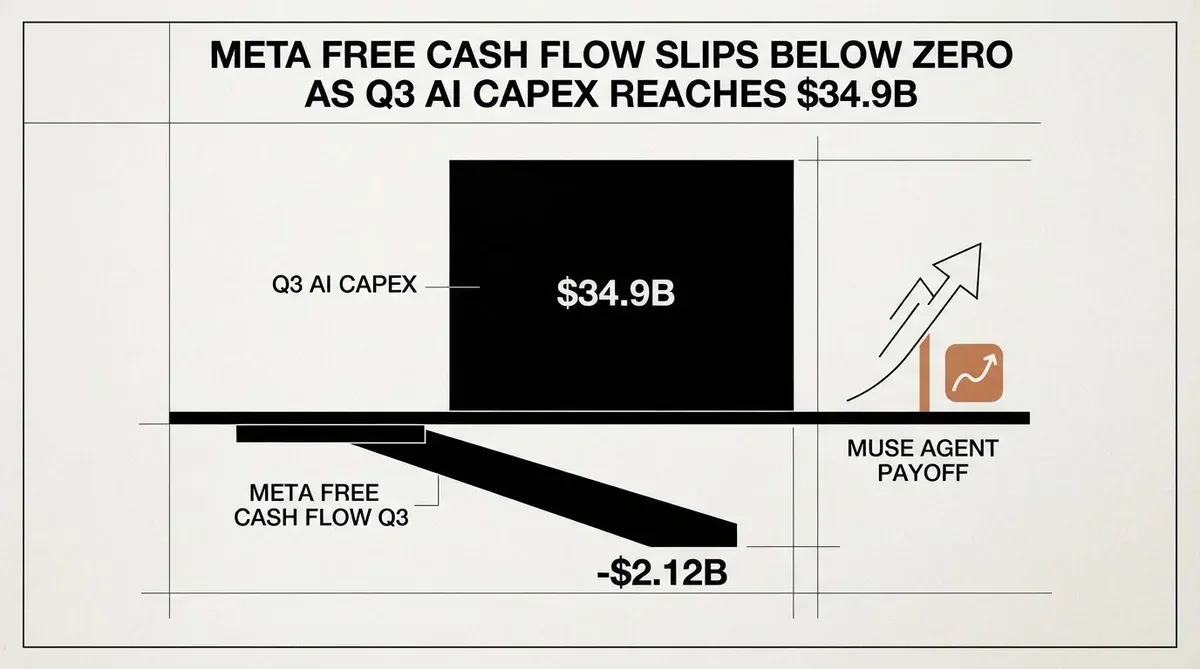
The cash line is where the strain shows. Capital expenditure reached about $34.9 billion in the quarter, while operating cash flow of roughly $32.79 billion did not cover it. That left free cash flow at about negative $2.12 billion, compared with roughly positive $10.6 billion a year earlier, according to third-party trackers. Those trackers also report cash of $82.45 billion as of September 30 and $1.36 billion in dividends paid. Meta's own figures for these lines were not available in the material reviewed.
Meta free cash flow and the equity option
Meta now has two funding routes beyond operating cash. The company said it will create a Class C share class to fund the AI buildout, pay employee stock compensation and finance acquisitions. The new shares are reported as non-voting, so issuance would raise capital without adding votes. For shareholders, the trade-off is dilution of economic ownership without a corresponding voice in governance.
The capital plan is also growing. Meta raised the low end of its 2026 capital spending range to $135 billion, keeping the top at $145 billion. That is a $5 billion increase in the floor. CFO Susan Li has said the 2027 budget is still being formulated, but Meta expects to keep an aggressive investment pace. Spending is therefore set to remain above operating cash generation unless revenue growth closes the gap.
What the payoff case depends on
The bull case rests on Muse. The material reviewed does not break out Muse revenue, usage or margin, so the market is pricing a monetization path that has not appeared in reported numbers. Meanwhile, Q4 guidance of $73 billion to $76 billion would need to hold for the core advertising business to keep funding growth at this pace. The company has not said when Muse-related revenue will become visible in its results.
Costs outside the balance sheet also deserve weight. Many new AI data centers run on-site gas turbines, which are loud for nearby residents, and gas-fired power carries high CO2 emissions. Cooling these facilities also draws large volumes of water. The sources reviewed do not detail Meta's power, noise or water arrangements, so these costs cannot be quantified for Meta here. They should still be counted when investors compare the buildout's returns against its footprint.
Why this matters
Meta's negative free cash flow shows that the AI buildout now draws on new equity and not only on operating cash. Investors are funding a Muse payoff that the quarter has not yet demonstrated. The next checkpoints are Q4 results against the $73 billion to $76 billion guidance and any Muse revenue disclosure. Until then, the buildout's local and environmental costs remain unpriced in the numbers.
While we strive for accuracy and rigor, ByteVyte can make mistakes. Readers are advised to verify all information independently and conduct due diligence before making decisions based on this reporting. We accept no liability for errors, omissions, or decisions made in reliance on this content.
Sources
Meta Platforms, Inc. - Form 8-K - FY2026 (Q3 earnings exhibit)
AI-generated image.
Related Articles
- Microsoft's 15% Surge vs Meta's $784M Cash Flow: The AI Capex Reckoning Arrives
- Meta AI Cloud Business Turns Capex Surplus Into Revenue as 2026 Spending Nears $145B
- Meta Increases 2026 Capital Expenditure to $145 Billion for AI Infrastructure
✔Human Verified
Researched and cross-referenced against primary sources by the Bytevyte editorial team. This article was generated with the assistance of artificial intelligence and reviewed by the Bytevyte editorial team.