
Microsoft's 15% Surge vs Meta's $784M Cash Flow: The AI Capex Reckoning Arrives
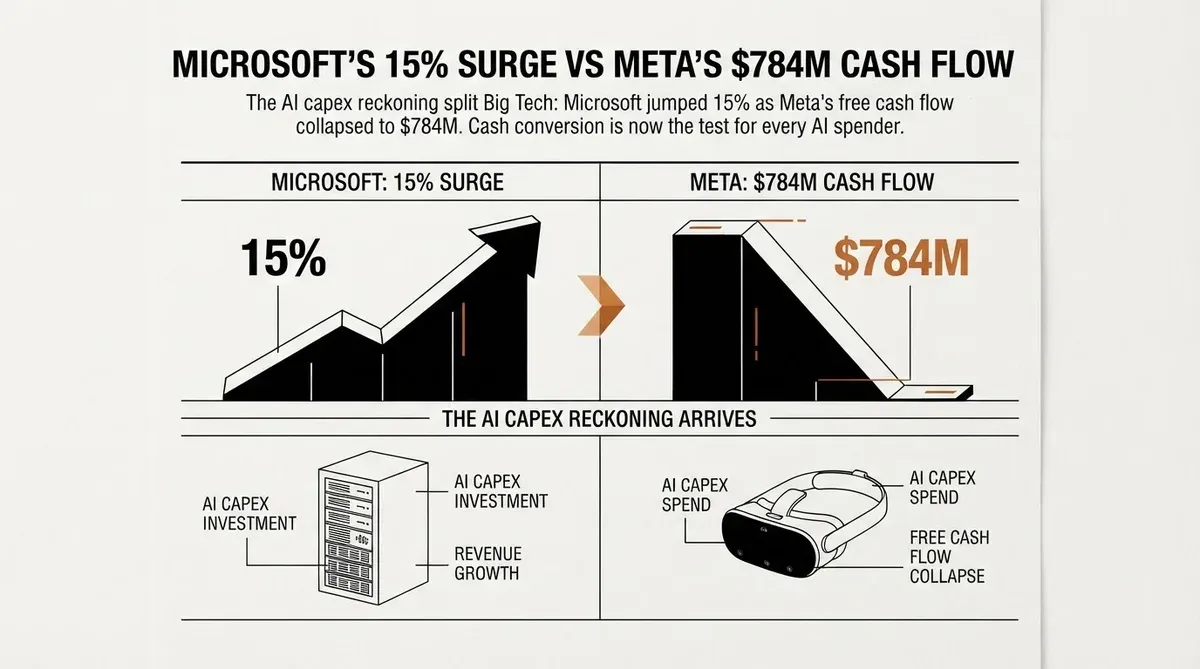
Microsoft and Meta reported earnings on the same day in late July, and the market turned the pair into a live referendum on AI spending: Microsoft shares jumped about 15 percent, their best single-day gain in 18 years, while Meta fell roughly 8 percent. The split came down to cash conversion. Microsoft showed Azure revenue up 43 percent and more than 30 million paid Copilot seats; Meta posted revenue up 28 percent but free cash flow of just $784 million, down 91 percent from a year earlier. The AI capex reckoning is now being priced against one question: how quickly each data-center dollar comes back as cash.
Meta's second-quarter report showed the strain. Revenue of $60.8 billion beat forecasts, but expenses climbed 55 percent to $42 billion, net income fell 14 percent to $15.8 billion against S&P Capital IQ projections of $18.8 billion, and earnings per share of $6.18 missed the $7.17 consensus by nearly 14 percent. Quarterly capital expenditures hit $31.1 billion, about double the year-ago figure, and the company narrowed its 2026 capex guidance to $130 billion to $145 billion by lifting the floor from $125 billion. Free cash flow, which exceeded $12 billion in the prior quarter, collapsed to $784 million. Shares slid about 8 percent in the following session after dropping nearly 10 percent after hours to $529.15.
Microsoft's fiscal fourth quarter pointed the other way. Azure grew 43 percent, ahead of the roughly 40 percent consensus, and the cloud business crossed $100 billion in annualized revenue for the first time. Paid seats for Microsoft 365 Copilot passed 30 million, up from more than 20 million as of April, a gain of roughly 10 million seats in about three months. The seat count matters as a consumption signal: enterprises are converting AI features into paid subscriptions, not just trials. Overall revenue beat analyst estimates. Microsoft's spending showed up as cloud revenue; Meta's showed up as a hole in cash flow.
| Metric | Microsoft | Meta |
|---|---|---|
| Growth signal | Azure +43% YoY; $100B annualized revenue | Total revenue +28% to $60.8B |
| AI monetization | 30M+ paid Copilot seats | No comparable subscription line |
| Capex | Q1 FY27 guided at $50B (25-year leases) | Q2: $31.1B; 2026 range $130B-$145B |
| Free cash flow | Supported by lease accounting change | $784M, down 91% year over year |
| Stock reaction | +15%, best day in 18 years | -8%; nearly -10% after hours |
The AI Capex Reckoning Is a Cash-Conversion Test
The difference between the two reports is where AI spending lands on the income statement. Azure converts data-center capex into cloud revenue directly, and Copilot converts it into subscription seats; the two metrics compound, with seats proving demand-side willingness to pay and Azure proving that the buildout produces sellable capacity. Meta's AI investment is embedded in its advertising machine, and it surfaced as a 55 percent jump in expenses, a 25 percent rise in operating cash flow, and a 91 percent collapse in free cash flow while capital spending roughly doubled. Meta's free cash flow also fell roughly 94 percent from the prior quarter's $12 billion-plus figure, a deterioration that made the buildout's cash cost impossible to ignore. Neither company is short of demand; the cost of delivery is the entire question.
The market's question has shifted from how much each company spends to how fast revenue closes the gap. Meta's expense growth of 55 percent is nearly double its revenue growth of 28 percent. Microsoft's Azure grew 43 percent against a roughly 40 percent consensus, with Copilot adding a second revenue stream on top. The structural difference is that Microsoft's AI spend carries a usage-based revenue model, while Meta's must be recovered indirectly through ad pricing and efficiency gains. The stock moves followed that arithmetic.
Microsoft's Lease Accounting Softens the Near-Term Picture
Part of Microsoft's cash-flow relief is accounting. The company now spreads long-term data-center leases over 25 years instead of 15, a change that supports free cash flow and lowers reported near-term capex, and it guided fiscal first-quarter 2027 capital expenditures at $50 billion on that basis. The shift reclassifies part of what would have been booked as asset purchases into long-term rent; the future rent commitments remain on the books, recognized over a longer horizon, which is why the guidance reads lower even though the buildout itself has not slowed. Chief Financial Officer Amy Hood has said about two-thirds of Microsoft's capital spending goes to short-lived assets, mainly GPUs and CPUs, which need rapid refresh. Reported capex and actual cash outflows can therefore diverge, and investors need to track both. The $50 billion first-quarter guide also sets the market's baseline under the new treatment, and actual outlays will be measured against it.
Meta offers no comparable cushion. Its capex is running at roughly double the year-ago pace, and management moved the floor of the 2026 forecast up rather than trimming the ceiling, a signal that the buildout is not slowing. Operating cash flow still rose 25 percent, so the constraint is not the core business itself but the scale of the investment against it. The company's position, restated on the call, is that the spending continues until returns improve. At $130 billion to $145 billion, the 2026 range is roughly double the plan laid out a year earlier. With free cash flow at $784 million against $31.1 billion of quarterly capex, Meta is spending essentially everything its operations produce.
The Template for Every AI Spender
The Microsoft-Meta split is the template for an earnings season in which the AI capex reckoning is being applied company by company. Days before the two reports, investors had already knocked Alphabet, Amazon, Meta and Microsoft on infrastructure concerns. Alphabet, reporting earlier in the week, raised 2026 capital expenditures to as much as $205 billion and posted its first negative free cash flow quarter since its 2004 IPO; its shares fell more than 7 percent, their worst day in over a year. LSEG data projects the five largest hyperscalers will generate roughly $340 billion more in annual operating cash flow in 2027 than in 2025, while capex rises about $534 billion over the same span, a gap that points to the group outspending its combined cash flow by 2027. Across Big Tech, demand is no longer the binding constraint; the pace of spending is. The pattern repeated across the week: each hyperscaler's shares moved on the cash-flow line rather than the revenue line.
The AI capex reckoning now has a clear template. Companies that attach spending to a monetized line, like Azure or Copilot seats, are rewarded; companies whose AI investment surfaces only as cost are marked down. Microsoft entered its report as the second-weakest stock in the Magnificent Seven this year, down roughly 21 percent, because capex grew at an average of about 62 percent annually between 2024 and 2026 while Azure expanded at closer to 37 percent, with capital spending consuming about 31 cents of every revenue dollar. One report, with Azure and Copilot numbers attached, reversed that repricing in a single day. The market's decade-long willingness to pay a premium for Microsoft's cash flow is being renegotiated in real time, and the same discipline now applies to Amazon, Alphabet and every hyperscaler facing the 2027 projection. With expenses growing at nearly twice the rate of revenue, Meta's path back to cash generation depends on revenue acceleration, not spending restraint.
Why This Matters
For decision-makers, AI budgets are now judged on cash conversion. Every AI dollar needs a revenue line or a measurable return attached, because the market is no longer funding spend-first strategies on faith. The next test is Meta's execution against its raised 2026 guidance and Microsoft's fiscal first quarter, the first full period under the new lease accounting, and the same standard will be applied to every AI spender this earnings season.
AI-generated image.
Related Articles
- Mag 7 AI Reckoning: Spending Scrutiny Erases $2.3 Trillion
- Meta Increases 2026 Capital Expenditure to $145 Billion for AI Infrastructure
- Rising Enterprise AI Spending Forces Strategy Shift at Microsoft and Uber
✔Human Verified
Researched and cross-referenced against primary sources by the Bytevyte editorial team. This article was generated with the assistance of artificial intelligence and reviewed by the Bytevyte editorial team.