
Illinois AI Safety Audits Set National Precedent as Pritzker Convenes Oversight Cabinet
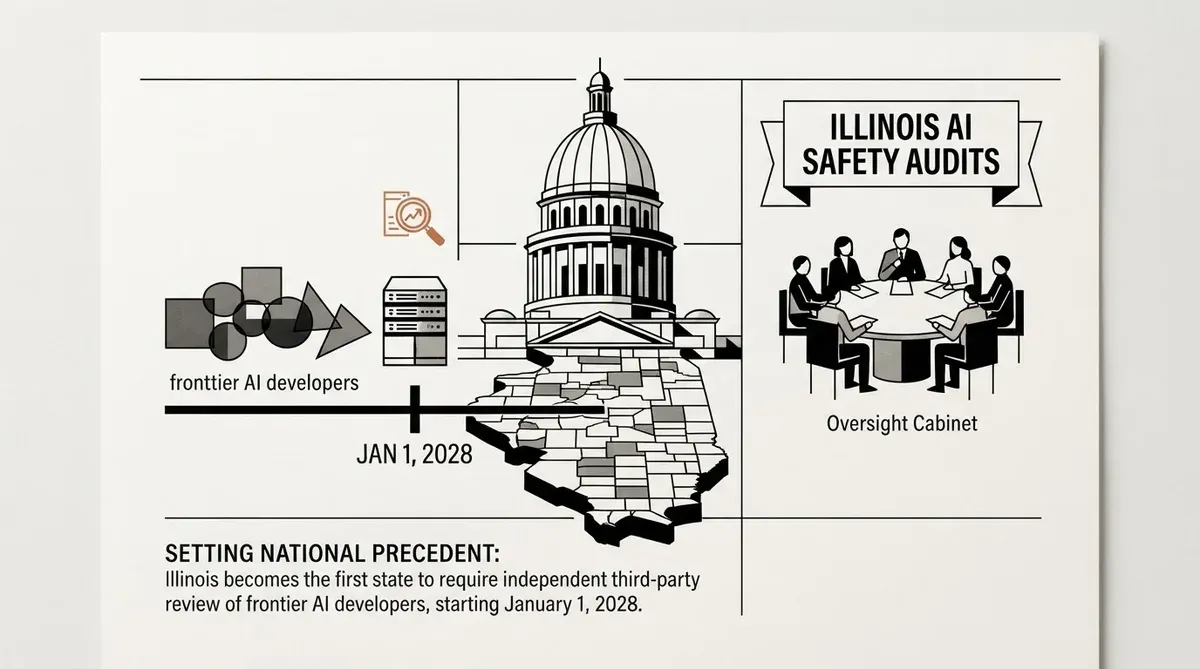
Illinois is the first US state to require independent third-party safety audits of the largest frontier AI developers. Governor JB Pritzker signed SB 0315, the Artificial Intelligence Safety Measures Act, on July 6, 2026, and this week established an Illinois AI Cabinet to assess risks to residents and identify where the state needs new protections. The audit requirement is the part of the law no other state has adopted. It also does not take effect until January 1, 2028, which makes the next 18 months the period when the state's choices about how the audits work will decide how much the mandate is worth.
The cabinet is a coordinating body, not a regulator. It pulls state agencies into a shared assessment of AI risk. The obligations it supports fall on developers of the most capable and costliest models. Under the act, covered firms must disclose their safety practices, report significant safety incidents and maintain documented compliance processes. Employees who raise safety concerns are protected from retaliation, a provision that matters because warnings about model behaviour are most credible when they come from inside a lab.
What the Illinois AI Safety Audits Require
The audit clause is the element other states have not copied. Covered large frontier model developers must retain an independent third party to examine their compliance every year. That reverses the default in AI safety reporting, where developers publish documentation they write themselves and certify their own measures.
The statute requires auditors to be qualified experts who hold no financial conflicts of interest with the developer under review. The clause addresses a known weakness in third-party review: an auditor whose future revenue depends on the firms it inspects has reason to stay lenient. Illinois wrote that constraint into law rather than leaving it to engagement letters, which matters to anyone who relies on an audit report to judge a vendor.
Disclosure and incident reporting carry weight of their own. A developer that must publish its safety practices creates a written record that auditors, regulators and customers can compare against later conduct. An incident-reporting duty gives the state a stream of evidence about failures that would otherwise stay internal. Whistleblower protection closes the loop by giving employees a route to report problems without ending their careers.
How Illinois Compares With California and New York
Illinois is the third state to require frontier model developers to disclose their safety practices, after California and New York. It is the only one of the three to require annual independent audits.
| State | Frontier-model transparency | Independent annual audit |
|---|---|---|
| California | Required | Not required |
| New York | Required | Not required |
| Illinois | Required | Required from January 1, 2028 |
Transparency-first regimes have produced a large volume of published documentation. That documentation has uses: it gives buyers a baseline for comparison and creates a record that can be checked against later behaviour. Its limit is verification. A self-reported disclosure does not show whether the described process was followed, and an incident report covers only what the developer chooses to classify as significant. Illinois is trying to close that gap with an examiner whose findings do not depend on the developer's own judgement.
The distinction is not cosmetic for a lab operating across all three states. Transparency obligations can be met with documents a developer already produces. An audit obligation puts an outside party in a position to examine internal processes and report on them. One annual audit of Illinois compliance will cover much of the ground the same firm documents for California and New York, which makes the state's requirement the binding standard for the group.
For developers, the practical result is that the highest common standard applies. A lab that meets the Illinois audit requirement will have assembled the evidence needed for the transparency duties in California and New York. The reverse is not true. That asymmetry explains why the audit clause has drawn attention well beyond Illinois, and why the state's implementation choices carry weight for firms that do not operate there.
The measure passed with bipartisan support and drew public backing from AI developers, including Anthropic. According to Cesar Fernandez, the company's head of state and local government relations, the independent audit requirement is the provision that sets Illinois apart from other states. Support from a company that will itself be audited is notable.
The 2028 Compliance Clock
The audit obligation begins on January 1, 2028, or 90 days after a developer first qualifies as a covered large frontier developer, whichever comes later. That leaves the largest labs about 18 months from the signing date to build audit trails, select auditors and settle the scope of review with firms that must remain independent of them.
The runway matters because audit capacity at the frontier is likely to be thin. Few organisations combine the technical depth to evaluate training and deployment practices with a clean commercial separation from the developers they would examine. If several large labs need annual reviews on the same calendar, scheduling and fees will be set by that scarcity rather than by competition. Compliance teams face a parallel problem. Much of the evidence an auditor will want was never designed for external inspection and costs more to reconstruct after the fact than to produce as work proceeds.
The developer commissions and pays for the audit. That places the cost with the regulated firm rather than the state, and it puts pressure on the independence clause to do the work a publicly funded model would otherwise do. Large labs can absorb an annual engagement of this kind. Firms approaching the coverage threshold face a different calculation, because the compliance burden arrives at the point where they are scaling into the category the law defines.
Scope will decide how much the audits reveal. Confirming that a documented process exists is a different exercise from testing whether that process worked in practice, and the two demand different evidence, different expertise and different budgets. How the state frames the auditor's remit over the next year will determine which version the first reports reflect.
The practical effect arrives after the next generation of frontier models ships. Systems released during 2027 fall under the disclosure and incident-reporting duties but will not face an outside audit before the deadline. That interval leaves the law's most demanding provision visible but not yet binding, and gives state officials time to settle the operational detail that sits on top of the statute, from reporting formats to audit expectations.
Enterprise procurement is where the requirement could bite first. Companies deploying frontier models in regulated workflows currently lean on voluntary frameworks, model cards and vendor questionnaires, all of which rest on the developer's own account of its practices. An audit report does not make a model safe. It does move part of the evidentiary burden away from the customer. Once Illinois reports exist, buyers elsewhere will ask for them, which extends the law's influence past the state's borders.
Why this matters
Illinois has taken the step California and New York avoided, and it did so while federal legislation on frontier AI safety remains stalled, leaving states to set terms that national labs must meet. The law's force depends on two things that are not yet settled: whether the state defines the auditor's remit broadly enough to test practice rather than paperwork, and whether enough independent reviewers exist to serve the largest labs. For developers, the operative question is how quickly they can produce audit-ready documentation. For enterprise buyers, reports arriving from 2028 will give a narrow but new basis for comparing vendor safety claims that today rest on self-assessment. For other legislatures, Illinois is the template, which makes the state's first audits the test of whether independent review can work at the frontier.
AI-generated image.
Related Articles
- Illinois Mandates Independent AI Safety Audits in Landmark Accountability Law
- Bipartisan Proposal for Great American AI Act Establishes National Oversight Standards
- California AI Audit Laws Signed as Newsom Pushes for National Rules
✔Human Verified
Researched and cross-referenced against primary sources by the Bytevyte editorial team. This article was generated with the assistance of artificial intelligence and reviewed by the Bytevyte editorial team.