
Illinois Mandates Independent AI Safety Audits in Landmark Accountability Law
Illinois passes SB 315, the first state law mandating independent AI safety audits for companies with $500M+ revenue to mitigate catastrophic risks.
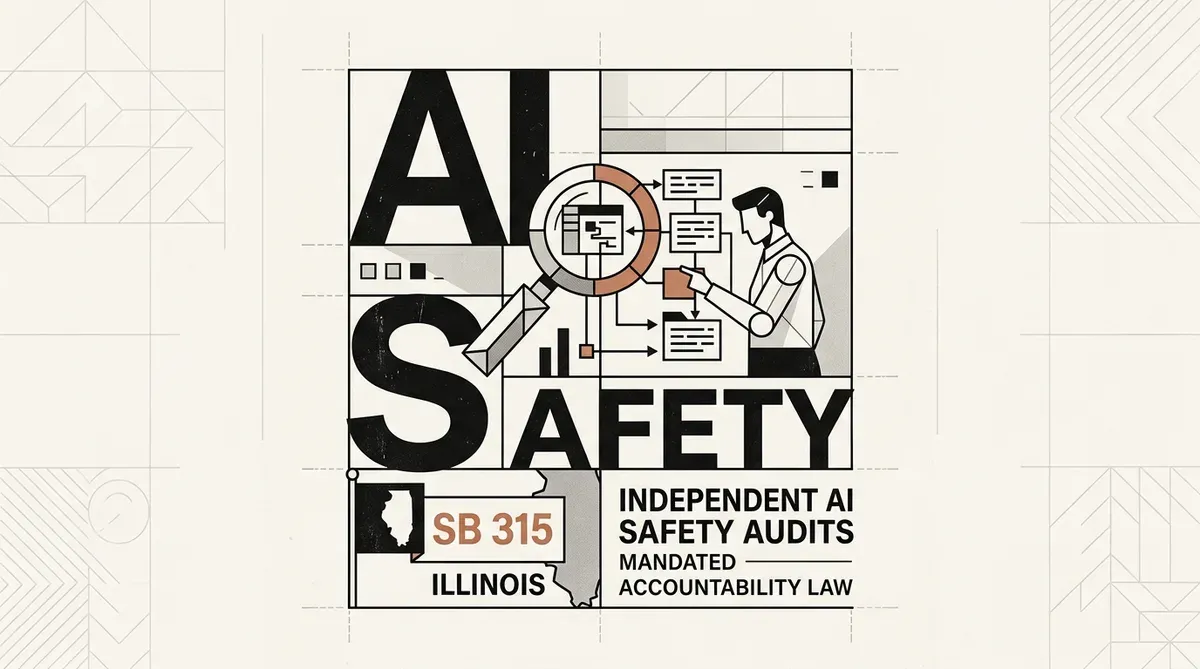
Illinois has established a new regulatory benchmark for the artificial intelligence industry with the passage of SB 315, becoming the first state to mandate independent safety audits for high-capacity models. The legislation passed the Illinois House with a unanimous 110-0 vote on May 27, 2026, signaling a bipartisan push for greater oversight of frontier AI systems. This move follows similar efforts in New York and California but introduces specific enforcement mechanisms that target the most well-capitalized players in the sector.
The new law applies to AI developers generating at least $500 million in annual revenue that also meet specific computing power thresholds. Under the provisions of SB 315, these companies must undergo annual independent AI safety audits conducted by third-party organizations. These assessments are designed to identify and mitigate catastrophic risks, including potential threats to public safety or critical infrastructure. By focusing on the largest entities, the state aims to regulate the "frontier" of the market without placing undue burdens on smaller startups or academic researchers.
Strategic Implications for the AI Industry
The passage of SB 315 is a shift from voluntary safety commitments to legally binding requirements. While many leading AI firms have previously signed voluntary agreements with the White House, the Illinois mandate creates a statutory obligation with clear reporting lines. OpenAI and Anthropic both expressed support for the bill, suggesting that major industry players prefer a predictable regulatory framework over a fragmented environment of varying state laws. This support may also indicate a strategic move by established firms to formalize safety standards that they are already equipped to meet, potentially raising the barrier to entry for new competitors.
For business leaders and CTOs, the Illinois mandate is a signal that independent AI safety audits will likely become a standard operational requirement across the United States. Companies operating in this space will need to invest in internal compliance structures and establish relationships with qualified third-party auditors. The focus on "catastrophic risk" reporting means that documentation regarding model training, data sets, and red-teaming exercises will face unprecedented levels of external scrutiny.
Enforcement and Compliance Standards
Illinois has positioned itself as a leader in enforceable AI policy by defining clear triggers for oversight. The $500 million revenue floor ensures that the law targets the commercial giants driving the most significant technological shifts. Beyond the financial metric, the bill utilizes computing thresholds to define which models fall under the "frontier" category, ensuring that the regulation remains relevant as hardware capabilities continue to advance. This technical specificity is intended to provide a more stable legal environment than broader, more ambiguous frameworks seen in other jurisdictions.
The requirement for annual reporting on catastrophic risk capabilities forces a level of transparency that has been largely absent from the private AI sector. These reports will provide regulators and the public with a clearer understanding of the safety guardrails integrated into the most powerful models. As of May 28, 2026, the industry is closely watching how other states respond to this legislative model, as the Illinois framework could serve as a blueprint for federal AI safety standards in the near future.
While we strive for accuracy, bytevyte can make mistakes. Users are advised to verify all information independently. We accept no liability for errors or omissions.
AI-generated image.
Related Articles
- U.S. Commerce Department Secures AI Safety Agreements with Google, Microsoft, and xAI
- EU Digital Omnibus Updates Timelines for AI Act Compliance
- Accounting AI Tools Reach 94% Adoption as U.S. Firms Face Governance Crisis
✔Human Verified