
EU Digital Omnibus Updates Timelines for AI Act Compliance
The EU Digital Omnibus updates AI Act compliance timelines for high-risk systems and provides administrative relief for small and mid-cap companies.
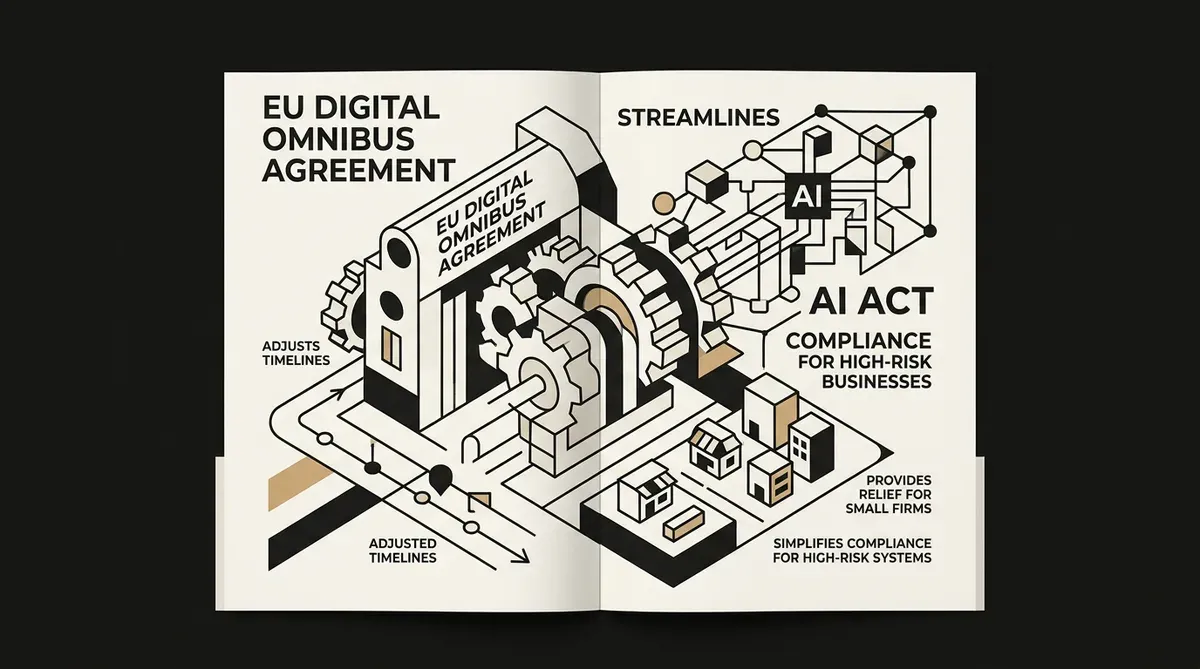
The European Union has finalized a political agreement on the Digital Omnibus. This legislative package modifies the implementation of the AI Act to assist smaller businesses and adjust regulatory schedules. These changes, confirmed this week, move compliance dates for high-risk systems and consolidate enforcement authority within the EU AI Office. The revisions are intended to accommodate technical development cycles as of May 22, 2026.
The Digital Omnibus changes the deadlines for high-risk AI systems (HRAIS). Developers of standalone high-risk applications have until December 2, 2027, to meet full regulatory requirements. For embedded systems, including those found in physical machinery or consumer products, the deadline is now August 2, 2028. These extensions allow manufacturers more time to integrate safety and transparency protocols into their production workflows.
Administrative Relief for Small and Mid-Cap Companies
The agreement includes specific exemptions for small and mid-cap companies (SMCs). These provisions lower the administrative requirements for smaller firms that often operate with fewer legal resources than large technology corporations. This policy aims to protect startup growth while maintaining safety standards. By reducing these burdens, the EU intends to support regional competitiveness during the transition to full AI Act compliance.
Supervision is now more centralized. The EU AI Office is the primary authority for cross-border guidance and legal enforcement. This structure creates a uniform regulatory environment across all member states. Businesses that operate in multiple European markets can follow a single set of interpretations, which simplifies the process of maintaining AI Act compliance.
Rules for AI-generated content are now stricter. The grace period for adding transparency markers, such as watermarks or metadata for synthetic media, is three months instead of six. This shorter window reflects regulator concerns regarding the rapid spread of synthetic content. Companies that build generative models must implement these technical safeguards on an accelerated schedule.
The Digital Omnibus is a technical update to existing European policy. The fundamental goals of the AI Act remain the same, but the new timelines and SMC rules address the economic costs of compliance. Organizations should review their product roadmaps against these updated dates. The EU AI Office will next publish technical standards to define the metrics for mandatory conformity assessments.
While we strive for accuracy, bytevyte can make mistakes. Users are advised to verify all information independently. We accept no liability for errors or omissions.
AI-generated image.
Related Articles
- AWS Debuts Open-Source Compute Tracker to Simplify EU AI Act Compliance for SageMaker Users
- U.S. Commerce Department Secures AI Safety Agreements with Google, Microsoft, and xAI
- Earlybird Venture Capital Closes Record €360 Million Fund for AI and Deeptech
✔Human Verified