
Rising Enterprise AI Spending Forces Strategy Shift at Microsoft and Uber
Microsoft and Uber rethink enterprise AI spending as costs for agentic workflows rise and productivity gains stall, leading to budget exhaustion.
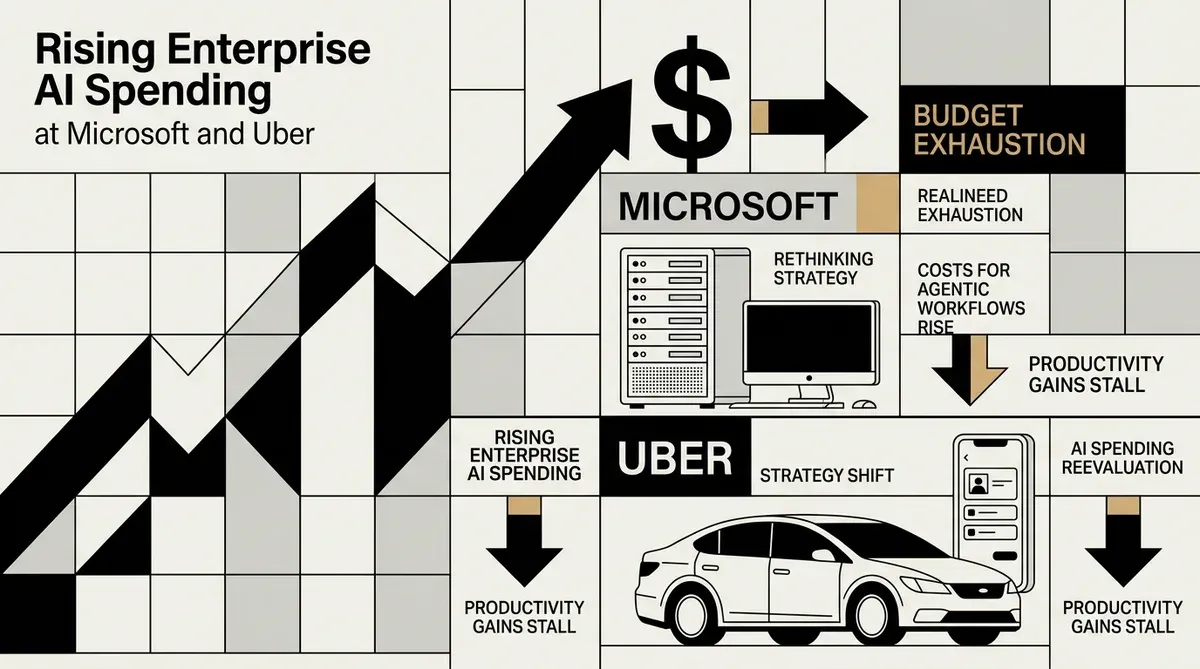
Microsoft and Uber are reevaluating their enterprise AI spending as the operational costs of advanced models begin to outpace immediate productivity gains. This shift comes as organizations discover that agentic workflows, which perform complex sequences of tasks, require significantly more computational resources than standard chatbots. Recent internal data suggests these automated processes consume between 5 and 30 times more tokens than traditional conversational interfaces, leading to unexpected budget exhaustion across major tech firms.
The financial strain of maintaining high-end model access is becoming a central concern for corporate strategists. Estimates indicate that providing employees with access to top-tier artificial intelligence tools costs between $1,500 and $5,000 per user annually. In some instances, the expense of these digital tools has surpassed the cost of human labor for the same tasks. This economic reality is forcing a transition from subsidized flat-fee models to metered, token-based pricing structures for corporate clients.
Budget Exhaustion and Internal Transitions
Uber recently experienced the impact of these rising costs firsthand. After deploying a large-scale rollout to 5,000 engineers, the company exhausted its entire 2026 AI budget in just five months. This rapid consumption of funds highlights the difficulty of predicting enterprise AI spending when utilizing autonomous agents that operate with high token intensity. The mismatch between allocated capital and actual usage is prompting a broader industry rethink regarding self-funding models that rely on immediate savings to justify upfront infrastructure investments.
Microsoft is also adjusting its strategy to manage escalating expenses. The company has instructed thousands of its engineers to stop using Claude Code, a tool developed by Anthropic, in favor of internal alternatives. Management set a deadline of June 30, 2026, for this transition to be completed. By moving technical staff to proprietary systems, the organization aims to reduce reliance on external providers and better control the margins of its development environment.
Strategic Implications for the AI Market
The current challenges suggest that the path to realizing significant business value from these technologies may span five to ten years, rather than the immediate turnaround many anticipated. While token prices are falling, the sheer volume of data processed by agentic systems keeps total expenditures high. Enterprises are finding that the initial infrastructure requirements are massive and immediate, while the return on investment remains a long-term prospect.
This environment is driving a move toward more sustainable deployment strategies. Companies are increasingly looking at specialized internal tools rather than general-purpose high-cost models for routine engineering tasks. As the industry moves past the initial hype phase, the focus is shifting toward rigorous cost-benefit analysis and the development of more efficient workflows that can deliver results without overwhelming corporate treasuries.
While we strive for accuracy, bytevyte can make mistakes. Users are advised to verify all information independently. We accept no liability for errors or omissions.
AI-generated image.
Related Articles
- EY and Microsoft Commit $1B to Accelerate Enterprise Agentic AI Adoption
- Meta, Microsoft Cut Staff for AI infrastructure investments
- Cloudflare and Upwork Cut Staff to Accelerate Pivot Toward Agentic AI Models
✔Human Verified