
Empery Digital Bitcoin Sale: $87M for AI Data Center Pivot
Empery Digital Bitcoin sale raises $87.1M as Nasdaq-listed firm pivots from BTC treasury to AI data center, selling 1,400 Bitcoin for the transition.
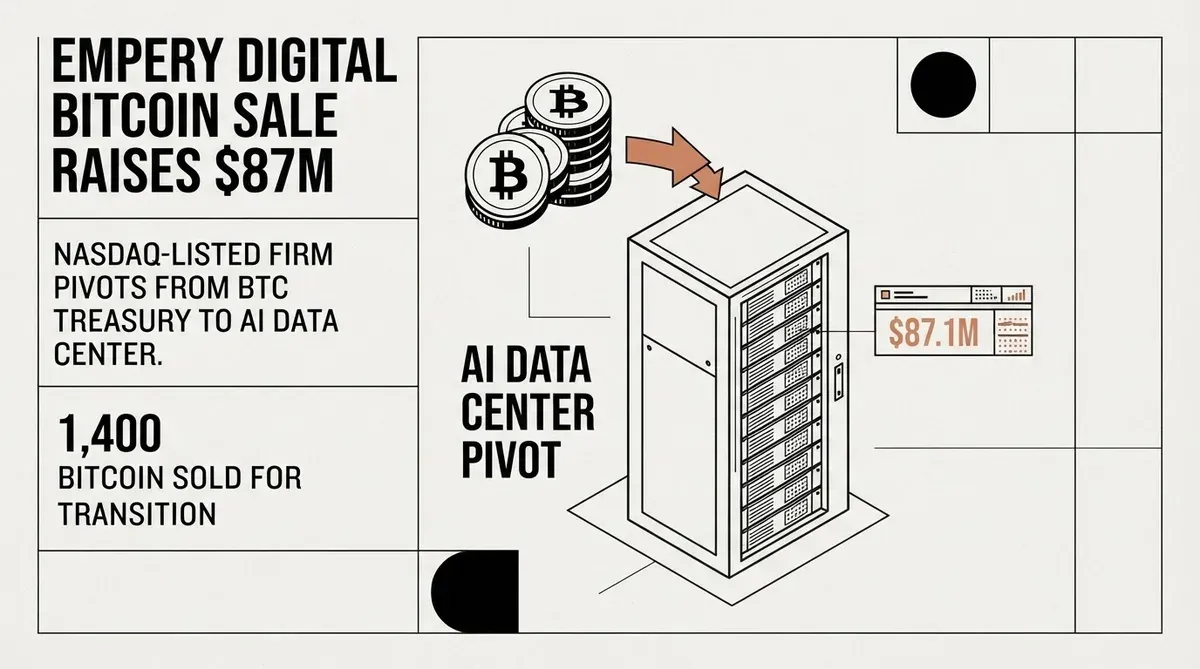
Empery Digital has sold nearly half its Bitcoin stash to finance a strategic pivot into AI data center infrastructure, raising $87.1 million by liquidating 1,400 BTC at an average price of $62,200 per coin between May and early July 2026. The Nasdaq-listed company, which rebranded from electric vehicle maker Volcon to a Bitcoin treasury firm in July 2025, now plans to redirect capital toward hyperscaler-anchored data center projects rather than accumulating more digital assets. The sale and the strategic shift raise a direct question: was the corporate Bitcoin treasury model ever sustainable beyond the 2024-2025 bull run?
The proceeds from the Empery Digital Bitcoin sale are allocated across several priorities. A $10 million portion repaid outstanding debt on July 7. The largest tranche of $65 million funds a 25% ownership stake in a consortium acquiring a 150-megawatt facility in the Midwest, developed alongside Hunt Properties and members of the Hunt and Crow families. That facility is slated for conversion into an AI data center with potential to double capacity to nearly 300 MW. Additional cash covers legal expenses from shareholder lawsuits and general operating costs.
Empery Digital Bitcoin Sale Details
The company still holds 1,514 BTC on its balance sheet, but it has explicitly stated it will not accumulate more and may sell additional coins to fund future opportunities. Empery Digital is also discontinuing its Bitcoin treasury dashboard, a small but symbolic move that signals the end of its identity as a crypto treasury firm. Co-CEO Ryan Lane said the company will continue allocating capital to hyperscaler-anchored opportunities going forward.
The total proposed AI data center campus carries an estimated $1 billion price tag. The Midwest location, with its access to energy infrastructure and land, positions the project to serve the large cloud providers that have been competing for compute capacity to train and run AI models. The 25% stake gives Empery Digital exposure to that demand without the operational burden of building the facility from scratch.
A Company in Search of Identity
Empery Digital's corporate history is a case study in rapid strategic reinvention. The company began as Volcon, an electric vehicle manufacturer that went public through a SPAC merger. In July 2025, at the peak of the corporate Bitcoin treasury frenzy, it rebranded and repositioned itself as a digital asset treasury company. Less than a year later, it is pivoting again, this time toward AI data center infrastructure.
The speed of these transitions reveals how quickly capital markets have shifted their enthusiasm. The same SPAC structure that enabled Volcon to go public and then rebrand as a Bitcoin treasury firm now provides the vehicle for an AI infrastructure play. Each pivot has followed the prevailing narrative in financial markets, raising questions about whether the company has an independent strategic vision or is simply chasing trends.
Empery Digital was part of a wave of hastily formed SPAC deals that rebranded as Bitcoin treasury companies during the 2025 bull run. The results for that cohort have been dire. Most comparable firms have seen their share prices collapse by 90% or more from their 2025 highs. Empery Digital's own stock (EMPD) did rise on the news of the Bitcoin sale, suggesting investors viewed the pivot to AI more favorably than continued Bitcoin accumulation.
The Bitcoin Treasury Thesis Under Pressure
The corporate Bitcoin treasury model gained mainstream traction when Strategy (formerly MicroStrategy) began accumulating large Bitcoin positions in 2020, viewing the cryptocurrency as a superior store of value to cash. The strategy was widely imitated during the 2024-2025 bull run, with dozens of companies, many formed through SPAC mergers, adopting similar approaches.
Empery Digital's exit from that strategy is significant because it reveals a structural weakness. When a company's stock price collapses and it needs capital, its most liquid asset is often the Bitcoin it was holding as a strategic reserve. Selling BTC to fund operations, debt repayment, or new investments turns the treasury thesis on its head. Instead of being a store of value that supports the business, Bitcoin becomes a piggy bank to be cracked open in times of stress.
The broader trend of crypto-adjacent firms liquidating digital assets to fund AI infrastructure investments suggests that institutional capital sees stronger returns in the physical infrastructure underpinning AI than in holding Bitcoin as a treasury asset. Multiple companies have made similar moves in recent months, creating a pattern that goes beyond isolated corporate decisions.
AI Infrastructure vs. Digital Gold
The trade-off between Bitcoin treasury management and AI data center investment is becoming an increasingly common calculation for public companies. On one side sits the Bitcoin thesis: BTC as a hedge against monetary debasement, with historical returns that have outperformed most traditional asset classes. On the other side sits the AI infrastructure thesis: physical assets with clear revenue models, long-term contracts with hyperscaler tenants, and direct exposure to the most capital-intensive growth story in technology.
For Empery Digital, the choice was shaped by necessity. The company needed $65 million to close its data center deal. Its stock price had fallen sharply, limiting its ability to raise equity on favorable terms. Selling Bitcoin was one of the few available sources of liquidity. The market reacted positively; the stock price increased on the news, validating the decision in the short term.
But the move also carries risks. AI data center development is capital-intensive, with long construction timelines and exposure to energy markets and regulatory approvals. The 25% stake gives Empery Digital meaningful downside if the project faces delays or if demand for AI compute capacity softens. The company is trading a liquid, easily valued asset for an illiquid, complex infrastructure project.
What Remains
Empery Digital retains 1,514 BTC, worth roughly $94 million at current prices near $62,000. But the company has made clear it views that position as a declining legacy rather than a core strategy. It has no plans to add more Bitcoin and may sell additional coins to fund further AI-related investments. The treasury dashboard is being shut down.
The company's future, if its current strategy holds, lies in AI infrastructure. Whether that pivot proves more durable than its brief identity as a Bitcoin treasury firm will depend on execution, market conditions, and the trajectory of AI compute demand. The SPAC structure that has carried the company through three identities in under two years provides the flexibility to pivot again, but it also raises questions about strategic depth.
Why This Matters
Empery Digital's move from Bitcoin treasury to AI data center investor is not an isolated corporate decision. It is a signal about where capital markets see the real growth. The willingness to liquidate a digital asset position built during a bull run to fund physical infrastructure speaks to the premium investors are placing on AI exposure over crypto exposure. For other companies still holding Bitcoin on their balance sheets, the question is whether their own shareholders would reward a similar pivot. The broader corporate Bitcoin treasury thesis, which once seemed like a permanent feature of the post-2020 era, now looks more like a bull market phenomenon that is being unwound as capital flows toward AI.
AI-generated image.
Related Articles
- TeraWulf Anthropic Data Center Lease: $19 Billion Deal
- Nebius Strengthens AI Infrastructure with $643 Million Acquisition of Eigen AI
- Alphabet Secures Record $80 Billion to Accelerate AI Infrastructure Expansion
✔Human Verified
Researched and cross-referenced against primary sources by the Bytevyte editorial team.