
Arcee AI Series B Lands $150M at a $1B Valuation as Open-Weight Models Win Enterprise Budgets
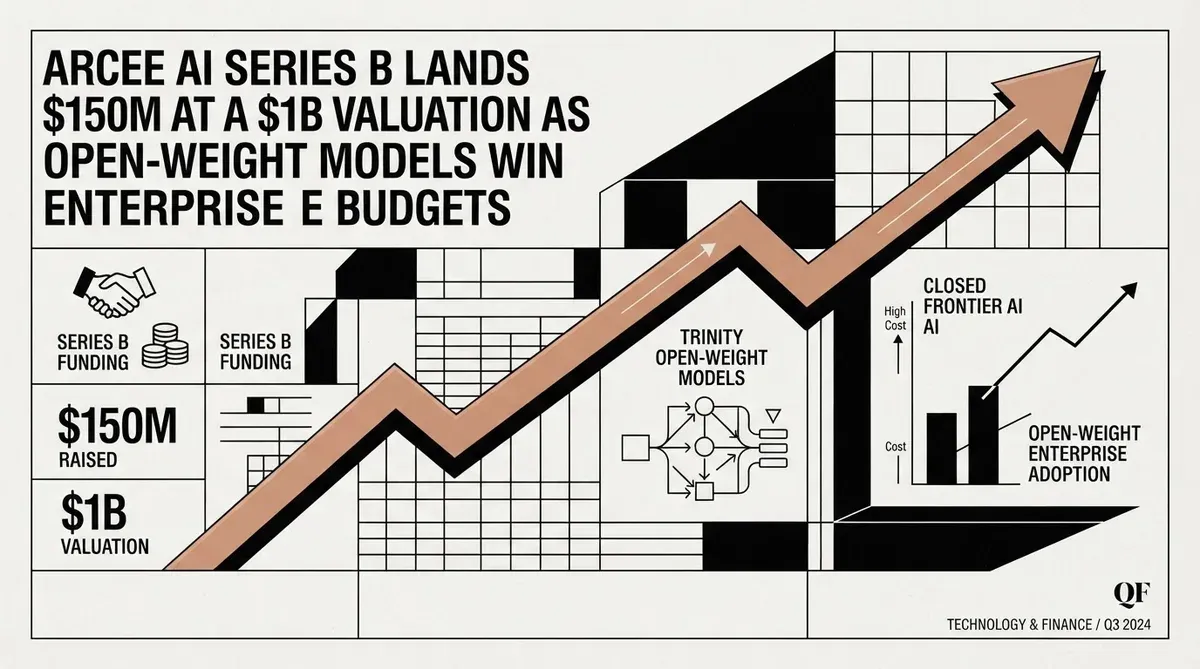
Arcee AI has closed a funding round that values the San Francisco open-weight model developer above $1 billion, converting a model program built for roughly $20 million into a billion-dollar enterprise AI vendor. The Arcee AI Series B was led by Vista Equity Partners, Cambium Capital and Emergence Capital, with Microsoft's M12, AI10 Ventures, Hitachi, IAG, P7 and Wipro taking part. Arcee states the capital will fund its next generation of frontier open-weight models and widen its work with the U.S. Department of Energy.
The round was announced on 16 September 2026. Arcee describes the valuation as above $1 billion; the pre-money figure is reported at $1 billion and the round size at at least $150 million, a number the company has not confirmed. Earlier in the year Arcee was seeking more than $200 million at a valuation north of $1 billion, so the closing amount sits at the low end of its own target. The distance between the two numbers is the interesting part: a lab that spent about $20 million building four models in 2025 is now priced at roughly 50 times that outlay.
Cost is the technical claim underneath the price. Nvidia's case study of the company documents Arcee training Trinity-Large-Thinking on 2,048 Nvidia B300 GPUs and reaching about $0.90 per million tokens of inference cost, which Nvidia frames as roughly 20 times cheaper than closed frontier models. Arcee's largest published system, Trinity Large, is a 400-billion-parameter sparse mixture-of-experts model that activates around 13 billion parameters per token, an architecture built to lower serving cost, with peak capability as the trade.
| Metric | Figure |
|---|---|
| Series B size | At least $150 million (not confirmed by Arcee) |
| Valuation | $1 billion pre-money; above $1 billion per Arcee |
| Largest published model | Trinity Large, 400B parameters, sparse mixture-of-experts |
| Active parameters per token | About 13 billion |
| Training hardware | 2,048 Nvidia B300 GPUs (Trinity-Large-Thinking) |
| Inference cost | About $0.90 per million tokens |
| Cost comparison | Roughly 20x cheaper than closed frontier models, per Nvidia |
| 2025 model lineup build cost | About $20 million |
What the Arcee AI Series B Is Really Pricing
Enterprise buyers weigh two things: capability at the top of the curve and cost per unit of work. Arcee competes almost entirely on the second. A workload of 200 million tokens a day costs about $65,000 a year at the stated $0.90 rate, while the same volume at closed frontier pricing lands near $1.3 million. For document processing, code assistance, internal search and support automation, that difference usually settles the procurement decision.
At $1 billion pre-money plus $150 million of new capital, the post-money figure lands near $1.15 billion. Because the earlier target was a larger raise at a similar valuation, the final terms suggest the round was priced on the existing Trinity line, with the trillion-parameter successor still to come.
The announcement covers more than training runs. Arcee's stated use of proceeds includes the infrastructure that supports deployment, which matters because serving a model at $0.90 per million tokens takes a capacity plan of its own: GPU allocation, request batching, and the tooling that carries a customer from evaluation to production. For an enterprise weighing self-hosting, that support layer is often what decides the decision, since the weights themselves are the easy part to obtain.
Provenance is the second lever. Arcee positions the Trinity family as an American alternative to the Chinese open-weight leaders whose releases dominate open-model leaderboards and create procurement friction for government and regulated buyers. Arcee's models have posted results ahead of Meta's Llama 3 in published evaluations and comparable to Mistral and leading Chinese releases, which is the benchmark position this round is buying.
The Department of Energy work shows where open weights beat hosted APIs. National labs and regulated agencies need models they can run on their own hardware, with weights they can inspect and retain, and procurement rules increasingly favor domestic supply chains. An open release fits that requirement in a way a foreign-hosted API cannot.
The investor list points to distribution. Wipro and Hitachi sell into large enterprise accounts, IAG brings a regulated customer base, and Microsoft's M12 links Arcee to a hyperscaler ecosystem even though Microsoft sells competing frontier models of its own.
Where the Trade-Offs Bite
Open weights are non-rival. Once Trinity is published, any cloud provider, consultancy or rival lab can host it, so Arcee cannot charge for the model itself. Revenue has to come from deployment, fine-tuning, integration and support, which is services economics rather than software margins.
Chinese labs anchor the price of open weights near zero. DeepSeek and Moonshot release frontier-class weights without license fees, leaving Arcee to sell trust, provenance and support, since the weights themselves are free to host. That is a defensible position with government customers and a thin one with cost-driven enterprises.
Self-hosting also shifts the refresh cycle onto the buyer. A closed API improves underneath a stable endpoint, while open weights freeze at the version a customer deploys, so teams must re-qualify a new checkpoint each time Arcee ships one. That maintenance cost is real and rarely appears in the per-token comparison that makes open weights look 20 times cheaper.
Capability at the very top of the market is a separate constraint. Closed models still lead the hardest reasoning and agentic workloads, and a sparse design that activates 13 billion parameters keeps serving costs down at the expense of top-end performance. Arcee has pitched investors on training a model above one trillion parameters, a run that $150 million does not obviously fund.
Concentration is the last exposure. A single Department of Energy relationship and a small set of enterprise design partners carry much of the near-term revenue signal, and government priorities move with budget cycles.
The round does fund more than seven times the entire 2025 model-building budget, which frames what the money is for: compute, evaluation runs and deployment engineering, not a broader research organization. Open-weight vendors also avoid the gross-margin trap of serving every request themselves, because the customer pays for the compute. That is the strongest part of the bull case.
The Verdict for Buyers and Investors
Open weights make sense where four conditions hold at once:
- Inference volume is high enough that per-token cost dominates the budget.
- Data cannot leave the premises or a specific jurisdiction.
- The workload sits below the frontier, so a model with 13 billion active parameters is sufficient.
- An internal team can run and maintain the deployment.
They make less sense for frontier reasoning research, for teams without infrastructure, and for buyers who want a vendor to carry operational risk. For buyers, the practical step is a bounded pilot: run one high-volume, non-frontier workload on Trinity weights and compare the fully loaded cost, including staff time, against the incumbent API bill.
For investors, the wager is that open-weight deployment becomes the default enterprise pattern and that Arcee owns the layer which packages and supports it. The valuation prices distribution and trust, not the weights themselves. The test is whether Arcee converts its investor roster into contracted deployments before a cheaper or stronger open model resets the comparison. The next milestone to watch is whether the company ships a successor to Trinity Large and whether the Department of Energy relationship moves from pilot programs into production deployments.
Why this matters
The Arcee AI Series B is a test of whether capital will reward cheaper inference over ever-larger closed models. If enterprise buyers keep moving high-volume, non-frontier workloads onto self-hosted open weights, the economics behind this valuation will spread across the market. If they stall, a $1 billion price on a $20 million model program looks like a wager on procurement and provenance that measured performance has yet to justify.
Sources
How Arcee AI Trained a Frontier Open Model on NVIDIA Blackwell | NVIDIA case study
AI-generated image.
Related Articles
- Open-weight inference is the next AI value layer
- AI Funding Tracker: 18 Deals Led by Fireworks AI's $1.5B Round
- Thinking Machines Lab's Inkling Open-Weights AI Model Bets Against One-Size-Fits-All AI
✔Human Verified
Researched and cross-referenced against primary sources by the Bytevyte editorial team. This article was generated with the assistance of artificial intelligence and reviewed by the Bytevyte editorial team.