
Open-weight inference is the next AI value layer
Fireworks AI's $1.5B Series D at a $17.5B valuation shows open-weight inference is AI's next margin layer, with Together AI's $800M round close behind.
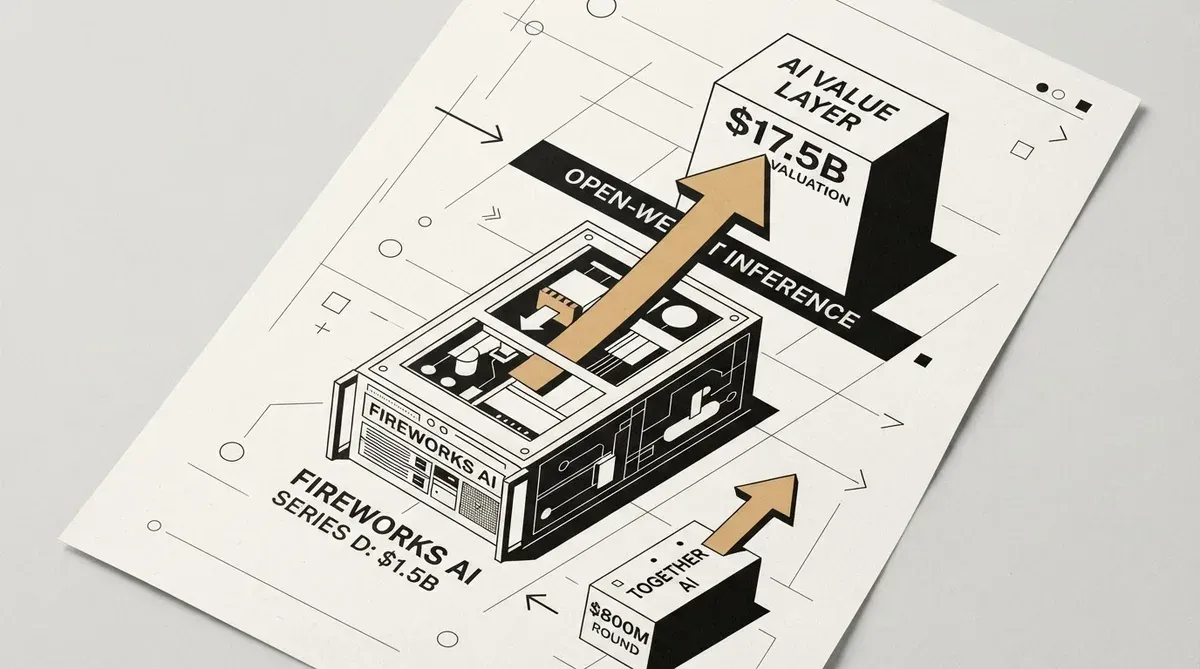
Fireworks AI said it has closed a $1.505 billion Series D at a $17.5 billion valuation, roughly a 4.4x step-up from the $4 billion it reported in October 2025. The round closed in mid-July 2026, with annual recurring revenue past $1 billion, up 5x year over year, according to the company. Fireworks also reports that more than 95% of the roughly 40 trillion tokens it serves daily come from models specialized on customer data. Together, the figures make open-weight inference the most likely site of AI's next durable margins, and they are the clearest signal yet that venture capital is moving past foundation model training.
The raise sits inside a broader reallocation of AI capital. Fewer, larger checks now flow to inference infrastructure and purpose-built vertical software, and both Fireworks and Together AI fit that pattern.
Why open-weight inference commands this valuation
Fireworks runs an infrastructure layer that lets enterprises fine-tune general-purpose or open-weight models on proprietary data and serve them in production, without standing up training or inference clusters in-house. Customers reach the customized models through an OpenAI-compatible API. The commercial pitch is that a specialized model can match or outperform a general closed model on the tasks a business actually runs, while delivering lower latency and lower cost than a generic hosted call.
Fireworks lists Uber, Shopify, Doximity, Elastic, GitLab, and MongoDB as customers. Legal AI firm Harvey and coding tool Cursor have built on top of the platform. The company said the Series D proceeds will fund compute capacity, engineering and go-to-market hiring toward roughly 600 employees by the end of 2026, and deeper cloud partnerships with Microsoft and Nvidia. Index Ventures and TCV, both existing backers, took part in the round.
The vertical dimension explains part of the momentum. Harvey in legal and Cursor in coding are exactly the kind of specialized applications that open-weight inference enables, and both are built on Fireworks. The OpenAI-compatible API keeps switching costs low at the interface, which lets teams start on the platform without rewriting their integration layer. That combination, a familiar API surface with a cheaper serving backend, is the wedge inference clouds are using against frontier endpoints.
The past month's two rounds put the repricing in direct comparison. Together AI, which competes for the same open-weight inference customers, said it closed an $800 million Series C at an $8.3 billion valuation. The round is backed by a coalition that includes Aramco Ventures and Nvidia.
| Company | Round | Amount | Valuation | Backers |
|---|---|---|---|---|
| Fireworks AI | Series D, July 2026 | $1.505B | $17.5B | Index Ventures, TCV |
| Together AI | Series C, August 2026 | $800M | $8.3B | Aramco Ventures, Nvidia |
The backer mix matters as much as the sizes. Nvidia investing in Together AI is a bet on its own GPUs: every specialized model served through the platform consumes accelerator capacity. Aramco Ventures brings state-linked and energy capital with no stake in closed frontier labs, and sovereign buyers treat open-weight sovereignty as a procurement requirement. The two investors signal that the open-weight inference layer is becoming a strategic asset with sovereign and supply-chain dimensions.
The two rounds, read together, reframe the balance of power in AI infrastructure. The open-weight layer now has a funding base large enough to build out independent compute capacity. Enterprises that do not want their inference tied to a single frontier lab have a funded alternative, and the market has put a combined valuation of roughly $26 billion on the two leading providers of it.
Managed serving versus running your own stack
The managed premium has a limit. Open-source serving stacks have matured, and teams with strict data-residency or air-gap requirements can operate inference themselves. For those teams, self-hosting is a deliberate cost choice rather than a technical compromise.
The $17.5 billion bet is that those teams remain the minority of the market. Fireworks is one of several providers reporting demand concentrated in open-weight inference; Together AI is chasing the same customers with the same tools. Baseten rounds out the inference-cloud segment, and the three companies now compete on throughput, latency, and the depth of their fine-tuning tooling. The competition cuts both ways: it disciplines pricing for buyers, and it keeps margin pressure on the providers.
The split between managed and self-hosted inference is becoming a market segmentation. Teams that value speed to production, guaranteed throughput, and support will pay the managed premium. Teams under regulatory data constraints, or those running air-gapped environments, will keep absorbing the operational cost of running their own stack. The funding round is a bet that the first group grows faster than the second, and that the cost gap between the two options stays wide enough to justify the premium.
What the repricing changes
Two mega-rounds in consecutive weeks have effectively revalued the GPU-cloud layer that underpins open-weight inference. At roughly 17.5x annual recurring revenue, the Fireworks valuation prices in a serving business compounding faster than the broader software market, and it prices in the assumption that frontier API pricing keeps pushing enterprises toward specialized alternatives.
The use of funds sketches the competitive posture. Compute expansion is a direct response to demand, and the stated deepening of cloud partnerships with Microsoft and Nvidia puts Fireworks inside the two largest distribution channels for enterprise AI. Supporting open-weight and frontier architectures concurrently, as the platform does, means the company can serve whichever model class wins any given workload, which hedges the bet on open weights themselves.
The financial picture behind the multiple is strong for a round of this size. Annual recurring revenue of $1 billion, up 5x year over year, puts Fireworks among the fastest-growing infrastructure businesses of the current AI cycle. That growth rate is what makes a 17.5x revenue multiple look defensible, and it explains why established backers such as Index Ventures and TCV participated alongside the new capital.
Open-weight models are turning inference into a control point. The weights are free, but the route to production runs through a serving layer that can price for performance, reliability, and data handling. Whoever owns that route owns the enterprise relationship, and the latest rounds say the market believes that route is worth more than any single model license. For a CTO comparing procurement options, the practical question has shifted from which model to pick to which serving layer to commit to.
The risks in the thesis are visible in the round's own numbers. Serving roughly 40 trillion tokens a day is capital-intensive, and the Series D is largely earmarked for compute, which means utilization and pricing discipline will decide whether the margin story holds. Specialized models can only beat closed frontier models while the underlying open weights stay competitive; if the frontier keeps pulling ahead, the cost advantage narrows. The inference clouds also compete with each other on price, which can compress the very margins the valuation assumes.
Why this matters
For enterprise buyers, the procurement calculus has changed: a funded, competitive alternative to frontier API pricing now exists, and the capital behind it gives specialized open-weight inference staying power. For investors and founders, the Fireworks and Together rounds define where the next cycle of AI value accrues: in the layer that turns open weights into production systems, with the foundation-model training bill now left to a shrinking number of labs. The repricing of that layer, at $17.5 billion for Fireworks and $8.3 billion for Together AI, is the defining financial signal of the current AI cycle.
AI-generated image.
Related Articles
- Fireworks AI Series D Funding: $1.5B Raised at $17.5B Valuation as ARR Hits $1B
- Together AI $800 Million Funding Round Fuels Open-Source AI Cloud Platform Growth
- Thinking Machines Lab's Inkling Open-Weights AI Model Bets Against One-Size-Fits-All AI
✔Human Verified
Researched and cross-referenced against primary sources by the Bytevyte editorial team. This article was generated with the assistance of artificial intelligence and reviewed by the Bytevyte editorial team.