
Fireworks AI Series D Funding: $1.5B Raised at $17.5B Valuation as ARR Hits $1B
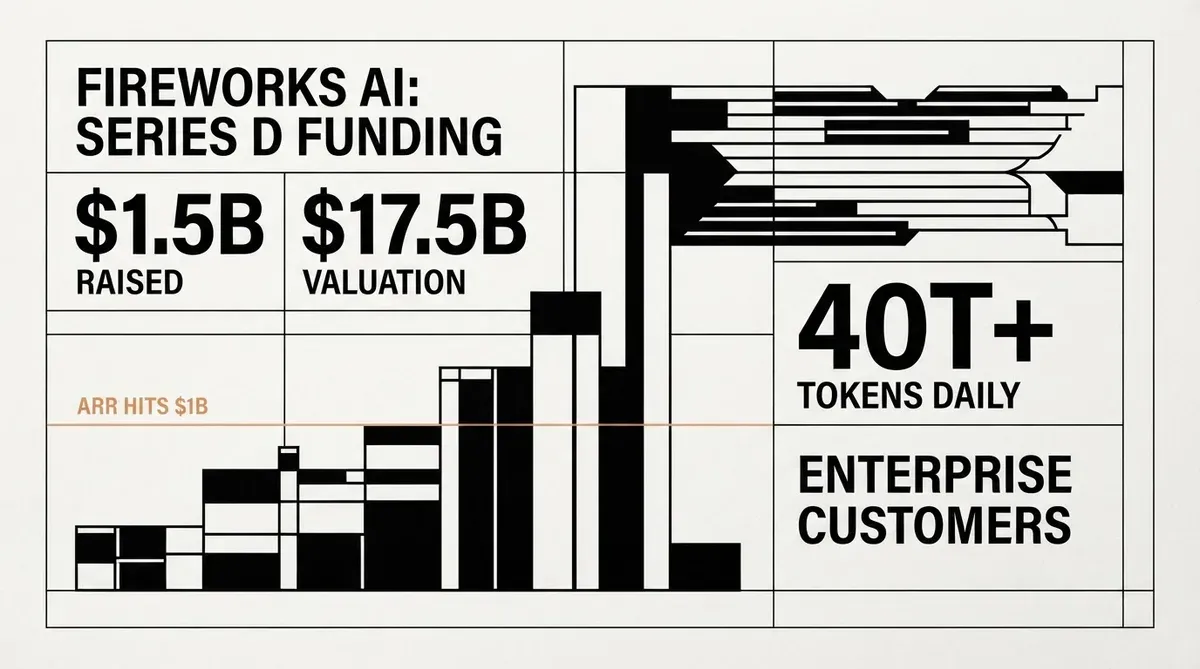
Fireworks AI Series D funding has closed at $1.505 billion, giving the AI infrastructure startup a $17.5 billion valuation and placing it among the largest private capital raises in the sector this year. The San Mateo-based company, which provides cloud infrastructure for running and customizing open-source AI models, announced the milestone alongside crossing $1 billion in annualized revenue, a fivefold increase from the prior year.
The round was co-led by Atreides Management, Index Ventures, and TCV. Participants included Nvidia, Lightspeed Venture Partners, Bessemer Venture Partners, Insight Partners, Menlo Ventures, Evantic Capital, 20VC, Ontario Teachers' Pension Plan, and Lone Pine Capital. Nvidia has been an ongoing backer of the company since earlier rounds, reinforcing the alignment between the GPU giant and the open-model ecosystem.
The Open-Source Inflection Point Behind the Fireworks AI Series D Funding
The round arrives at a moment when enterprises are increasingly shifting from proprietary AI models toward open-weight alternatives. Fireworks sits at the center of this transition, offering a platform that lets companies deploy, fine-tune, and serve models like Llama, Mistral, and others on their own data, at a cost advantage the company pegs at 5 to 10 times cheaper than equivalent closed models from providers such as OpenAI or Anthropic.
The startup now processes more than 40 trillion tokens daily across its infrastructure, up from 15 trillion tokens per day over the same stretch last year. Of those tokens, over 95% come from models that have been specialized on customers' proprietary data, a metric that highlights how deeply the platform is embedded in enterprise workflows rather than generic inference workloads.
Founded in 2022 by Lin Qiao and six other former Meta engineers, Fireworks has built a customer roster that includes Uber, Shopify, Doximity, Elastic, GitLab, and MongoDB. The company once generated more than half its revenue from coding startup Cursor alone, but it has since diversified its client base as adoption of open models has broadened across industries. The annualized revenue figure, at more than $1 billion, is roughly a tenfold increase over the past 16 months, according to internal team statements.
Revenue Trajectory and Scale
Crossing $1 billion in annualized revenue places Fireworks in an elite tier among private AI infrastructure companies. The fivefold year-over-year growth reflects both the volume of tokens flowing through the platform and the stickiness of the specialized model layer the company helps build. Unlike raw GPU rental providers, Fireworks differentiates by offering tooling for customization and optimization on top of compute, a higher-margin position in the AI stack.
The company plans to use the new capital to expand its engineering team and increase global compute capacity, which likely means additional GPU acquisitions and expanded data center footprint. With Nvidia as both an investor and a strategic hardware partner, Fireworks is positioned to secure access to next-generation accelerators as enterprise demand continues to outpace supply. The hyperscalers, including Amazon Web Services and Google Cloud, also compete in this space, but Fireworks argues its focus on open-model optimization gives it a performance-per-dollar edge that general-purpose cloud GPU rentals cannot match.
The fundraising environment for AI infrastructure remains aggressive despite broader venture capital headwinds. Fireworks' $17.5 billion valuation while still private places it ahead of most standalone AI application companies and within striking distance of larger infrastructure peers. By comparison, investors have valued Anthropic and OpenAI above $800 billion each this year, underscoring the wide gulf between the frontier model layer and the infrastructure layer that serves it.
Why Specialized Models Drive the Business Model
The strategic thesis behind Fireworks is that enterprises will not rely on a single general-purpose frontier model. Instead, they will run multiple specialized models tuned on proprietary data, each optimized for a specific task such as sales prediction, fraud detection, code generation, or customer support. Fireworks calls this approach specialized intelligence, a model shaped by the knowledge that only one business holds.
This philosophy stands in contrast to the all-in-one model strategy pursued by OpenAI and Anthropic. For CFOs and procurement teams, the appeal is straightforward: specialized open models on Fireworks can deliver comparable or superior performance on narrow tasks at a fraction of the cost. With 95% of Fireworks' daily tokens originating from customized models, the market data suggests the thesis is resonating with enterprise buyers.
The cost advantage is a primary driver of adoption, particularly as companies scrutinize AI spending. Running inference on open models through Fireworks' optimized infrastructure can reduce expenses by 5 to 10 times compared to API calls against frontier models, according to the company. For organizations processing billions of tokens per day, that differential translates into millions of dollars in annual savings, giving finance leaders a concrete rationale for the open-model approach.
Competitive Positioning in the AI Stack
Fireworks operates in a crowded but rapidly expanding segment of the AI market, competing with cloud GPU providers, managed inference services, and the API platforms of the frontier model companies. Its positioning rests on three pillars: open-model flexibility, performance optimization, and enterprise-grade infrastructure.
Unlike hyperscaler GPU rentals, Fireworks provides a managed layer that handles model serving, scaling, and cost optimization. Unlike the proprietary API providers, it gives customers full control over the model weights and data. This middle-ground approach appeals to technical buyers who want customization without managing infrastructure from scratch.
Token volume on the Fireworks platform has more than doubled from 15 trillion to over 40 trillion daily tokens in the past year alone. That growth rate suggests the company is capturing a meaningful share of inference workloads as enterprises move from experimentation into production at scale. The participation of Nvidia in the round signals continued confidence in the open-model trajectory, since Nvidia benefits when more models run on its hardware regardless of whether they are open or closed.
Why This Matters
The Fireworks AI Series D funding validates the thesis that open-weight models will power a substantial share of enterprise AI, not as a cheap alternative to frontier models, but as the preferred architecture for specialized, cost-sensitive workloads. For technology leaders evaluating AI strategy, the message is clear: the infrastructure that serves customized open models is maturing fast enough to attract billions in capital and anchor enterprise deployments at scale. The decision between proprietary APIs and self-hosted open models is no longer primarily a technical trade-off. It has become a financial and strategic one with implications that reach into procurement, data governance, and long-term vendor lock-in.
AI-generated image.
Related Articles
- Venice AI Unicorn Valuation: $65M Series A and Profitability
- Databricks Valuation Targets $175 Billion in Upcoming Capital Raise
- AlphaSense Enterprise AI Funding Reaches $350 Million as Valuation Hits $7.5 Billion
✔Human Verified
Researched and cross-referenced against primary sources by the Bytevyte editorial team.