
AWS Opens Amazon Redshift Analytics in ChatGPT Work to Enterprise Data Teams
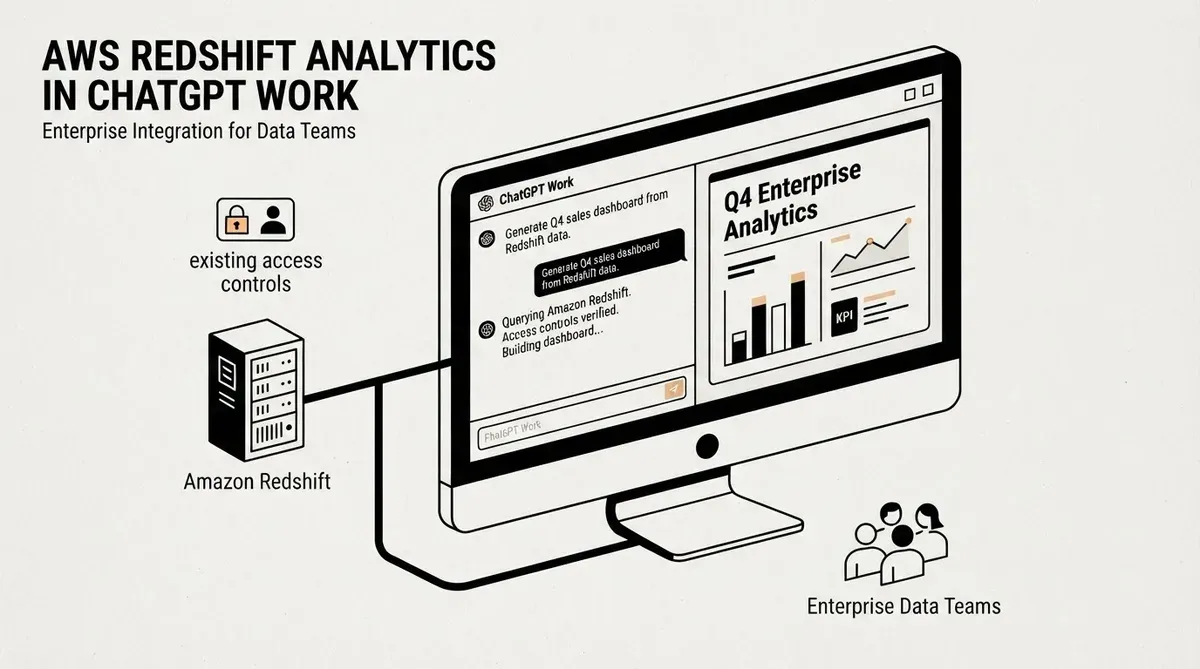
AWS has extended Amazon Redshift analytics in ChatGPT Work, letting business users query governed warehouse and data lake data without opening a BI tool or writing SQL. The AWS Data Analytics plugin for OpenAI's new Data agent, announced on September 10, 2026, converts a plain-language question into Redshift SQL, runs it against the tables and rows the user already has permission to see, and returns a conversational answer or a shareable dashboard.
The move lands on the same day OpenAI introduced the Data agent in ChatGPT Work, its workplace tier. That agent connects to approved company sources, investigates what changed in business metrics, and builds interactive dashboards. Redshift is one connector among several available from launch, alongside Snowflake, Google BigQuery, Databricks, ClickHouse, MongoDB and Datadog.
The strategic weight sits with where enterprise questions get asked, not with the database feature itself. AWS is placing its warehouse behind someone else's front door.
What the Plugin Actually Does
The integration runs on specialised Amazon Redshift skills from the Agent Toolkit for AWS, the toolkit AWS began wiring into Redshift earlier this year for AI-assisted warehouse management. The Data agent selects a skill, generates SQL, executes it against the customer's data, and formats the result as prose or a dashboard.
AWS states that the plugin respects existing organisational access controls and governance practices, so users see only data they were already entitled to. AWS does not create a separate copy of the data; queries run where the data already lives.
SQL generation is the load-bearing part. The Data agent has to infer which tables answer a business question, then write a query that survives contact with the customer's schema. AWS's answer is to constrain that step with prebuilt Redshift skills instead of letting a general-purpose model improvise against raw metadata. That limits what the agent can attempt, and it improves the odds that what it attempts is valid.
Coverage spans the analytical estate rather than the warehouse alone:
- Provisioned Amazon Redshift clusters and Redshift Serverless workgroups
- AWS Glue Data Catalog, Amazon S3 Tables and Amazon Athena
- Apache Iceberg and other open table formats
- Dashboards generated in conversation and shared with colleagues
| Layer | What AWS provides |
|---|---|
| Deployment | Provisioned Redshift clusters and Redshift Serverless workgroups |
| Compute | Graviton-based RG instances, up to 2.4x faster than RA3 at 30% lower price per vCPU, per AWS |
| Table formats | Apache Iceberg and other open formats via the integrated data lake query engine |
| Catalog and federation | AWS Glue Data Catalog, Amazon S3 Tables, Amazon Athena |
| Agent plumbing | Amazon Redshift skills from the Agent Toolkit for AWS |
| Access model | Inherits existing organisational permissions and governance policies |
AWS has already published reference architectures for the missing middle. One describes a semantic layer built with Stardog over Amazon Aurora and Amazon Redshift, queried by a Strands agent on Amazon Bedrock AgentCore so that customer 360 questions can be answered across both sources without extract, transform and load steps. The plugin is that pattern delivered as a managed connector instead of a build-it-yourself project.
Buyers have three broad routes: wire a warehouse directly into an agent framework and own the plumbing, adopt a packaged connector such as this one, or wait for their BI platform to add its own conversational layer. The packaged connector trades flexibility for deployment speed, and it ties the question layer to a vendor whose roadmap the customer does not control.
Who Gains, and Who Is Displaced
The clearest winner is the non-technical employee. Sales, operations and finance staff who file a ticket and wait days for a report can ask directly, and the answer arrives in the thread where they are already working. AWS frames the shift as every team becoming a data team, and the connector is the mechanism behind that claim.
Analyst roles change rather than disappear. The work moves from producing recurring reports to curating the semantic layer, assigning metric ownership and auditing what the agent answered. Teams that treat the plugin as a replacement for their BI function will find answers degrade quietly. Teams that treat it as a new consumer of their modelling work will get more out of it.
Platform engineers inherit the harder problem. Permissions designed for a small number of scheduled jobs now face ad hoc, high-variance query patterns from a much larger group of users. AWS points to customers such as Verizon Connect, which built an agentic analytics system that turns fleet data into insights for 100,000 users a day, as evidence that the pattern holds at scale.
The Accuracy Problem in Shared Dashboards
Conversational analytics carries a failure mode that traditional BI suppresses. When a fixed dashboard shows the wrong number, the error is visible, versioned and traceable to a query someone can inspect. When an agent writes SQL on the fly, a plausible-looking figure can travel into a shared dashboard before anyone checks the join logic behind it.
Sharing makes that worse. The plugin's dashboards are built to be passed around, so one misread column definition can reach a whole department in an afternoon. The mitigation is unglamorous: lock down metric definitions, name tables clearly, and keep a human review step on anything that leaves the team that generated it. The semantic layer is the control that keeps generated SQL honest.
The Governance and Cost Tests
Two questions decide whether this works outside a demo.
The first is auditability. Inheriting warehouse access controls settles who can see which rows. It does not settle how a regulated firm explains, months later, which employee asked what and which rows came back through a third-party interface. Compliance teams will want that trail before access widens.
The second is spend. Warehouse costs now scale with curiosity. A finance team that once refreshed a fixed set of dashboards may generate a long tail of exploratory queries, and without budget alerts and workload isolation the bill turns into an argument about the tool rather than the data. Faster Graviton instances lower the unit cost but leave the trigger with whoever is typing.
How Amazon Redshift Analytics in ChatGPT Work Fits AWS's Strategy
AWS also sells Quick Suite as a workplace alternative to consumer chat tools, aimed at knowledge workers who want one place to ask questions and act on the answers. Shipping a first-party Redshift connector into ChatGPT Work looks contradictory next to that.
It is a hedge. AWS captures demand from teams that standardise on ChatGPT Work while keeping a native option for buyers who will not. The company has made comparable bets across the agent market, investing in Bedrock AgentCore and semantic-layer partnerships so that Redshift remains the query target no matter which agent asks the question.
Every connector shipped into ChatGPT Work also makes that surface more useful and the warehouses behind it more interchangeable. Redshift, Snowflake and BigQuery become answer engines behind one interface, which is a strong position for OpenAI and a weaker one for any single database vendor.
Two signals will show whether the approach holds. The first is whether AWS ships equivalent connectors into other agent surfaces, which would confirm that distribution matters more than interface ownership. The second is whether query-level budget controls and answer-level audit logs arrive as first-class features, since regulated deployments need both.
The reasonable position for most mid-size teams is to adopt the packaged connector and spend the saved engineering time on metric definitions. Regulated enterprises should reverse the order: semantic layer and audit trail first, connector second.
Why This Matters
The plugin moves the competitive question in analytics from which warehouse stores the data to which surface employees open first. AWS is betting it can own the query layer without owning the chat window. OpenAI is betting the agent becomes where work starts. For a CTO weighing adoption, the connector is the easy part; the durable decisions are where the semantic layer lives, how permissions are audited, and who pays when query volume spikes. Run the integration against your own permission rules and watch query spend for a full billing cycle before widening it beyond a pilot group.
Sources
Every team is a data team — bring Amazon Redshift analytics to ChatGPT Work
Cloud Data Warehouse - Amazon Redshift - AWS
Amazon Redshift | AWS Big Data Blog
Amazon Redshift | Artificial Intelligence
Cloud Data Warehouse – Amazon Redshift Features – AWS
Analytics | Artificial Intelligence
Amazon Redshift FAQs - Cloud Data Warehouse - Amazon Web Services
Getting Started with Amazon Redshift - Cloud Data Warehouse - Amazon Web Services
AI-generated image.
Related Articles
- AWS Integrates Kiro AI Agent for Natural Language Querying in Amazon Redshift
- AWS Launches Amazon Redshift RG Instances to Power High-Speed AI Agent Analytics
- Databricks and AWS Launch New AI Governance Tools for Agentic Workloads
✔Human Verified
Researched and cross-referenced against primary sources by the Bytevyte editorial team. This article was generated with the assistance of artificial intelligence and reviewed by the Bytevyte editorial team.