
AWS Rebuilds Amazon OpenSearch Serverless for Agentic AI and Dynamic Workloads
AWS has re-architected Amazon OpenSearch Serverless with 20x faster autoscaling and 60% lower costs to support agentic AI and dynamic vector workloads.
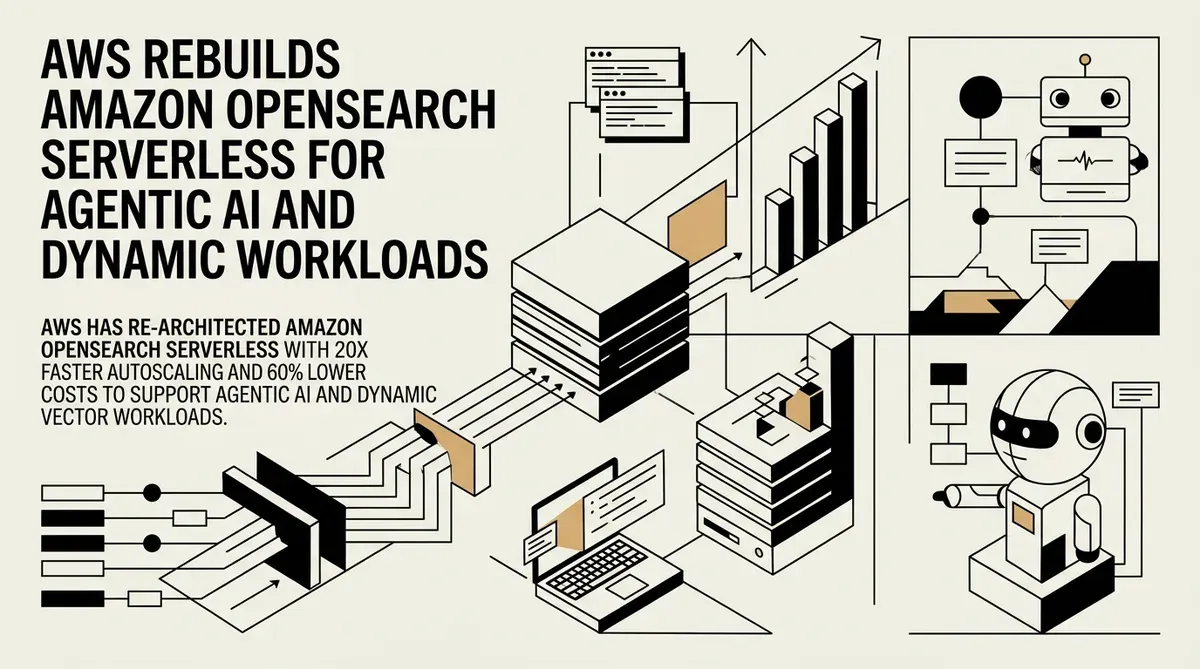
Amazon Web Services has launched a major re-architecture of Amazon OpenSearch Serverless, rebuilding the platform to handle the unpredictable demands of agentic AI and dynamic vector search workloads. The update, announced this week, introduces a decoupled compute and storage model that allows the service to scale up to 20 times faster than previous versions. By separating these layers, the system can now provision additional capacity in seconds rather than minutes, addressing a critical bottleneck for developers building responsive AI agents.
The new architecture for Amazon OpenSearch Serverless introduces a scale-to-zero capability that can reduce costs by up to 60% for idle or intermittent workloads. This is particularly relevant for enterprise applications where search demand fluctuates throughout the day. To further improve performance for high-dimensional data, the platform now includes GPU-backed compute resources. These specialized units automatically accelerate the construction of HNSW vector index structures, which are essential for the retrieval-augmented generation (RAG) patterns used in modern large language model applications.
Strategic Impact of Amazon OpenSearch Serverless
For technical leaders, the shift toward Amazon OpenSearch Serverless is a move toward more efficient multi-tenant management. A new Regional endpoint simplifies how organizations handle multiple data collections, while the introduction of Collection Groups allows different tenants to share compute capacity. This sharing mechanism ensures that resources are utilized more effectively across a company's entire AI portfolio, preventing the over-provisioning that often plagues early-stage AI deployments.
The integration of GPU acceleration directly into the serverless indexing pipeline is a significant change in how vector databases operate. By offloading the heavy lifting of index creation to GPUs, the service maintains high query performance even as data sets grow or change rapidly. This capability ensures that AI agents have access to the most current information without the latency typically associated with re-indexing large volumes of vector embeddings.
As of 2026-05-29, these updates are available to customers looking to optimize their search infrastructure for the next generation of autonomous applications. The combination of faster autoscaling and lower entry costs positions the service as a primary option for businesses scaling their AI initiatives from pilot programs to full production environments. AWS continues to focus on reducing the operational overhead of managing complex search clusters, allowing teams to concentrate on the logic of their AI agents.
While we strive for accuracy, bytevyte can make mistakes. Users are advised to verify all information independently. We accept no liability for errors or omissions.
Sources
The next generation of Amazon OpenSearch Serverless: Built from the ground up for agents
AI-generated image.
Related Articles
- AWS Unveils Amazon Bio Discovery to Accelerate Medical Research with Agentic AI
- AWS Introduces Automated Optimization Tools for Amazon Bedrock AI Agents
- AWS Launches Amazon Redshift RG Instances to Power High-Speed AI Agent Analytics
✔Human Verified