
Bose Doubles Down on Open-Ear Earbuds With $199 Sport and $299 Ultra (2nd Gen)
Bose's open-ear earbuds now span $199 Sport Open and $299 Ultra Open (2nd Gen), shipping October 1 with Cinema Mode, wireless charging and 9-hour battery.
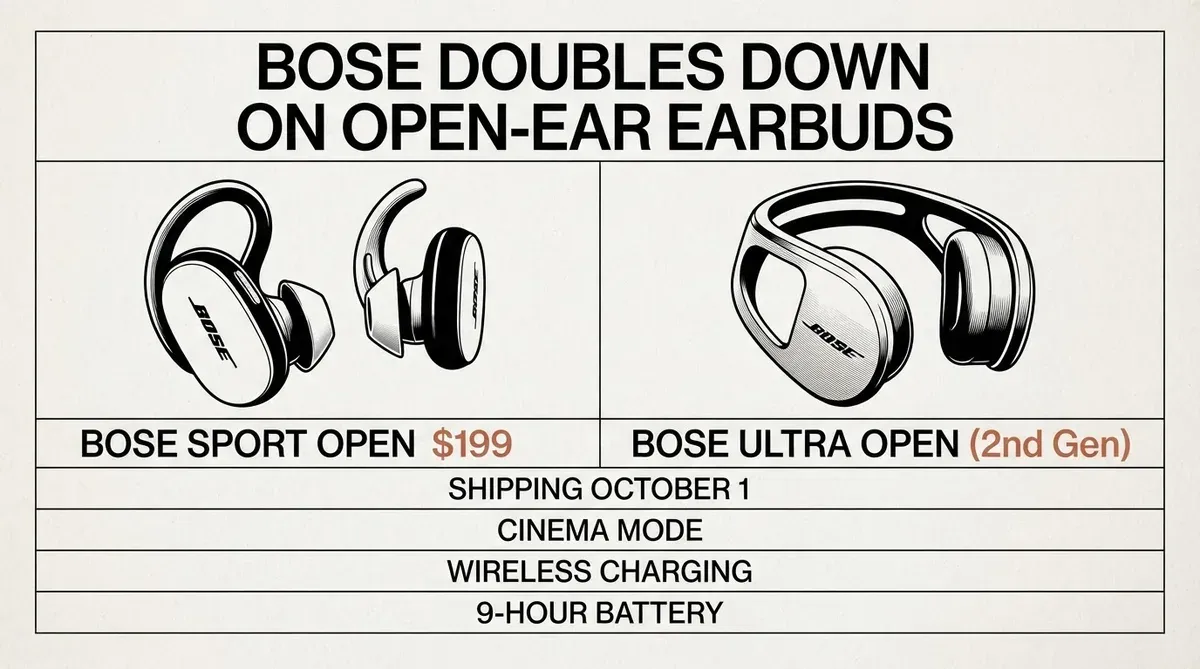
Bose has widened its open-ear earbuds range from a single flagship to two models aimed at different buyers. The Ultra Open Earbuds (2nd Gen) sell for $299 and update the cuff-shaped design Bose introduced in 2024, while the new Sport Open Earbuds cost $199 and are built for running, workouts and outdoor use. Preorders opened on September 19 and both products reached retail on October 1, 2026.
Both models rely on the approach Bose calls OpenAudio, which places the driver outside the ear canal instead of sealing it. Sound reaches the listener while surrounding noise stays audible, which suits cyclists, runners and desk workers who need to hear what is happening around them. The point of the design is awareness of surroundings rather than isolation.
What the Ultra Open (2nd Gen) changes
Bose fitted a redesigned driver to the second-generation Ultra Open and says it produces deeper bass and higher maximum volume than the original. Voice pickup uses a system Bose markets as SpeechClarity, which it describes as its strongest voice-separation technology for calls in noisy places.
Playback volume now adjusts automatically to ambient noise, raising output on a loud train and lowering it in a quiet room without input from the wearer. A new Cinema Mode applies Bose's TrueSpatial processing with head tracking to place sound in the space in front of the listener, aimed at films and video podcasts.
Connectivity runs on Bluetooth 5.4 with SBC and AAC codecs, and the Ultra model alone adds aptX Adaptive, a codec Apple devices do not use. Battery life reaches nine hours in the earbuds and 19.5 hours with the case, although Bose rates Immersive Audio playback at roughly five hours, so spatial effects cost close to half the runtime. The self-standing case adds wireless induction charging, multipoint pairing covers two devices at once, and a ten-minute charge returns about two hours of playback.
Ultra versus Sport: how the open-ear earbuds compare
| Model | US price | Japan MSRP | Battery (buds / case) | Key features |
|---|---|---|---|---|
| Ultra Open Earbuds (2nd Gen) | $299 | 39,600 yen | 9 h / 19.5 h | Redesigned driver, SpeechClarity calls, automatic volume, Cinema Mode with TrueSpatial, aptX Adaptive, wireless charging case |
| Sport Open Earbuds | $199 | 29,700 yen | 7 h / 22 h | C-arm silicone cuff, IP54 dust and water resistance, textured physical buttons |
The Sport Open Earbuds take a different route to staying put. A silicone C-arm cuff hooks around the ear, and textured physical buttons remain usable when hands are wet or sweaty. Bose rates the Sport model at IP54 for dust and water resistance, with seven hours of playback in the buds and 22 hours with the case, three hours more than the flagship delivers from its case.
The two products also split on software. The Sport model leaves out Cinema Mode, automatic volume and aptX Adaptive, keeping its price $100 below the Ultra Open. Buyers who want open-ear earbuds for exercise get durability and longer case life, while buyers who want the extra processing pay for the flagship.
The $199 entry price is the strategic piece. Until now Bose's open-ear range started at the flagship price, and the Sport model gives the company a lower rung for shoppers comparing clip-on designs from other brands. It also answers a practical constraint of the format: a cuff that stays fixed during sprint intervals and survives sweat needs different materials and button design than one meant for a train carriage.
Battery and charging hardware carry over between the two. Each model ships with a self-standing case that supports wireless induction charging, pairs with two devices at once through multipoint, and recovers about two hours of listening from a ten-minute top-up. Bose sells both through its own store, Amazon and selected retailers, and the Japanese launch followed an announcement in mid-September.
Price, markets and the generational squeeze
US pricing is $299 for the Ultra Open (2nd Gen) and $199 for the Sport Open, with European pricing around 299 euros for the flagship. Bose lists recommended Japanese prices of 39,600 yen and 29,700 yen, while Akihabara retailers have advertised the same pair at 35,640 yen and 26,730 yen, roughly 10 percent below list.
The harder comparison sits inside Bose's own catalogue. The first-generation Ultra Open Earbuds were discounted to roughly $179 to $199 during Amazon's October Prime Day event this month, which places the 2024 flagship within $20 of the new Sport model. Anyone who wants the cuff shape can buy last year's version for about what Bose now charges for its entry-level open-ear product.
Competition is closing in from outside as well. Sony's LinkBuds Clips occupy similar clip-on territory, and the open-ear segment has grown from a niche experiment into a mainstream product line in roughly two years. Bose's answer is coverage across price points rather than a single flagship.
For a runner who wants traffic awareness and a secure fit, the $199 Sport Open is the straightforward pick, and its IP54 rating and 22-hour case make it the more practical option outdoors. The $299 Ultra Open (2nd Gen) suits people who wear earbuds through a working day, where automatic volume, multipoint pairing and a wireless charging case remove small daily irritations. Cinema Mode is the one feature with no equivalent in the Sport model, and it justifies the higher price only for buyers who care about video and spatial audio.
The uncomfortable part is the generational price gap. The new Ultra Open costs $100 more than the discounted original, and the additions that justify the jump are software features and a charging case rather than a change in the core listening experience. Anyone drawn mainly to the open design has a cheaper route to it, and that is a decision Bose has handed its own customers.
Why this matters
Open-ear audio has moved from a niche format into a product family with distinct price tiers, and Bose now competes against its own previous generation as much as against Sony. For buyers, the decision turns on which trade-off they accept: $199 for durability and longer case life, or $299 for software built around all-day wear.
AI-generated image.
Related Articles
- Snapdragon Sound Elite Gen 2 Turns Earbuds Into Standalone AI Endpoints
- Samsung's Open-Ear Galaxy Buds On Clear FCC Ahead of Q4 Debut
- Oppo Enco X4 and Watch S2 Land in China With 53-Hour Earbuds
✔Human Verified
Researched and cross-referenced against primary sources by the Bytevyte editorial team. This article was generated with the assistance of artificial intelligence and reviewed by the Bytevyte editorial team.