
ByteDance Unsecured AI Loan: Banks Bet $29.6B on Cash Flow, Not Collateral
The ByteDance unsecured AI loan of $29.6 billion funds Southeast Asia data centers and shows lenders now price AI risk on cash flow, not collateral.
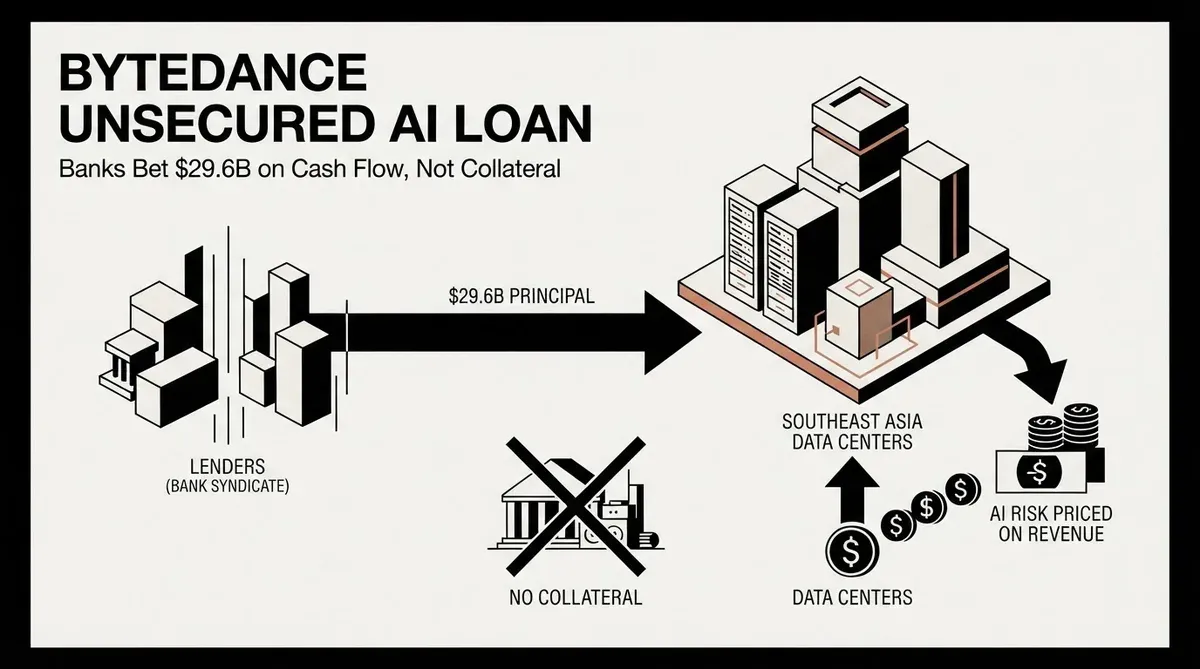
ByteDance has closed a $29.6 billion syndicated loan from close to 30 banks to finance AI infrastructure and data-center projects outside China, placing the TikTok owner among the largest corporate borrowers in Asia this year. The ByteDance unsecured AI loan, finalized in early September and denominated in dollars, was upsized from an initial $20 billion target after orders ran ahead of supply. Its defining feature is what is missing: no assets or shares back the debt.
The size and the structure need to be read together. The package is Asia's second-largest dollar loan of 2026 and counts among the region's biggest corporate credit facilities of the year. The syndicate spans the United States, Europe, Singapore and China, led by Citigroup and JPMorgan, with Chinese banks supplying more than 60 percent of the total. Unsecured credit of this scale is rare for any borrower, and rarer still for a private company whose finances do not appear in public filings.
What the ByteDance unsecured AI loan really underwrites
Conventional project finance protects lenders with liens on physical assets such as land, buildings and equipment. This facility carries no such protection and no pledge of shares. The credit case rests on the ByteDance name, its cash generation and its existing banking relationships, which means repayment depends on the advertising and short-video businesses, TikTok above all, continuing to generate the cash that services the debt.
The market's verdict is visible in the price. The loan is priced at 68 basis points over SOFR, tighter than the 85 basis points ByteDance paid on its 2024 offshore borrowing. Orders reached roughly $30 billion against the $20 billion starting target, about 1.5 times oversubscribed. A tighter spread combined with that appetite shows international lenders remain willing to extend dollar credit even as the geopolitical climate around Chinese technology stays difficult.
The term runs three years with options to extend by two further one-year periods, leaving room to refinance before the buildout matures. The trade-off for the banks is symmetrical: in a default, unsecured lenders would line up with general creditors, and recovery would depend on the company staying solvent. What makes that position acceptable is the anchor of Chinese banks, whose majority stake lets the American, European and Singaporean participants hold smaller exposures while keeping a seat in the relationship.
The choice of structure also explains how the deal will be managed. Equity would have diluted the owners of a private company, and asset-level project finance would have tied each data center to its own repayment schedule. An unsecured corporate facility keeps the funding flexible. With nothing to seize, the banks' discipline rests on covenants and on the fact that ByteDance will need this market again, because its next offshore borrowing will be priced against how this facility performs.
An offshore buildout hedges compute access
Officially the ByteDance unsecured AI loan is designated for "general corporate purposes." In practice the capital funds the AI expansion the company has been scaling up, including data-center development outside mainland China. ByteDance is the offtaker for many of the Southeast Asian data centers now under construction, meaning it has agreed to buy the capacity those sites produce.
The geography does real work. Placing the buildout outside China separates ByteDance's compute from the regulatory environment at home and from export-control rules that have constrained Chinese companies' access to advanced chips. Raising the money in dollars from a syndicate that includes Western institutions extends the same logic to capital. One structure hedges compute access and geopolitics at once, while concentrating the risk in a single obligor whose cash flow must keep the whole arrangement liquid.
Booking the debt offshore matters for the lenders as well as the borrower. A dollar facility raised outside mainland China is serviced from the cash flows of overseas operations, which is a cleaner repayment path than one dependent on domestic capital controls or approval processes. The structure keeps the funding attached to the same markets where the data centers and the offtake contracts sit.
Who owns Southeast Asia's AI capacity
The deal redistributes ownership in a concrete sense. Developers and operators hold the physical data centers, ByteDance's offtake commitments decide whether those facilities earn money, and the lending banks hold claims on the cash those contracts generate, not on the buildings. The operative question for every bank in the syndicate is whether ByteDance keeps buying capacity and keeps paying. The answer rests on the durability of its distribution business, which is what makes the ByteDance unsecured AI loan workable at this size.
The lenders' exposure is demand risk more than construction risk. The syndicate is betting that ByteDance's AI workloads keep growing fast enough to absorb contracted Southeast Asian capacity, and that the company's cash flows stay strong enough to pay for it. That is a narrower set of risks than owning data centers outright, and a broader one than lending against a single asset.
For Southeast Asia's data-center market, the pattern matters. New capacity is being financed on the strength of one anchor customer, and developers who can sign similar offtakes gain a clearer path to funding. Other AI builders seeking bank money will be measured against this template.
The developers building those centers face their own balance-sheet question. Their construction financing will be judged on the strength of the ByteDance contract they hold, and the new unsecured credit line functions, in effect, as an endorsement of the offtake paper they will present to their own lenders.
The verdict
The precedent extends beyond ByteDance. When banks accept an unsecured facility of this magnitude, they confirm that AI capital expenditure is now priced on ecosystem position, contracted demand and cash generation instead of physical security. Large technology companies financing offshore AI capacity will be compared with this structure.
For data-center operators, the deal shows what a contracted anchor tenant does for financeability. For lenders, it provides a pricing reference point for AI-exposed credit to Chinese technology names. For ByteDance, it locks in committed funding at scale for a program of rising AI spending.
Two open questions remain. The covenant package has not been disclosed, so the financial tests attached to the loan are unknown. Whether the facility runs its full term or is refinanced early will indicate how the offshore dollar market for Chinese technology credit develops. ByteDance's AI spending has climbed sharply, and the repayment schedule the banks signed will test whether that spending converts into the cash flow the underwriting assumes.
Why this matters
This loan compresses a broader shift into a single number: banks will lend tens of billions for AI infrastructure without collateral when they trust a borrower's distribution reach and its contracted demand. The facility also anchors the ownership of Southeast Asia's AI data centers to a Chinese-founded company backed largely by Chinese banks yet located offshore, a configuration that regional regulators and competitors will have to reckon with as the buildout proceeds.
AI-generated image.
Related Articles
- Nvidia OpenAI Circular Financing: $250 Billion Guarantee Reshapes AI Infrastructure Risk
- ByteDance AI Infrastructure Budget Hits $30 Billion for 2026
- SoftBank’s $6 Billion OpenAI Margin Loan Stalls Over Collateral Valuation Issues
✔Human Verified
Researched and cross-referenced against primary sources by the Bytevyte editorial team. This article was generated with the assistance of artificial intelligence and reviewed by the Bytevyte editorial team.