
CADDi Series D Funding Values Manufacturing AI Startup at $1.2 Billion
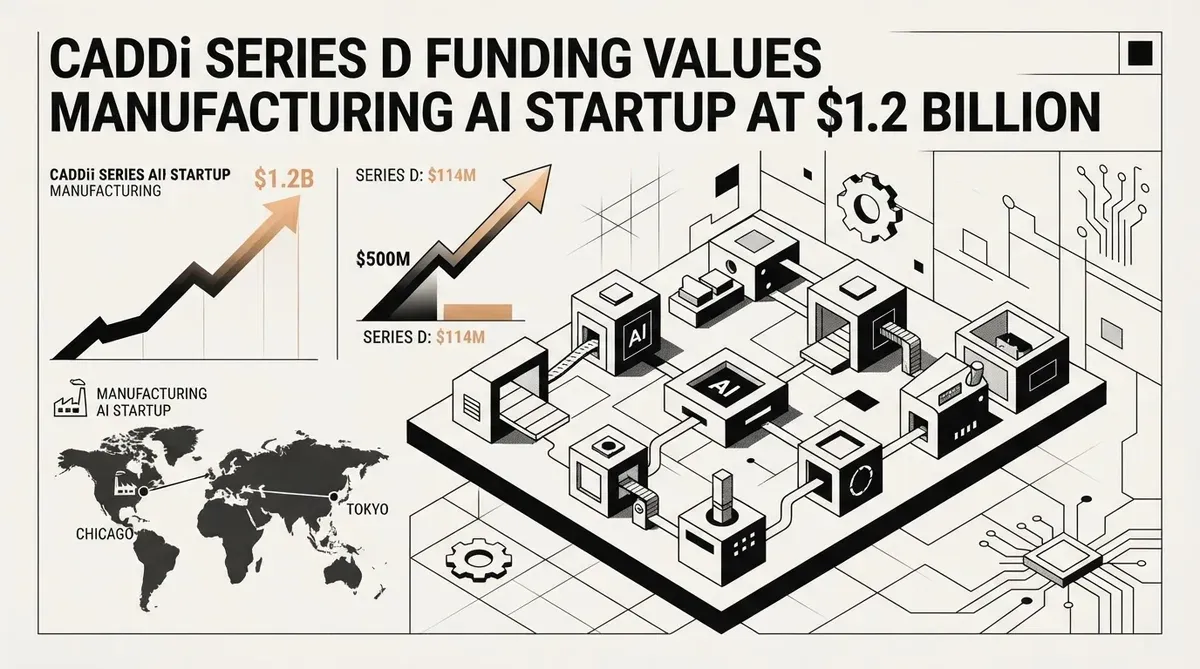
CADDi has raised $114 million in a Series D round that values the manufacturing AI company at $1.2 billion, more than double the $470 million valuation it reported in March 2025. The CADDi Series D funding was disclosed on 15 September. Atomico, Globis Capital Partners and the JPS Growth funds managed by a Japan Post Bank subsidiary remain on the cap table, with new capital joining them.
The round is a test of one proposition: that a narrow, document-bound workflow holds its price even as the underlying model capability gets cheaper every quarter. The most informative detail is who priced it. Three existing backers led the deal. Insider pricing is the strongest support for the $1.2 billion figure, and it is the thing the next round will check.
CADDi is headquartered in Tokyo and Chicago. Its software reads the drawings, quotations and part specifications that move through industrial supply chains, and turns paper-heavy documents into structured records that procurement teams can search, quote and buy against.
What CADDi Sells, and Why Procurement Needs It
Industrial procurement runs on documents that were never built to be machine-readable: scanned drawings, emailed quotations, specifications locked inside whichever tool created them. CADDi's platform takes those inputs and returns searchable data. The company describes the product as an AI data platform that makes design and supply chain data accessible and actionable for manufacturing teams.
Production evidence arrived in June 2026, when nVenia adopted the CADDi platform to process roughly 750,000 drawings and pull aftermarket value from them across several brands. The deployment shows the commercial mechanism. A manufacturer's archive of legacy drawings stops being dead weight once it is indexed, because spare-part identification and quoting become lookups instead of manual searches.
CADDi was founded in 2017 by Yushiro Kato and Aki Kobashi. Its original business served procurement and manufacturing directly, covering sheet metal, machining, framing and plastics. The software push repositions that operation. The company now sells the data layer that makes parts sourcing legible; it no longer brokers parts itself. Leadership has moved toward Chicago to sit closer to North American industrial customers while the engineering base stays in Tokyo.
The Funding History Behind the Step-Up
CADDi's Series C raised $89 million in 2023 and a $38 million extension followed in 2025, taking cumulative funding to roughly $202 million before this round. The CADDi Series D funding lifts disclosed equity past $300 million, and the valuation has multiplied by about 2.6 since March 2025.
| Round | Announced | Amount | Post-money valuation |
|---|---|---|---|
| Series C | 2023 | $89M | Not disclosed |
| Series C extension | 2025 | $38M | ~$470M |
| Series D | September 2026 | $114M | $1.2B |
The size of the step-up matters less than the shape of the register. Across four rounds CADDi has drawn capital from roughly 20 backers, and the Series D keeps three of them in the lead. A concentrated register gives a company fewer competing term sheets to work with, and it leaves the next markup in the hands of a small group that already knows the business.
How the Round Compares
Other enterprise and industrial AI rounds this year frame the figure. Factory raised $150 million at a $1.5 billion valuation for enterprise coding agents, Glow raised $180 million at $1.2 billion for endpoint security, and AI² Robotics raised $144 million at $1.45 billion for industrial robots. CADDi's round size and valuation sit inside that band, between $1.2 billion and $1.5 billion.
The defence-adjacent names trade far higher. Hadrian raised $1.4 billion at a $7.9 billion valuation, and Shield AI raised $2 billion at $12.7 billion. Both carry capital requirements an order of magnitude larger, tied to factories and hardware rather than software licences.
Dilution tells a second story. CADDi handed over about 9.5% of the company for $114 million, roughly the same proportion Factory gave up and less than Glow, which conceded about 15% for $180 million. A smaller slice of equity for a similar valuation suggests the buyers priced CADDi's existing traction more generously than the headline comparison alone implies.
The structural difference is who wrote the cheque. Factory's $150 million round was led by Khosla Ventures, with Sequoia Capital and Insight Partners participating, a roster of new price-setters. CADDi's round leans on backers who already held equity. Insider-led rounds carry a genuine signal, because the investors closest to the numbers chose to add, but they bring fewer independent valuations into the company's story.
The Trade-Offs Behind the $1.2 Billion Mark
The bull case rests on workflow specificity. Procurement savings are measurable, the buyer is a company instead of a consumer, and once a manufacturer's drawings are indexed and wired into its quoting and enterprise resource planning systems, removing that layer is expensive. CADDi's investors are funding a narrow, document-bound workflow, and the round shows capital still flowing to that position.
The bear case is that the moat sits in the wrong layer. Document and vision models improve every few months, which erodes the value of raw extraction. If reading a scanned drawing becomes a commodity capability, the durable assets are the customer's indexed archive and the workflow built on top of it. CADDi has been building both, but the company has not published revenue figures that would show how much of the $1.2 billion rests on software contracts and how much on the older services business.
Scale is the second open question. The United States and European Union account for an early slice of CADDi's footprint, and the Chicago move signals intent while the North American base is still forming. A $1.2 billion mark assumes the platform travels across languages, drawing standards and industrial verticals without a proportional rise in implementation cost. Nothing in the company's disclosures settles that.
Physical industrial AI sharpens the contrast. Hadrian builds plants: four sites, close to three million square feet in total, one of them in Alabama and partly financed by the US Navy for submarine production. AI² Robotics makes robots for quality inspection and assembly, validated with automotive manufacturers including Dongfeng Liuzhou Motor. Those businesses need heavy capital and years to scale. CADDi needs customers willing to digitise archives. The trade is a lower ceiling for faster deployment.
At the top of the market, horizontal coding AI shows how much higher that ceiling goes. Cognition has raised around $1 billion at a valuation near $47 billion, after a revenue run rate that climbed from $37 million in May 2025 to $492 million within twelve months. CADDi's vertical position trades that ceiling for stickier demand and less contested pricing.
Adjacent vendors show how crowded the territory is becoming. Assent has raised close to $500 million and reached a $1 billion valuation in supply-chain compliance software, a neighbouring problem set with overlapping buyers. CADDi's differentiation is the engineering drawing itself, a document class compliance platforms do not process.
The timing shapes how the round should be read. CADDi's raise lands alongside a cluster of large enterprise AI financings, from Factory's coding agents to Hadrian's defence plants, while several consumer-facing AI efforts have struggled to hold their valuations. Capital is concentrating on applications with a named buyer and a measurable cost line, and procurement documentation fits that description.
For CADDi the practical consequence is a higher bar on disclosure. A company that has raised more than $300 million and carries a $1.2 billion price tag will face questions about retention and average contract value that its earlier stages did not require.
Why this matters
The CADDi Series D funding is a clean test of whether vertical AI valuations hold when the product is unglamorous and the buyer is an industrial procurement team. For manufacturing IT leaders, the practical question is whether indexing legacy drawings pays back faster than the implementation effort it demands, and the nVenia deployment is the closest public evidence available. For investors, the insider-heavy cap table is the detail to watch, because the next round will need outside price discovery at a moment when document AI keeps getting cheaper.
AI-generated image.
Related Articles
- Hadrian Series D: Defense AI Capital Goes Physical
- Castelion Series C Turns Missile Backlog Into $13B Valuation
- Generalist AI Funding Round Secures $400 Million to Advance Physical AGI
✔Human Verified
Researched and cross-referenced against primary sources by the Bytevyte editorial team. This article was generated with the assistance of artificial intelligence and reviewed by the Bytevyte editorial team.