
Castelion Series C Turns Missile Backlog Into $13B Valuation
The Castelion Series C raised $1B at a $13B valuation to mass-produce the Blackbeard hypersonic missile, a 37x step-up that prices defense capital like AI.
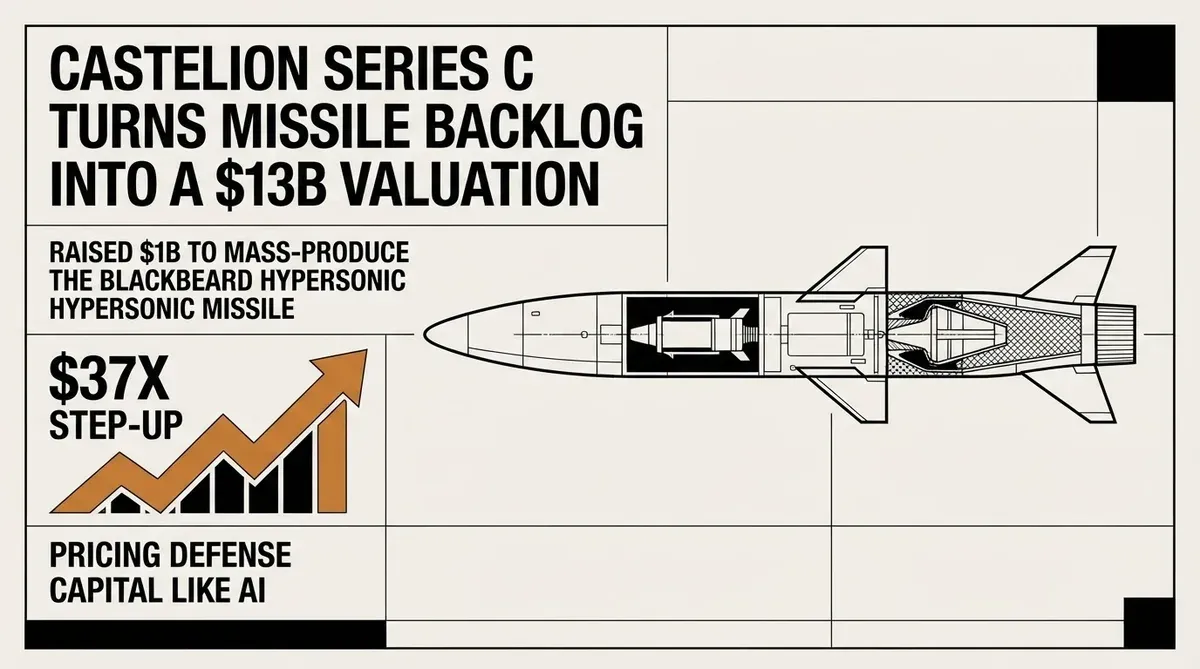
The Castelion Series C has closed at $1 billion, valuing the Torrance, California missile maker at $13 billion and pricing defense capital the way AI mega-rounds are priced. The round closed Aug. 19 and was announced last week, combining $800 million in equity with a $250 million committed revolving credit facility to fund the mass production of Blackbeard, the company's first low-cost hypersonic strike missile.
The $13 billion valuation is a 37x step-up from Castelion's $350 million Series B, and the equity portion was co-led by JPMorgan Chase's Strategic Investment Group, Andreessen Horowitz and funds managed by Carlyle. Lightspeed Venture Partners, Lavrock Ventures, Altimeter, General Catalyst, Interlagos and T. Rowe Price, a newcomer to the cap table, joined the syndicate, with Davis Polk advising JPMorgan on the transaction. Proceeds are earmarked for the 1,000-acre Project Ranger campus in Rio Rancho, New Mexico, where the company will scale Blackbeard output while developing a longer-range strike weapon and new air and missile defense systems.
Underpinning the valuation is a production framework signed with the U.S. Department of War covering a minimum of 500 Blackbeard missiles per year, pending testing and validation. Castelion has also accumulated more than $500 million in U.S. military contracts over the past 18 months. The company, founded in 2022 by three former SpaceX executives, targets initial fielding in 2027.
The Rio Rancho site, called Project Ranger, sits in Sandoval County and is the physical expression of the volume thesis: a campus built for production lines rather than prototypes. The financing is designed to carry that campus to maximum production rate, which the company has tied to the 2027 fielding schedule.
| Deal component | Detail |
|---|---|
| Total financing | $1.05 billion ($800M equity + $250M revolving credit facility) |
| Post-money valuation | $13 billion |
| Co-lead investors | JPMorgan Chase Strategic Investment Group, Andreessen Horowitz, Carlyle |
| Other participants | Lightspeed, Lavrock Ventures, Altimeter, General Catalyst, Interlagos, T. Rowe Price (new) |
| Prior round | $350 million Series B |
Why the Castelion Series C Prices Like AI
The round's structure follows the template of AI infrastructure deals: a large equity tranche from blue-chip co-leads, a committed credit facility layered on top, and a syndicate that mixes growth-stage funds with a public-market asset manager in T. Rowe Price. That crossover pattern is familiar from the OpenAI and Anthropic fundraising playbooks, where late-stage investors pay for capacity expansion rather than near-term profit. Castelion is selling the same logic for missiles: the Department of War framework turns a contract into a recurring revenue floor, and the valuation prices that backlog the way AI rounds price compute scale.
The multiple itself is the tell. A 37x step-up from $350 million to $13 billion would stand out even in the AI sector; for a hardware company whose revenue still depends on testing milestones, it means investors are underwriting production capacity and contract flow rather than current earnings. Traditional defense primes are valued on earnings and order books, and venture-backed hardware rarely clears double-digit billion valuations before meaningful deliveries. Castelion is being priced as an AI-scale bet on the assumption that missile demand is elastic: if the unit price is low enough, the government buys many more units.
The corporate lineup reinforces the point. JPMorgan invested through its Strategic Investment Group, part of the bank's Security and Resiliency Initiative, and Carlyle's participation brings private-equity capital that has historically concentrated in later-stage defense assets. The $250 million committed revolving credit facility is the less common piece: debt at the venture stage is rare, and a facility of this size points to lenders treating the contract flow as collateral. It also means Castelion can fund the New Mexico campus without selling more equity at the current price. The equity and the facility together give the company roughly $1.05 billion in committed capital, one of the largest recent raises for a Los Angeles-area defense technology company.
The raise comes as blue-chip investors have been moving into defense technology, drawn by procurement patterns that increasingly favor volumes of cheaper systems over small numbers of expensive ones. Castelion fits that shift directly: a missile priced like a consumable, produced on an industrial-scale campus, sold under a framework agreement that guarantees volume. Castelion frames the program as part of restoring conventional deterrence, and the Department of War's production framework suggests the buyer side shares that framing.
The Unit Economics Bet
Castelion's thesis is that low unit cost changes how hypersonic weapons get used. Hypersonic weapons today are bespoke, expensive and produced in small numbers, which caps how they can be deployed. Castelion has positioned Blackbeard as a low-cost, volume-produced strike missile. The bet is that a missile cheap enough to treat as a consumable becomes something a force can field in volume rather than ration.
Blackbeard, named for the English pirate, is engineered for volume production rather than bespoke craftsmanship, and that design choice is what the framework monetizes. The Department of War's 500-missile annual minimum gives the company a guaranteed production base once testing and validation are complete. That contract structure is what converts the framework from a procurement document into a valuation input, and it explains why the syndicate accepted the step-up.
The trade-off is execution risk. The Department of War framework is conditional on testing and validation, the Project Ranger campus must reach maximum production rate, and the cost and schedule targets that support the low-cost thesis are still unproven. A production ramp that comes in above the target cost would undercut the demand math that justified the multiple, since the entire valuation rests on volume economics. The comparison to AI rounds cuts both ways: in AI, the multiple is anchored to model capability and compute demand; here it is anchored to a single missile program whose cost and schedule claims have not yet been validated.
The bet only works if government buying behavior changes with the price. At current U.S. system prices, hypersonic missiles are procured in small numbers; at Castelion's target price, the same budget line buys far more units. Until Blackbeard proves the numbers, the $13 billion valuation is a bet on the framework, not on delivered hardware.
The product roadmap adds a second layer of risk and opportunity. The round funds Blackbeard production plus a longer-range strike weapon and new air and missile defense systems, three programs at once. That breadth is what a $13 billion valuation demands, but it also splits engineering attention before the first product has cleared validation.
What to Watch Next
The Castelion Series C makes the next two milestones the story. Blackbeard's testing and validation schedule gates the 500-per-year framework and the 2027 fielding target. The build-out at Project Ranger in Sandoval County will show whether the company can convert the round's capital into actual throughput, and the longer-range strike weapon and defensive systems in development will test whether the unit-economics play extends beyond a single product.
For other defense startups, the round resets expectations about what a hardware company can command before first deliveries. For the Pentagon, the bet is testable: if Blackbeard clears validation near its target cost, the economics of hypersonic strike change; if testing slips or unit costs climb, the framework's volume minimums lose their anchor.
Why This Matters
The Castelion Series C shows contract backlog and production capacity being priced like AI model scale, with blue-chip capital accepting defense execution risk in exchange for growth-stage multiples. For investors and strategists, the round resets the benchmark for defense hardware pricing, and Blackbeard's testing milestones become the next data point to watch ahead of the 2027 fielding target.
AI-generated image.
Related Articles
- Hadrian Series D: Defense AI Capital Goes Physical
- Cambridge Aerospace Series C hits $3.4B value
- Helsing Raises $1.8 Billion in Series E, Surging to $18 Billion as Europe's Largest Defense AI Startup
✔Human Verified
Researched and cross-referenced against primary sources by the Bytevyte editorial team. This article was generated with the assistance of artificial intelligence and reviewed by the Bytevyte editorial team.