
Helsing Raises $1.8 Billion in Series E, Surging to $18 Billion as Europe's Largest Defense AI Startup
Helsing raises $1.8 billion in Series E at $18 billion valuation, becoming Europe's most valuable defense AI startup with HX-2 drones and Altra battlefield software.
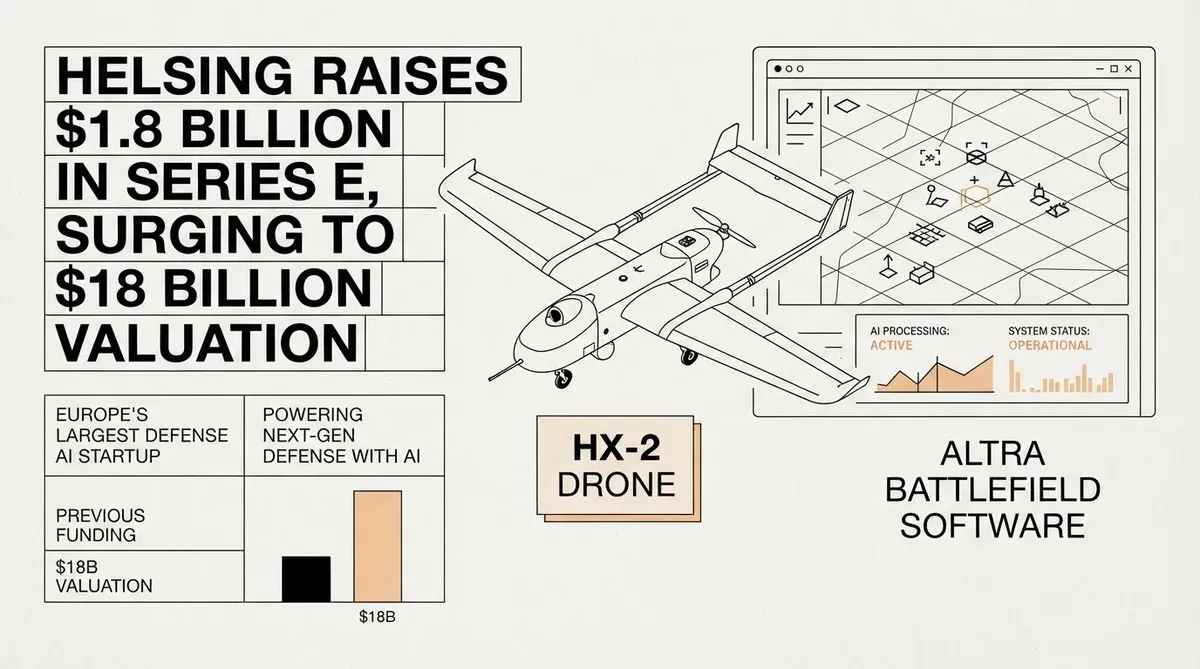
A German defense AI company that began operations just five years ago has secured the largest funding round ever recorded by a European defense-technology startup, becoming the continent's most highly valued private technology company. Helsing raises $1.8 billion (roughly €1.58 billion) in a Series E round that values the Munich-based firm at $18 billion, a significant leap from the €12 billion valuation it commanded in June 2025.
The round drew participation from both new and existing investors including Dragoneer Investment Group, Lightspeed Venture Partners, Iconiq, Growth Equity at Goldman Sachs Alternatives, General Catalyst, Plural, and JPMorgan Chase. Helsing stated that investor demand substantially outstripped the available allocation, a signal of how aggressively capital is now flowing into defense AI across Europe. The mix of specialist tech venture firms and bulge-bracket banks underscores how far the sector has moved beyond early-stage thematic investing into mainstream institutional territory.
Helsing's board remains unchanged. Spotify founder Daniel Ek continues as chair, with former Airbus CEO Tom Enders serving alongside him. The presence of Ek, who built Spotify into a global audio platform, and Enders, who led one of Europe's largest aerospace manufacturers, gives the company a governance structure that blends technology scaling expertise with deep defense industry knowledge.
The company emphasized it remains predominantly European-owned despite the participation of several US-based investment firms.
Helsing raises $1.8 billion as Europe Builds a Defense AI Champion
Founded in 2021, Helsing has rapidly evolved from a niche drone developer into a full-spectrum defense AI platform. Its product lineup spans hardware and software: the HX-2 strike drone already deployed in Ukraine, the Altra AI battlefield management system, and the CA-1 autonomous fighter jet concept still in development.
The company partners with major European defense contractors including Rheinmetall, Kongsberg, and Saab. Rather than building entirely new weapons for each contract, Helsing integrates its AI software into existing platforms that allied militaries already operate. This approach shortens the path from development to field deployment and avoids the long certification cycles that completely new hardware systems typically require.
Helsing's HX-2 drones have seen combat use in Ukraine, providing AI-enhanced strike capabilities. That real-world validation has accelerated investor confidence. A defense product tested under active battlefield conditions carries different weight than one demonstrated only in simulations or test ranges, and Helsing can point to operational data from an ongoing conflict when pitching its technology to new partner nations.
The company's broader thesis holds that software, not hardware, is becoming the primary differentiator in modern warfare. Systems that can process sensor data, identify targets, and coordinate autonomous platforms through AI outperform static platforms regardless of their physical specifications. This software-centric view aligns with how the US Department of Defense and several European ministries are now structuring their procurement priorities.
How the Valuation Jump Reshapes the Market
Helsing's valuation rose from €12 billion in June 2025 to $18 billion with this round. The increase reflects not just the additional capital but a repricing of the entire defense AI category in Europe. When Helsing last raised, the Ukrainian conflict was already reshaping military procurement. But the intervening year has demonstrated that software-defined warfare is now a permanent feature of military planning, not a temporary adaptation driven by a single conflict.
Several factors explain the investor appetite. European NATO members have been increasing defense budgets consistently since 2022, creating a large addressable market for AI-enabled weapons. The war in Ukraine has demonstrated that software-defined drones, electronic warfare, and AI-assisted targeting have become decisive battlefield capabilities rather than experimental adjuncts. Helsing's product lines address each category directly.
The round also reflects a structural shift in how defense contracts are awarded. Traditional prime contractors such as Rheinmetall and Saab are now partnering with AI-native startups rather than building equivalent software capabilities in-house, a dynamic that funnels procurement dollars toward companies like Helsing. These partnerships give Helsing access to established supply chains and government relationships while the incumbents gain AI expertise they would struggle to develop internally.
Helsing's raise also sets a benchmark for other European defense AI startups. Quantum Systems raised $1.2 billion earlier in July 2026, and the two raises together suggest a funding cycle that is still accelerating. As the largest startup by valuation in mainland Europe, Helsing now operates with a balance sheet that allows it to bid on large-scale integration contracts that would previously have gone exclusively to established prime contractors.
What the Capital Will Buy
Helsing said the new capital will accelerate development and integration of AI platforms into defense capabilities for partner nations. That covers manufacturing scale-up of the HX-2 drone, deeper integration of Altra software with allied command-and-control systems, and continued work on the CA-1 fighter concept. The company did not disclose specific hiring targets or facility expansion plans.
The oversubscribed nature of the round suggests the company could have raised more capital than it accepted. That restraint implies the founding team is managing dilution carefully, a sign consistent with Helsing's statement that it remains majority European-owned despite drawing capital from US firms. The company has structured its cap table to preserve strategic autonomy, an important consideration for a firm whose customers are European defense ministries that may prefer to buy from a European-controlled supplier.
The involvement of Goldman Sachs Alternatives and JPMorgan Chase alongside pure tech investors such as Lightspeed and General Catalyst points to a broadening of the investor base for defense AI. Crossover funds that traditionally avoided defense exposure are now treating the sector as a mainstream technology bet with clear government-backed revenue pipelines. Helsing's revenue model relies on long-term government contracts rather than consumer adoption, giving it a visibility into future cash flows that many SaaS companies cannot match.
The Competitive Picture
Helsing is frequently compared to Anduril, the US defense AI company founded by Palmer Luckey that reached a $28 billion valuation earlier in 2026. While Helsing trails Anduril on valuation by roughly $10 billion, the European firm operates in a different competitive environment. Anduril has benefited from a US defense budget that exceeds the combined defense spending of all European NATO members, and it enjoys a domestic market where the Pentagon is the single largest customer. Helsing must handle procurement processes split across dozens of sovereign nations, each with its own requirements, language, and certification standards.
That fragmentation is both a challenge and a competitive advantage. A startup that can successfully integrate AI software across Rheinmetall tanks, Kongsberg missiles, and Saab fighter systems builds relationships and technical integrations that are difficult for a US competitor to replicate. The partnerships with Rheinmetall, Kongsberg, and Saab are not just revenue channels but strategic barriers to entry for would-be rivals.
Helsing also differentiates through its European ownership structure. Several EU member states have expressed unease about relying on US-controlled defense technology, particularly for systems that process sensitive battlefield data or operate autonomously. A European-owned supplier that answers to European governing boards can credibly address those concerns in a way that a US-headquartered competitor cannot.
Why this matters
Helsing's Series E is not just a large funding number in isolation. It signals that European defense technology has become an institutional asset class on par with its US counterpart. The participation of Goldman Sachs, JPMorgan, and Lightspeed shows that mainstream crossover capital now treats European defense AI as a durable investment category rather than a thematic punt. For decision-makers across NATO governments, the raise confirms that a software-first, AI-native defense supplier has emerged inside Europe's own industrial base, reducing reliance on non-European vendors for the algorithmic layer of future warfare. The company that Helsing raises $1.8 billion to build is, in effect, the template for how Europe intends to compete in the AI-driven defense race.
AI-generated image.
Related Articles
- Earlybird Venture Capital Closes Record €360 Million Fund for AI and Deeptech
- Kling AI Funding Round Nears $3 Billion at $18 Billion Valuation from Tencent and Alibaba
- Unframe Enterprise AI Funding Reaches $100M as Startup Hits Major Revenue Milestone
✔Human Verified
Researched and cross-referenced against primary sources by the Bytevyte editorial team.