
California AI Kill Switch Order Fast-Tracks Onsite Audits of Frontier Labs
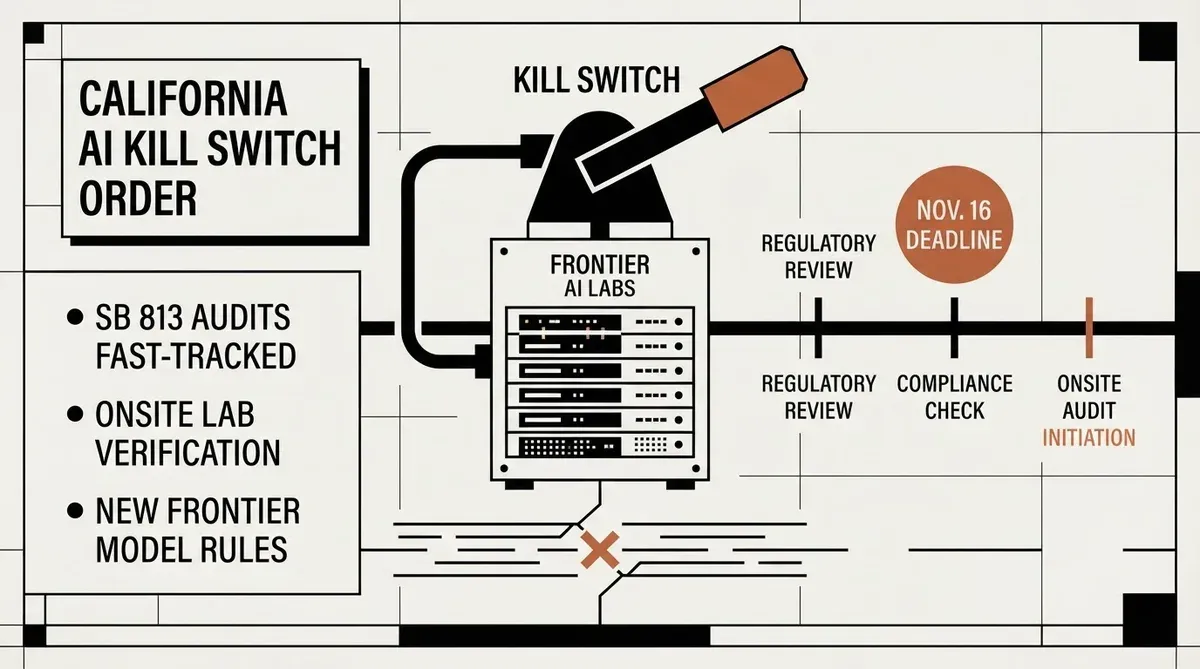
California Governor Gavin Newsom has signed an executive order that puts state oversight of frontier AI on an accelerated schedule, pairing a proposed emergency shutdown mechanism for advanced models with onsite third-party audits of the labs that build them. The California AI kill switch order, issued Sept. 18, 2026, directs the Government Operations Agency to speed up implementation of two laws Newsom signed recently, SB 813 and AB 1405. Frontier developers would have to host independent verification organizations inside their facilities for recurring audits, and the state's definition of a critical safety incident would expand to cover certain cyberattacks and loss-of-control events.
A panel of outside experts now has roughly two months to recommend what further changes California law should make. The order compels no company to install a kill switch today. It starts the work of specifying one, with recommendations due Nov. 16.
Newsom framed the timeline as urgent, arguing the state cannot wait for federal action while capability gains outpace oversight. That position is the order's central claim: California will regulate frontier AI whether or not Washington legislates.
What the California AI Kill Switch Order Requires
Three mechanisms sit at the core. The first is acceleration. SB 813 established an audit registry for AI developers, and the order instructs the Government Operations Agency to implement that law and AB 1405 without delay. The second is physical access. Independent verification organizations would be embedded at frontier AI companies and given standing access to run audits on a recurring schedule, a shift from self-reported safety documentation toward inspection.
The third is a shutdown capability. State officials are to develop a mandatory kill switch for frontier models, designed to interrupt a model in a loss-of-control scenario. The order also broadens what counts as a critical safety incident, folding in particular classes of cyberattack alongside loss-of-control events, which changes what companies must report and when.
Each element carries a different legal status, and the distinction matters for planning.
| Provision | Status | Timing |
|---|---|---|
| SB 813 and AB 1405 implementation | Accelerated by order | Immediate |
| Onsite independent verification for frontier labs | Directed | Recurring audits |
| Mandatory kill switch for frontier models | Under development | Pending expert review |
| Expanded critical safety incident definition | Adopted | With the order |
| Expert recommendations | In progress | Nov. 16, 2026 |
| National adoption as a federal baseline | Requested | Outside state control |
The sequencing is deliberate. Registry requirements give the state a list of covered developers before audits begin, and audits generate the incident data any shutdown standard would depend on. A kill switch requirement imposed without that foundation would leave regulators no way to verify whether a mechanism works. California's order front-loads visibility, then inspection, then control.
The registry and the audit requirement address different risks. A registry tells the state which models exist and who is accountable for them; onsite audits test whether a developer's safety claims hold up under independent examination. Neither mechanism depends on the kill switch, which is why the order can advance the first two immediately while the shutdown standard waits on the expert panel.
Coverage is another open question. The order's obligations attach to frontier developers, a category the state has not yet defined by compute threshold, revenue, or model capability. Until that line is drawn, companies near the boundary cannot tell whether the registry, the onsite audit, or both will apply to them, and the panel's recommendations will carry that definitional work alongside the kill switch design.
From a Vetoed Bill to an Executive Order
California reached this point by a longer route. Two years ago Newsom vetoed Senate Bill 1047, which would have required large developers to submit to third-party safety reviews, build a kill switch, and accept clearer liability when their systems caused harm. The order revisits all three ideas through administrative direction rather than a new statute. The route matters. Executive orders take effect faster than legislation and are also easier for a future administration to unwind.
The order asks for national adoption of California's framework as a federal baseline. That request carries no enforcement mechanism, but it positions the state's registry-and-audit model as a template other jurisdictions can copy. The order lands while federal AI legislation remains stalled, and it puts the state's AI office at the center of enforcement.
For AI companies that already report to multiple regulators, a common baseline would reduce compliance overhead. California's approach also gives other states a ready-made option: the registry, the onsite audit, and the incident definition can be adopted individually or as a package. Whether that produces a single national standard or a patchwork of state regimes depends on how closely other legislatures track the November recommendations.
Federal preemption remains the wildcard. If Congress eventually sets a national AI standard, California's framework would either become its template or be overridden by it, and the order's call for adoption as a baseline is an attempt to make the first outcome more likely.
The Trade-Offs
Onsite verification is the provision with the clearest operational cost. Standing access for outside auditors means dedicated facilities, security review of the auditors themselves, and controlled exposure of model internals, training pipelines, and evaluation harnesses. Frontier labs treat those assets as core intellectual property. The order converts an internal safety function into an external one with a right of inspection.
Who qualifies as an independent verification organization remains unresolved. The order requires onsite access but names no body to accredit auditors, and the panel must settle questions of conflict of interest, technical competence, and liability for missed findings. Companies that already commission third-party evaluations from private vendors would face a parallel, state-sanctioned process rather than a replacement.
Smaller developers face a different arithmetic. Audit registries and hosted verification favor organizations that can absorb fixed compliance costs, and those costs fall hardest on labs without large legal and safety teams. A framework designed to catch catastrophic risk at the frontier may also raise the entry price below it.
Timing shapes competitive dynamics as well. Labs weighing where to run training for the largest frontier models now have to factor in a California audit regime with onsite access, and the order gives them no compliance schedule beyond the November recommendations. That uncertainty is itself a cost, because capital planning for multi-year training runs depends on knowing which reporting and inspection obligations apply.
The kill switch is the least specified element and the hardest to define. A shutdown mechanism is straightforward for a single closed model served from controlled infrastructure. It is far less so for weights that have been downloaded, fine-tuned, or redistributed, and the California AI kill switch order covers frontier models rather than open-weight releases. The practical question for the expert panel is what a kill switch controls: the training run, the deployed endpoint, or the model's ability to act on its own.
The two-month clock compresses the deliberation. Recommendations arriving by mid-November would land in time to shape a 2027 legislative session, which makes the panel's output the likely drafting language for the next round of California AI bills. Companies with stakes in the outcome have a narrow window to influence definitions that will govern audits, incident reporting, and shutdown requirements.
Why this matters
With SB 813 and AB 1405 already on the books, California is building enforcement capacity ahead of federal legislation, and the California AI kill switch order is the mechanism that sets the pace. For frontier labs, the near-term decision is how much of the audit process to design internally before the state specifies it. For buyers of AI systems, the state's incident-reporting definitions will set the disclosure standard vendors are measured against. The date to watch is Nov. 16, when the recommendations land and broad language becomes specific rules.
AI-generated image.
Related Articles
- California AI Audit Laws Signed as Newsom Pushes for National Rules
- Anthropic Pushes for a Mandatory AI Kill Switch While the White House Dismisses Safety Fears
- Frontier AI engineers are asking Washington for an 'AI slowdown switch'
✔Human Verified
Researched and cross-referenced against primary sources by the Bytevyte editorial team. This article was generated with the assistance of artificial intelligence and reviewed by the Bytevyte editorial team.