
Vertiv King Environmental Acquisition Turns Liquid Cooling Into a Service Business
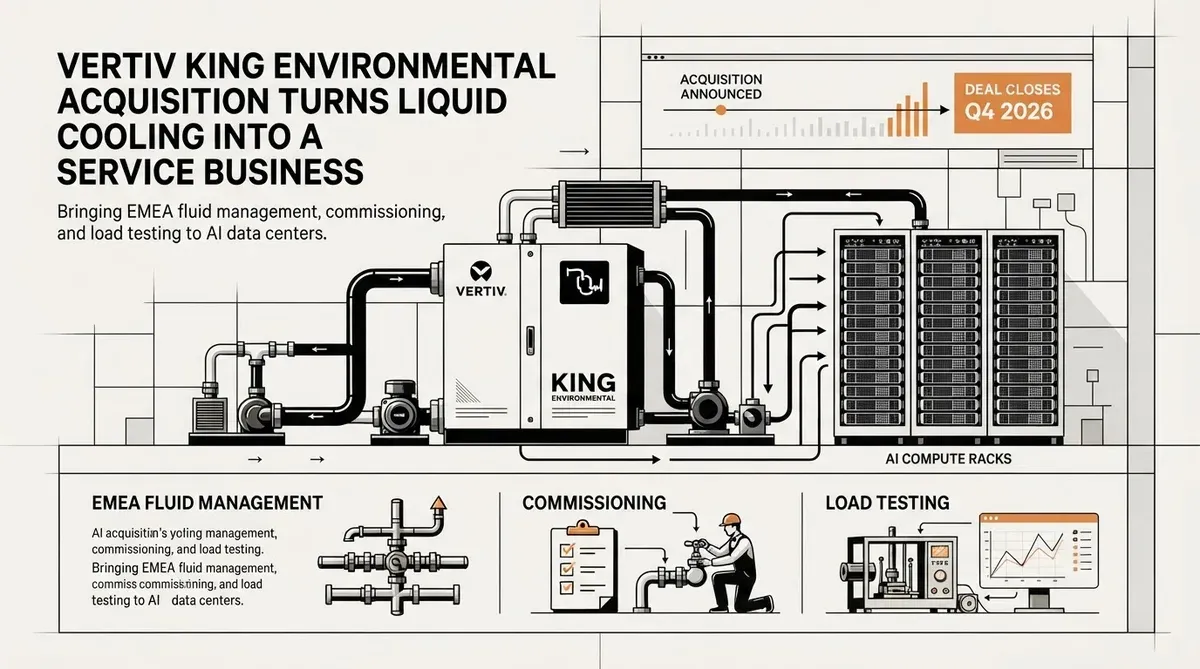
Vertiv has agreed to acquire King Environmental Services, an Ireland-based provider of fluid management and load-testing services for high-density, liquid-cooled data centers. The deal extends the Columbus, Ohio company's thermal management services across Europe, the Middle East and Africa, mirroring a capability Vertiv already built in North America. The Vertiv King Environmental acquisition is the clearest sign yet that the company now treats liquid cooling as a service business, not a hardware catalogue.
King Environmental Services performs the operational work that keeps liquid-cooled facilities from degrading. Its technicians prepare fluid systems, flush pipework, treat and filter water, carry out testing, adjusting and balancing (TAB), run thermal and electrical load tests, and capture data logs and thermography. Vertiv states the purpose directly: preventing contamination, corrosion and flow imbalance in high-density deployments. None of that work appears on a spec sheet, and all of it determines whether a cooling loop still performs years after installation.
Why Fluid Management Decides Uptime
Liquid cooling moves enormous heat through narrow channels, and the fluid carrying it is a working system rather than an inert input. Particulate matter, dissolved minerals and biological growth reduce heat transfer and can block cold plates. Mixed metals in a loop invite galvanic corrosion. Uneven resistance across parallel branches produces flow imbalance, which shows up as hot racks sitting next to cool ones in the same hall. Testing, adjusting and balancing exists to correct that distribution before it becomes an emergency call at 2 a.m.
Load testing is the other half of the job. Before a hall takes production traffic, thermal and electrical load banks simulate the heat and current that real racks will produce, letting operators find a weak branch or an undersized pump while the building is still empty. Commissioning done badly at that stage is expensive to undo later, because a fault buried under a live production floor costs far more to reach than one caught in a bare shell.
Thermography and data logging extend the discipline past commissioning. Infrared imaging catches hot spots that sensors miss, while logged flow and temperature data reveal drift before a threshold alarm fires. For operators running tens of megawatts of dense compute, that is the difference between planned maintenance and an unplanned outage. It is also the work that generates recurring revenue.
What the Vertiv King Environmental Acquisition Actually Buys
Vertiv did not disclose the purchase price and said the transaction is not expected to be material to its financial results. Closing is expected in the fourth quarter of 2026. Read those two statements together and the Vertiv King Environmental acquisition reads as a capability purchase, sized small enough to absorb without balance-sheet drama.
PurgeRite gave Vertiv service depth in North America in 2025. King Environmental Services delivers the same in EMEA. Liquid-cooled capacity is being commissioned across Ireland, the Nordics and the Gulf states, and each market needs crews who understand local water chemistry, filtration practice and flow dynamics. Flying engineers across borders to service those sites is slow and expensive, which is the argument for buying a regional operator instead of building one from scratch.
| Deal | Region | Capability added | Status |
|---|---|---|---|
| PurgeRite | North America | Fluid management and cleaning services for liquid-cooled facilities | Acquired in 2025 |
| King Environmental Services | EMEA | Fluid system preparation, pipework flushing, water treatment, TAB, thermal and electrical load testing, thermography | Announced September 2026; expected to close in Q4 2026 |
EMEA is a fragmented service market. Ireland, the Nordics and the Gulf each impose different water chemistry, climate and regulatory conditions on a fluid system, and one regional organisation is a cheaper way to cover them than building separate national teams. That fragmentation is what made a local operator like King Environmental Services worth acquiring rather than replicating.
Step back and the acquisitions line up along the stack. PurgeRite and King Environmental Services cover fluid management and commissioning. Strategic Thermal Labs and ThermoKey sit inside the thermal portfolio. A proposed UtilityInnovation Group acquisition would push Vertiv upstream into onsite power and microgrid infrastructure for AI data centers. Vertiv is assembling the pieces a customer needs to take a dense hall from empty shell to running load, rather than adding isolated point products.
The pattern matters for anyone selling liquid-cooling hardware. Component supply is crowded, and differentiation at the box level is thin. Owning the crews that flush, balance and test those loops across several regions is harder to copy, and it keeps Vertiv in the room long after the equipment sale closes. A rival can match a cold plate specification. Matching a trained field organisation in four countries takes years.
Service revenue also behaves differently from equipment revenue. It recurs, it carries switching costs once a provider knows a site's loop topology, and it grows as an installed base ages. For a company selling into a build-out cycle that will eventually slow, that recurring layer is a hedge. The catch is that service margins depend on utilisation, and utilisation depends on how much liquid-cooled capacity actually gets commissioned on schedule.
The Strongest Case Against It
The best argument against this deal is that service is a people-heavy, lower-margin business that scales badly. Every region needs trained technicians, spare-parts logistics and management attention, and those costs do not shrink when a customer's build-out slips by two quarters. Services acquisitions can also complicate the story for investors who bought Vertiv for equipment and power margins.
Vertiv's guidance blunts that concern for now, because the company is not asking investors to underwrite a margin reset. The deeper rebuttal is that the alternative carries more risk. If Vertiv ships liquid-cooling hardware into EMEA without controlling commissioning quality, the failures land on its equipment and its reputation regardless of who holds the service contract. Owning the service layer converts that exposure into revenue.
One variable sits outside Vertiv's control. The largest hyperscalers already run in-house mechanical and electrical teams, and some could extend that model to fluid management as their fleets grow. If insourcing spreads, the market for third-party commissioning narrows. The counterweight is that colocation providers and enterprise operators rarely carry that depth, and those are the customers buying service contracts.
What to Watch Before the Deal Closes
- Attach rate. How often Vertiv sells commissioning and lifecycle service alongside new liquid-cooling equipment in EMEA, instead of letting customers tender it separately.
- Integration speed. Whether King Environmental Services retains its existing customer base while adding Vertiv-designed systems to its remit.
- Pricing discipline. Whether bundled service wins on accountability or turns into a discount lever that erodes the margin the deal is meant to protect.
Two dates frame the next phase. The transaction is expected to close in the fourth quarter of 2026, and Vertiv has said it will not move its financial results materially. Between now and then, the useful signal is whether EMEA customers start asking for fluid management in the same conversation as the cooling hardware itself. The Vertiv King Environmental acquisition will not settle that question by itself.
Why this matters
King Environmental Services is not a headline asset. Its value sits in the unglamorous middle of a data center build: the flushing, balancing and testing that decide whether a liquid-cooled hall runs at design capacity or limps along with hot spots and corrosion.
For the people who build, buy or finance AI infrastructure, the signal is that liquid cooling has entered its operational phase. The hardware question is largely settled. The open question is who keeps thousands of fluid loops clean, balanced and monitored across continents, and Vertiv is betting that owning that answer is worth more than adding another product line.
AI-generated image.
Related Articles
- The Vertiv UIG Acquisition Puts a $2.6B Price on AI's Power Problem
- Samsung AI data center cooling gets $158M Gwangju plant
- The Flex EPC Power Acquisition: A $4.4 Billion Bet on AI's Electricity Chokepoint
✔Human Verified
Researched and cross-referenced against primary sources by the Bytevyte editorial team. This article was generated with the assistance of artificial intelligence and reviewed by the Bytevyte editorial team.