
The Flex EPC Power Acquisition: A $4.4 Billion Bet on AI's Electricity Chokepoint
The Flex EPC Power acquisition adds a $4.4B grid-to-chip capability ahead of Flex's Q1 2027 CPI spinoff, signaling where AI capex is heading.
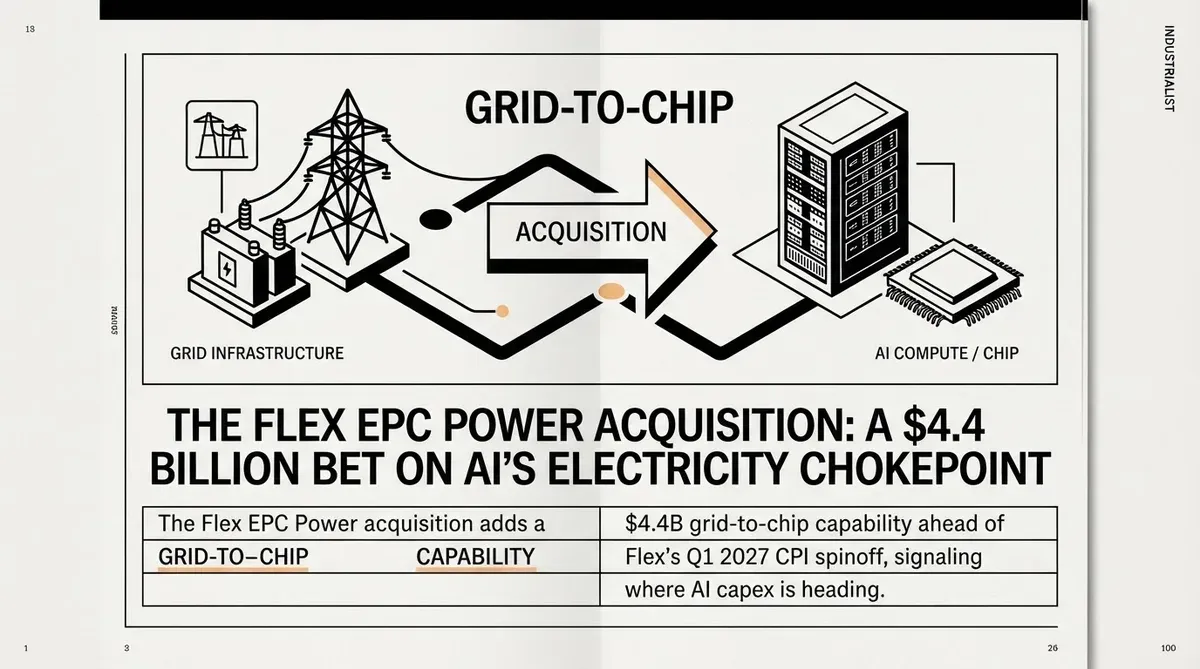
The Flex EPC Power acquisition, valued at $4.4 billion and announced this week, is the largest of three recent deals reshaping who controls the electricity path into AI data centers. Flex (NASDAQ: FLEX) is folding the San Diego-based power conversion specialist into its Cloud and Power Infrastructure (CPI) segment, with closing expected in the fourth quarter of calendar 2026.
EPC Power builds the equipment that sits between the utility grid and the server rack. Its product line spans grid-forming converters, rectifiers, DC-DC conversion systems and solid-state transformers that condition power for high-density AI racks built on 800-volt architectures. Flex describes the combination as an integrated grid-to-chip portfolio. EPC Power has deployed more than 15 GW across 62 countries, and its U.S. manufacturing capacity is projected to exceed 30 GW by 2027.
The financial plan explains the price. Flex expects EPC Power to generate roughly $800 million in revenue during 2026, and it projects about 40% organic growth with an EBITDA margin near 30% for 2027. On those assumptions, 2027 revenue would land around $1.1 billion and EBITDA in the $330 million range. Flex intends to spin off the combined CPI business as an independent public company in the first quarter of 2027, which makes those figures the opening earnings story of the new listing.
What the Flex EPC Power acquisition signals
The Flex EPC Power acquisition is the third power-infrastructure purchase of its size in about a month, after nVent's $1.75 billion agreement for Maverick and Vertiv's move for UIG at up to $2.6 billion. Three deals concentrated on the same link in the delivery chain point to one conclusion: the practical constraint on AI buildout has shifted from compute supply to the path that moves electricity from the grid into the chip, and owners of that path now command prices to match.
For operators standardizing on 800-volt rack architectures, the wave brings consolidation at the moment the technology moves from pilot deployments into standard builds. Fewer, larger suppliers in the power layer means lead times and pricing for conversion gear are increasingly set by balance sheets sized for billion-dollar deals rather than by component startups.
Why this matters
Flex is paying $4.4 billion for a business expected to deliver about $800 million in revenue this year and to compound near 40% with roughly 30% EBITDA margins in 2027, then float it as a standalone public company within months of closing. The wager is that whoever owns the conversion layer between grid and chip keeps a durable share of AI capital spending, and that thesis now has a market price. With closing targeted for the fourth quarter of 2026 and the CPI spinoff planned for early 2027, investors will get their first independent read on that math within about six months.
AI-generated image.
Related Articles
- The Vertiv UIG Acquisition Puts a $2.6B Price on AI's Power Problem
- Emerald AI's $150M round puts a $1.05B price tag on flexible grid assets
- Why the Musk Gas Turbine Acquisition Exposes AI's Dirty Power Secret
✔Human Verified
Researched and cross-referenced against primary sources by the Bytevyte editorial team. This article was generated with the assistance of artificial intelligence and reviewed by the Bytevyte editorial team.