
Emerald AI's $150M round puts a $1.05B price tag on flexible grid assets
Emerald AI raised $150M at a $1.05B valuation to make AI data centers flexible grid assets, backed by Nvidia and 12 Fortune Global 500 investors.
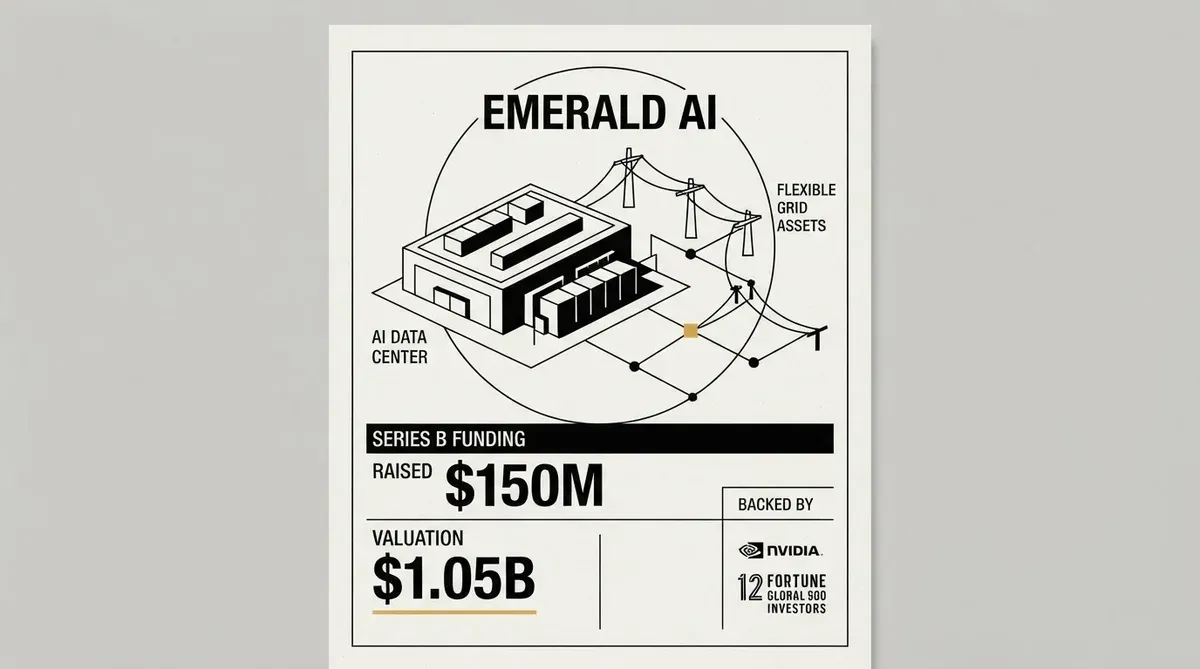
Emerald AI has closed a $150 million Series A, an oversubscribed round that values the company at $1.05 billion and makes it a unicorn. Announced August 25, the round was led by Energize Capital and DCVC and drew financial and strategic investors as well. The shareholder register lists 12 Fortune Global 500 companies, and lifetime funding now stands above $220 million.
The software at the center of the deal lets AI data centers trim or postpone their power draw at times of grid stress. Instead of treating a facility's load as a fixed cost, the system turns it into a resource the grid operator can dispatch, with the campus selling flexibility back to the network. That framing is why the round pulled in energy, hardware, and software investors rather than a single financial backer.
Dr. Varun Sivaram, a former climate policy official in the Biden administration, runs the company as CEO. Emerald AI incorporated in Washington, D.C. last year and maintains a sizable presence in Arlington County, Virginia, close to federal energy regulators and the utilities that operate the eastern grid. The company has set a target of unlocking more than 100 gigawatts of currently unused U.S. grid capacity.
The Washington-area footprint is not incidental. Federal energy policy and regional grid rules determine how much value flexible load can capture, and being headquartered near the agencies that set those rules shortens the distance between product development and regulation. Arlington also sits inside one of the country's densest data-center corridors, where utilities are already working through how to serve accelerating AI demand.
Who is backing the flexible grid assets play
The shareholder list reads like a cross-section of the AI supply chain. Nvidia and Samsung Ventures sit on the chip side; Siemens and GE Vernova cover grid equipment and industrial automation; RWE, Aramco Ventures, and JERA Ventures represent generation and energy supply; Salesforce Ventures brings enterprise software; and In-Q-Tel ties the company into U.S. government technology needs.
| Investor | Role in the value chain |
|---|---|
| Nvidia, Samsung Ventures | Semiconductors and AI hardware |
| Siemens, GE Vernova | Grid equipment, industrial automation |
| RWE, Aramco Ventures, JERA Ventures | Power generation and energy supply |
| Salesforce Ventures | Enterprise software |
| In-Q-Tel | U.S. government technology |
The presence of generation and grid companies carries more weight than the headline figure. When a utility or an equipment maker invests, it usually signals a procurement path rather than a product experiment. For Emerald AI, that mix suggests the software will be evaluated against real interconnection and capacity-planning workflows. Read as a supply-chain signal, the round prices flexible grid assets as a standard layer of AI infrastructure rather than a niche demand-response program.
Nvidia's participation deserves particular attention because it links compute sales to power availability. Chip revenue depends on data centers being built and operated at scale, and the constraint on that growth is increasingly the grid. A software layer that unlocks capacity by making loads flexible helps every hardware vendor downstream, which explains why a semiconductor company would take an early stake in what is nominally an energy software business.
The financing also reflects how the AI infrastructure market is changing. Data-center demand has grown faster than the grid's ability to serve it, and power availability now shapes where new AI capacity can be built. A company that makes facilities more responsive to grid conditions attacks that bottleneck without waiting for new transmission lines or power plants.
Why power flexibility is becoming a competitive requirement
Data centers have historically run as near-constant loads. Operators buy firm power, and utilities plan around a demand profile that barely moves. That model is under strain as AI workloads multiply capacity needs and grid operators in several regions manage tighter supply-demand balances. Across much of the U.S., interconnection queues stretch for years and new generation is slow to come online, which makes shiftable load an attractive near-term answer. Load that can be curtailed or shifted on short notice changes the planning calculus: it can be served by capacity that would otherwise sit idle, and it lowers the cost of keeping the system stable.
Emerald AI's approach is software-defined rather than hardware-heavy. Facilities keep their normal equipment; the software decides when to defer non-critical work, move training jobs, or cut draw during peak stress events. For a hyperscaler or colocation provider, that capability means lower exposure to high-price periods and a stronger case when applying for interconnection. The economics of flexible grid assets hinge on how much shiftable load a facility can sign up, which is why the company is chasing gigawatt-scale contracts rather than individual buildings.
Flexibility has a long track record in power markets. Utilities have paid large industrial customers for years to cut load during peak events, and grid operators already lean on such programs for stability. What is new is applying that logic to AI workloads, where a single campus can draw hundreds of megawatts and where training schedules are often deferrable by design. Software that automates the trade-off between compute output and power price turns a technical constraint into a managed business decision.
The trade-off inside that model is worth stating plainly: shifting or curtailing load means some compute work happens later or at lower priority. For training jobs that are not time-critical, the cost of waiting can be small relative to the electricity savings; for latency-sensitive inference, flexibility has to be applied selectively. That distinction is likely to determine how far the software can push adoption, because every facility carries a different mix of deferrable and non-deferrable workloads.
Measured against the size of the problem, the round is modest: $150 million in a market counted in hundreds of gigawatts of potential flexible load. The $1.05 billion valuation expresses confidence that the category itself will expand as operators adopt flexibility as a standard part of data-center design.
What decision-makers should watch next
For CIOs and infrastructure teams, the takeaway is that power management is moving from a facilities concern to a software procurement decision. The load-shifting logic utilities have used in demand response for decades is being productized for AI workloads, and capacity planning and power purchase agreements should now include flexibility requirements.
For investors, the deal is a data point on where AI infrastructure spending is heading. The largest commitments in the sector have gone to chips, models, and physical data-center construction; this round signals that the operating layer between hardware and electricity is starting to attract serious capital. With Nvidia and several utility-linked funds on the cap table, follow-on rounds will likely be judged on measurable grid impact rather than customer counts alone.
The 100+ gigawatt target frames what success looks like. If flexible grid assets become a standard procurement category, Emerald AI's value becomes a function of how much shiftable load it can contract, not how many facilities it owns. That asset-light structure is what makes the model scalable, and it is also what separates the company from developers who raise capital to build and own data centers.
Why this matters
AI's growth is now constrained by the power grid as much as by compute, and Emerald AI is betting that the fix is software that turns data-center demand into an asset for grid operators. This round puts a concrete price on that idea, and the next milestone to watch is whether hyperscalers and utilities convert the company's 100+ gigawatt target into signed flexibility agreements. For the industry as a whole, the lesson is that the next phase of AI infrastructure competition will be decided by power availability as much as by silicon.
AI-generated image.
Related Articles
- Nvidia Lancium Investment Moves the AI Race onto the Grid
- National Grid's $1.75B Bet on Dedicated AI Power
- Nvidia Cloverleaf Infrastructure investment: buying the power behind the AI buildout
✔Human Verified
Researched and cross-referenced against primary sources by the Bytevyte editorial team. This article was generated with the assistance of artificial intelligence and reviewed by the Bytevyte editorial team.