
Crusoe Series F Hits $30.9B as New York Bills $1M per MW [Update]
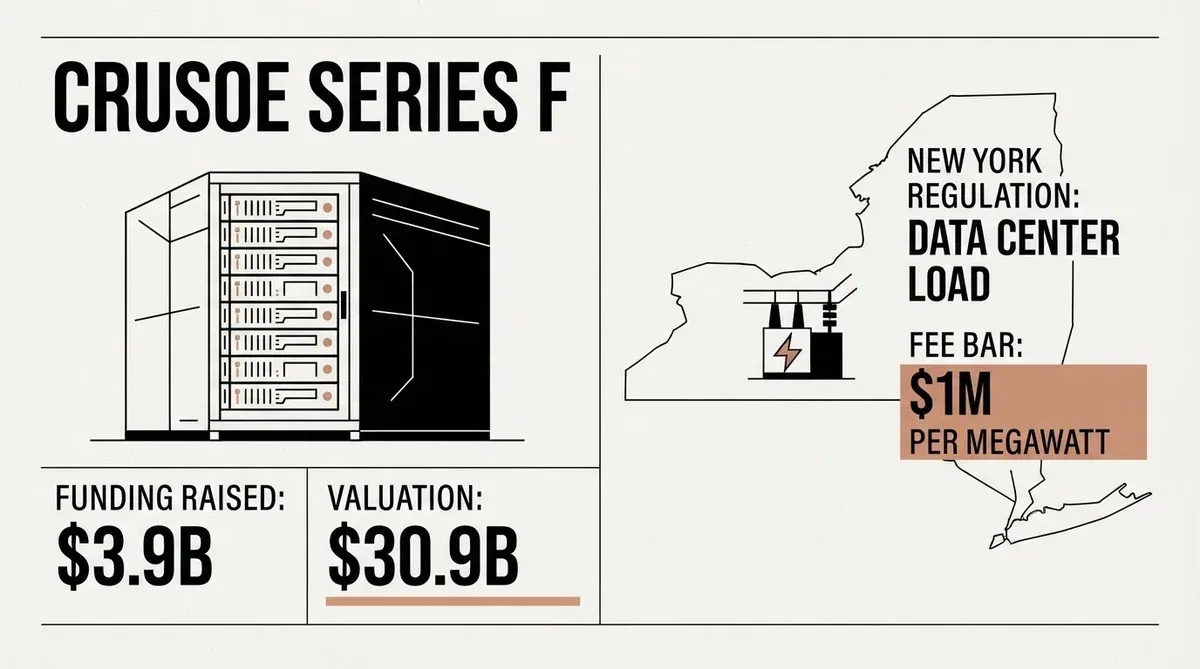
Crusoe just closed the first tranche of its Series F round: $3.9 billion, at a $30.9 billion post-money valuation for the Denver company, roughly triple what it was worth about ten months ago. Tripling in ten months is a startling re-rating, and it landed in the very same week New York State published guidance urging towns to charge data center developers $1 million per megawatt of utility demand before approving a project. The two moves pull in opposite directions, and that tension is the story: investors are funding megawatts wherever they can be built fastest, while host communities are starting to bill for the privilege of hosting them.
The Crusoe Series F round was co-led by Atreides Management, Mubadala Capital and Valor Equity Partners. Founders Fund, GIC, NVIDIA, the Qatar Investment Authority, Radical Ventures and TPG joined, alongside Altimeter, ARK Invest, Baillie Gifford, Fidelity, Salesforce Ventures, Tiger Global and Robinhood Ventures Fund. Crusoe counts roughly 29 investors in the wider syndicate.
The investor mix carries its own signal. Three institutional and sovereign funds share the lead, and NVIDIA put money into a company that buys its accelerators and competes partly on inference speed. Mubadala Capital, the Qatar Investment Authority and GIC all bring capital suited to long-dated infrastructure returns rather than venture-style exits.
Bytewrite covered the reported shape of this raise earlier this month, when it was expected to land near a $30 billion valuation. The official initial close confirms $30.9 billion, on an oversubscribed round with more than two dozen backers beyond the three co-leads. Robinhood Ventures Fund I disclosed buying about $25 million of Crusoe preferred stock, a transaction that closed on August 31, 2026.
What the Crusoe Series F round buys
Crusoe reported total contracted value across its platform above $140 billion, with gross contracted capacity above 6 gigawatts, of which 1 GW is delivered and operational.
| Metric | Figure |
|---|---|
| Series F initial close | $3.9 billion |
| Post-money valuation | $30.9 billion |
| Valuation roughly ten months earlier | About $10 billion |
| Total contracted value | More than $140 billion |
| Gross contracted capacity | More than 6 GW, with 1 GW operational |
| Crusoe Managed Inference ARR | Above $100 million |
Crusoe Cloud bookings grew more than 20 times year over year in 2026, and Crusoe Managed Inference passed $100 million in annual recurring revenue. The company reports inference performance up to 9.9 times faster time-to-first-token and 5 times higher throughput than vLLM. Crusoe's headcount now exceeds 1,800 people spread across five countries, and new offices are opening in Bellevue, Washington, and in New York City.
The gap between contracted and delivered capacity is where the risk sits. More than 6 GW is contracted; 1 GW is running. A $30.9 billion valuation is priced against capacity that largely does not exist yet, and the $140 billion contracted figure runs about 4.5 times the valuation. Bookings growth of 20 times against just over $100 million in annual recurring revenue shows how much of that value is commitment rather than cash collected.
Crusoe's answer is vertical integration: it manages power from the source through the data center rather than renting both. The capital plan splits between large campuses and modular, truckable Crusoe Spark units built to move to sites with spare power. Customers include OpenAI, Cognition, Figure and Perplexity, and OpenAI trained its Astra model on Crusoe infrastructure. The company also supplies cloud and data center services to Meta, Microsoft and Oracle.
New York puts a price on the same megawatt
Governor Kathy Hochul's office introduced the Community Investment Framework as guidance for towns negotiating with data center developers. Empire State Development, the state's economic development agency, describes it as a structured approach to identifying, negotiating and documenting developer investments that address local priorities.
The framework sets six expectations for negotiations:
- A community investment benchmark of $1 million per megawatt of utility demand
- Long-term planning, including what happens to the site when a data center leaves
- A roadmap for managing ongoing project costs
- Named local priorities such as roads, water systems, housing, schools, child care and workforce training
- Confirmation that funded projects are locally owned
- Clear timelines for multi-year, phased investments
The framework is voluntary, not a binding state fee. Applied literally, a 50-megawatt facility carries a recommended $50 million community investment. Developers have requested roughly 9,000 MW from the New York grid, which at the $1 million-per-megawatt benchmark works out to about $9 billion reaching host towns.
New York's one-year moratorium, signed in July, covers projects larger than 50 MW and is described by the Governor's office as the first statewide pause on hyperscale data centers. More than 500 jurisdictions across the United States have imposed similar temporary bans or moratoriums. Because the pause covers projects above 50 MW, the framework's near-term effect falls on deals below that threshold or on negotiations that resume once the moratorium lifts.
Hochul's office framed the guidance as a tool for communities that do want to host hyperscale facilities and as a way to keep towns from being taken advantage of while federal rules remain absent. Nearly 100 organizations wrote to the Governor before the framework was released, arguing that a comprehensive environmental review should come first. That pushback suggests the $1 million benchmark is being challenged as too low, or at least premature.
The same megawatt, two prices
For a developer, $1 million per megawatt is a siting cost. A 1 GW campus in New York would carry a recommended $1 billion in community investment before land, interconnection or construction. The $3.9 billion Crusoe Series F raise would cover the benchmark for roughly 3.9 GW of New York load, leaving nothing for the hardware those megawatts are meant to run.
Crusoe's megawatts and New York's requested megawatts are the same commodity. The state's roughly 9,000 MW of developer requests is 1.5 times Crusoe's entire contracted global portfolio, which shows how concentrated demand has become in a handful of jurisdictions.
That arithmetic makes modular capacity strategically useful. Truckable Crusoe Spark units can be aimed at sites with spare power and lighter conditions, and vertical integration means Crusoe controls generation instead of buying it at whatever price a utility sets.
The trade-offs cut both ways. A $1 million-per-megawatt benchmark gives towns leverage, and it also gives developers a reason to look elsewhere. New York already pauses projects above 50 MW, and the framework's demand for exit planning concedes that a data center can leave. Crusoe's mobility lowers its exposure to any single jurisdiction while tying more capital to physical assets that cannot be redeployed quickly.
The demand side sharpens the siting question. Research by Jessica Wachter, a finance professor at the University of Pennsylvania's Wharton School, estimates hyperscaler data center spending will approach $1.1 trillion by 2027 and calculates that AI companies need productivity gains of about 2.7 times to break even by 2030, assuming a 15% return on capital and depreciation of the assets. Her paper concludes that missing those returns would risk missed interest payments, bankruptcies and what it calls the largest capital misallocation in history.
Money moved toward the same physical bottlenecks elsewhere in the 24 hours around the close. EVAS Intelligence raised nearly RMB2 billion for RISC-V-based cloud AI chips at a reported post-money valuation approaching RMB15 billion, Zhongke Guosheng added RMB600 million for domestically developed light gas turbines, and Xili Optoelectronics secured RMB100 million-scale financing for photonic chips used in high-speed data center links. Power, interconnect and compute are drawing the capital; the application layer is not.
Why this matters
Two documents published within days of each other now set terms for the same asset. Crusoe's $30.9 billion valuation says a megawatt of contracted AI capacity can be financed at industrial scale, while New York's framework says that same megawatt owes the town hosting it $1 million. The next wave of data center deals will turn on which of those two prices developers can move, and whether the megawatts land in New York or in jurisdictions with lighter terms.
See our earlier coverage: Crusoe $30 billion valuation puts contracted GPU revenue to the test
AI-generated image.
Related Articles
- Crusoe $30 billion valuation puts contracted GPU revenue to the test
- New York Data Center Moratorium Reshapes AI Economics
- Crusoe Perplexity Cloud Deal Locks Up GB300 Capacity Across the Full Model Lifecycle
✔Human Verified
Researched and cross-referenced against primary sources by the Bytevyte editorial team. This article was generated with the assistance of artificial intelligence and reviewed by the Bytevyte editorial team.