
DeepSeek Revenue Run Rate Doubles to $1 Billion as API Margins Hold
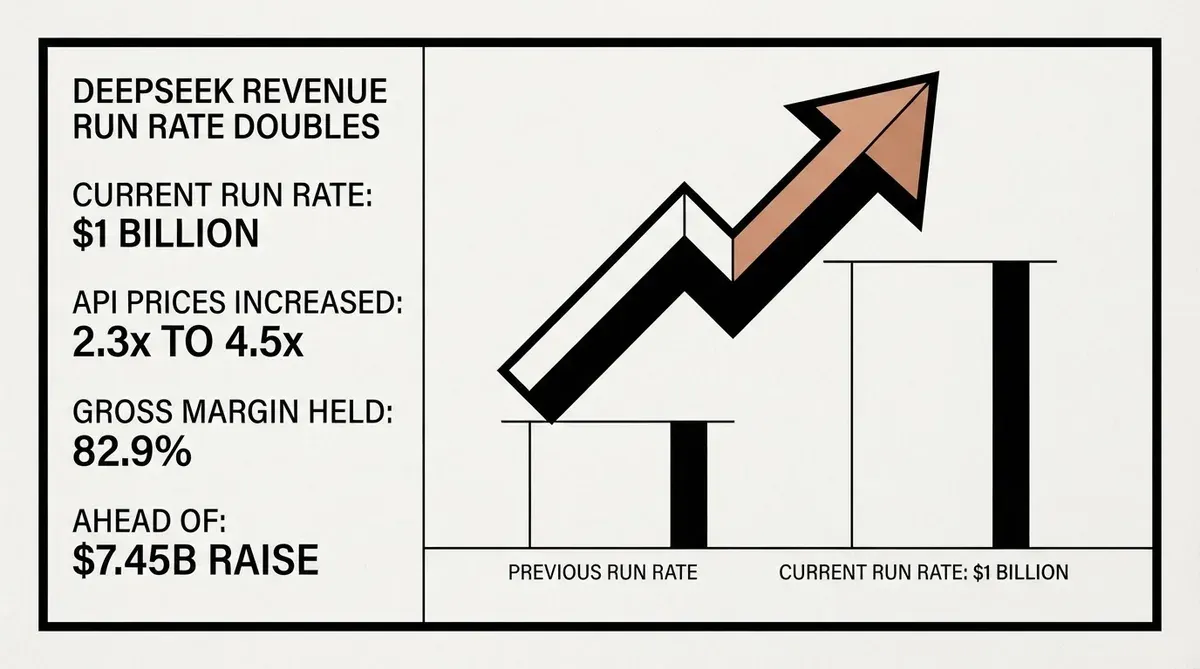
DeepSeek has pushed past a $1 billion annualized revenue run rate, more than doubling a level that sat below $500 million just months earlier, as the Chinese developer finalizes a fundraising round of roughly 50 billion yuan. The DeepSeek revenue run rate now rests on an unusual set of levers: API prices raised between 2.3 and 4.5 times, customer attrition that stayed low, and an 82.9% gross margin on API access through July.
The company booked about 475 million yuan, or roughly $70.7 million, across the first seven months of 2026, a tenfold jump against its cumulative total before this year. The round is targeting a close by the end of October, and DeepSeek has signalled plans to list in Shanghai.
Taken together, the numbers describe a company that raised prices in the middle of an industry price war and kept its customers anyway. That is the part worth examining.
How the DeepSeek Revenue Run Rate Adds Up
Every metric in the current disclosure reinforces the others. Revenue roughly doubled in a matter of months while list prices climbed by more than double, which means usage held rather than collapsed when the invoice went up.
| Metric | Figure |
|---|---|
| Annualized revenue run rate | Above $1 billion, up from under $500 million |
| Revenue, first seven months of 2026 | About 475 million yuan (~$70.7 million) |
| Growth versus prior cumulative total | 10x |
| API price increase | 2.3x to 4.5x |
| API gross margin through July | 82.9% |
| Target raise | About 50 billion yuan (~$7.45 billion) |
| Reported valuation | 500 billion yuan |
| Target close | End of October 2026 |
The 82.9% gross margin carries the most weight of any figure here. It shows how much of each additional yuan of API spending reaches gross profit instead of being consumed by serving costs. On a $1 billion run rate, that margin implies close to $829 million in annualized gross profit at the API layer.
That is what makes the valuation conversation possible. A 500 billion yuan valuation converts to somewhere between $50 billion and $74 billion depending on the exchange rate and the reporting, with most published figures landing near $70 billion. Against the DeepSeek revenue run rate of $1 billion, buyers are being asked to pay roughly 70 times current annualized sales. Enterprise software has traded at those multiples, though usually with multi-year contracts that make the next twelve months predictable. DeepSeek sells metered inference, where a customer can move to a rival endpoint through a configuration change.
Why the Price Increase Held
Pricing power is the harder half of this story. An increase of 2.3 to 4.5 times on API access is the kind of move that normally triggers a migration wave, particularly in a market where several capable Chinese models compete on cost. The absence of meaningful attrition suggests the buyers who stayed were not paying for the cheapest token. They were paying for model behaviour they had already built product around, and switching costs measured in engineering hours outweighed the new price.
That reading has a limit. Customers who absorb one increase are not committed to a second, and DeepSeek has not disclosed how much of its API revenue sits with a small number of accounts. Concentration would make the 82.9% margin durable in the short term and fragile across a full budget cycle.
The round has had a bumpy path. It was paused in July after leaked remarks by founder Liang Wenfeng circulated on Chinese social media, then restarted in August. The structure is designed to preserve founder control as outside capital arrives, which means investors are buying exposure to Liang's roadmap without much ability to change it.
Gross margin at the API layer measures unit economics rather than company profit. DeepSeek has also recorded a net loss, which fits a business funding heavy compute expansion while charging prices that cover serving costs. Anyone comparing the 82.9% figure with margins quoted by larger labs should check what each number includes, because they rarely measure the same thing.
Where the Cost Base Comes From
The compute constraint explains the pricing decision better than ambition does. DeepSeek has shifted a portion of its inference workloads onto Nvidia gaming GPUs to work around compute shortages. Access to top-tier datacenter accelerators is restricted for Chinese buyers, so the company serves part of its traffic on hardware that costs less per unit of throughput than the parts its competitors buy by the rack.
That choice is not free. Gaming cards carry less memory bandwidth per board, so serving the same model efficiently takes more engineering, more careful batching, and more tolerance for failure at the edges of capacity. It raises the value of optimisation work and lowers the value of raw capital. DeepSeek's cost advantage is therefore partly a technical asset, and technical assets depreciate when competitors hire the same people or publish the same methods.
The contrast with the largest Western labs is instructive. Those companies are committing tens of billions of dollars to datacenters and premium accelerators, which buys certainty about capacity and a wide margin for error. DeepSeek is buying the same output through a narrower, cheaper path that leaves less room for mistakes. Both strategies can carry a company to a $1 billion revenue run rate. Only one of them can defend an 82.9% gross margin when prices fall, which is what a price war eventually forces.
What the Price War Actually Rewards
The past two years of model releases have been read as a contest of capital: larger training runs, bigger clusters, longer commitments from hyperscalers. DeepSeek's numbers point to a different scoreboard. A company that controls its serving costs can cut prices and still hold margin, while a company that rents capacity at premium rates has to choose between market share and profitability every time a rival moves first.
The size of the raise relative to the business is worth sitting with. Investors are committing about $7.45 billion against a $1 billion annualized run rate, roughly seven years of current revenue in a single round. That capital has an obvious destination: compute. A company routing inference through gaming GPUs does not lack ambition, it lacks capacity, and the round is built to convert investor money into serving headroom before demand outruns the workarounds.
The Shanghai listing plan connects directly to the revenue story. A domestic listing gives DeepSeek access to Chinese retail and institutional capital that is largely closed to its Western peers, and it gives employees and early backers a way to realise value. It also imposes disclosure. Once the company files, the gap between an 82.9% API gross margin and a net loss becomes a public document rather than an investor conversation, and the market will price that gap directly.
The open question is whether the pricing power survives. Inference costs keep falling across the industry, and every reduction gives a competitor room to undercut without losing money. DeepSeek's defence is that its own cost base falls at the same time or faster. The 82.9% margin through July is evidence for that claim, not proof of it. The end-of-October close and the eventual listing prospectus are the next two places the claim gets tested.
Why this matters
For anyone buying or building on AI infrastructure, price is a weak proxy for durability. The vendors most likely to hold their terms through the next round of cuts are the ones whose serving costs are structurally lower, and DeepSeek has now shown that an increase of up to 4.5 times can coexist with doubling revenue and a margin near 83%. Buyers negotiating multi-year inference contracts should ask about cost structure, not just headline rates, because that is what determines whether a supplier can afford to keep the discount it just offered.
AI-generated image.
Related Articles
- DeepSeek API Price Hike Signals End of Ultra-Cheap AI Era
- DeepSeek Funding Round Targets $7.4 Billion as Valuation Hits $59 Billion
- DeepSeek Funding Round Targets $10B Valuation
✔Human Verified
Researched and cross-referenced against primary sources by the Bytevyte editorial team. This article was generated with the assistance of artificial intelligence and reviewed by the Bytevyte editorial team.