
Diablo IV Switch 2 Debut Bundles Both Expansions at $69.99
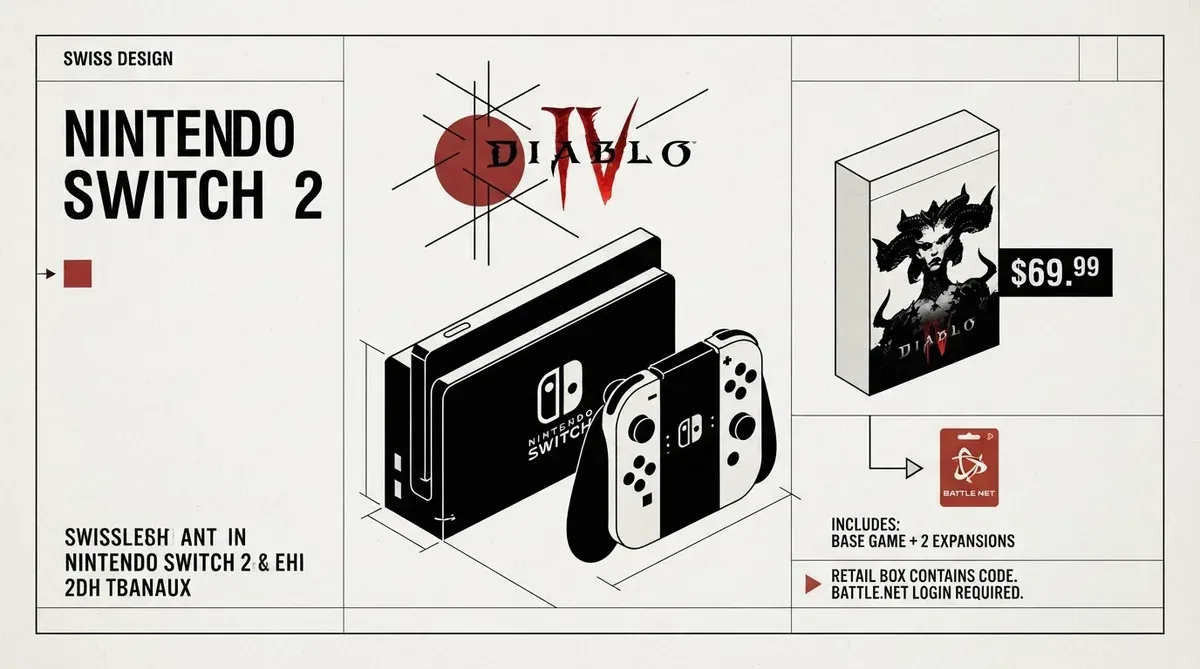
Blizzard Entertainment has released Diablo IV for Nintendo Switch 2, ending nearly three years of speculation about whether the studio's live-service action RPG could run on a handheld. The Diablo IV: Age of Hatred Collection arrived on 15 September 2026 at $69.99, £62.99 or €69.99. The package combines the base game with the Vessel of Hatred and Lord of Hatred expansions.
Retail listings and store packaging appeared in North America ahead of the official announcement. The version is built for Switch 2 alone. Blizzard has not announced a release for the original Switch, which limits the potential buyer pool to owners of the newer console.
What Diablo IV Switch 2 Buyers Get
The port ships with the current state of the game rather than the 2023 launch build. That includes the Nahantu and Skovos regions, the three classes added after release in the Spiritborn, Paladin and Warlock, and years of reworked item and progression systems.
Release day coincides with Season 15, Season of Hell's Legacy, which also went live on 15 September. Cross-play and cross-progression carry over from PC, PlayStation and Xbox, so a player's existing character transfers to the handheld with no separate save file and no restart.
Aligning the launch with a season reset gives Blizzard an extra advantage. New Switch 2 owners begin on the same progression track as everyone else, rather than joining mid-season behind players who have already banked weeks of seasonal rewards.
Elsewhere the base game and its two expansions are sold as three separate purchases. The Switch 2 version arrives as a single line item, which simplifies the decision and removes the option of buying the base game alone.
Nintendo's Switch 2 catalogue has relied heavily on full-price ports of games that launched on other hardware first, and this release follows the same pattern. There is no discount for the years since the original debut; buyers pay current-generation pricing for content that has already been through two expansion cycles.
A Retail Box Without a Cartridge
Physical copies are code-in-box products. The packaging contains a download code instead of a game cartridge or a Game-Key Card, so the box occupies shelf space while the software itself stays on the eShop.
An internet connection and a Battle.net account are both required to play. Those conditions limit what an owner can do with the purchase. A code cannot be lent, resold, traded or passed to a friend the way a cartridge can, and the account link keeps progress inside Blizzard's ecosystem rather than on the console. Blizzard's eShop listing states both requirements plainly, so the restriction is visible before purchase rather than discovered after unboxing.
| Market | Price | Retail format |
|---|---|---|
| United States | $69.99 | Code in box |
| United Kingdom | £62.99 | Code in box |
| Eurozone | €69.99 | Code in box |
The box and the digital version cost the same in every market, so the physical edition adds nothing beyond gifting or shelf presence. The price matches what Blizzard charges for the same bundle on other platforms, which places the collection in the top tier of Switch 2 software instead of at a discount for arriving years late.
Can a Seasonal Game Hold a Handheld Audience?
Retention is the open question. Diablo IV operates as a live-service title, with seasonal updates, an expansion cadence and online features built to bring players back at regular intervals. Nintendo's audience has historically bought software as a one-off transaction, and a bundle that already includes both expansions removes the most obvious reasons to spend again soon.
Folding everything into one purchase raises the entry price while giving newcomers a complete campaign arc across several storylines. That is the strongest argument Blizzard can make to someone who has never touched Diablo IV. It also shifts the burden onto the seasonal loop, because the end of the campaign is the point at which a handheld player decides whether to keep going. Season 16 will be the first real signal, since anyone who works through the story before then has to judge whether grinding, seasonal resets, online events and matchmaking queues suit a portable device.
Existing owners face a different calculation. Someone who already bought the base game and expansions on another platform pays the full $69.99 again for portability, with cross-progression as the offset. That is a workable pitch for players who want the game on the move and a weak one for anyone who mostly plays at a desk. Blizzard has not attached performance targets for the handheld build to the announcement, leaving frame rate and resolution as the details most likely to settle that group's answer.
The audience splits three ways. A first-time player gets the cheapest route into the game and a fixed amount of content to work through. A lapsed owner has to decide whether portability justifies paying again for material already owned. A current seasonal player is buying an extra screen for an account that already exists, which makes that group the most likely to convert and the easiest for Blizzard to measure.
The commercial logic cuts both ways for the studio. Bringing the Switch 2 inside the content roadmap means future expansions need to support the hardware, which adds development work a single-platform release would not require. A fourth player base also feeds the same seasonal calendar, and that shared schedule is what keeps a live-service game's events and matchmaking populated.
Why this matters
The Diablo IV Switch 2 debut tests whether a full-price, always-online seasonal game can build a recurring audience on Nintendo hardware, where most successful software is bought once and played offline. If retention holds, the platform becomes credible for live-service releases that Nintendo's own catalogue does not cover, and Blizzard gains a fourth active player base to feed into the same seasonal calendar. If it does not, the collection still lands as a premium one-off sale, the exact outcome the live-service structure exists to move past.
AI-generated image.
Related Articles
✔Human Verified
Researched and cross-referenced against primary sources by the Bytevyte editorial team. This article was generated with the assistance of artificial intelligence and reviewed by the Bytevyte editorial team.