
Etsy Layoffs Trim 12% of Staff as CEO Denies AI-Driven Cuts
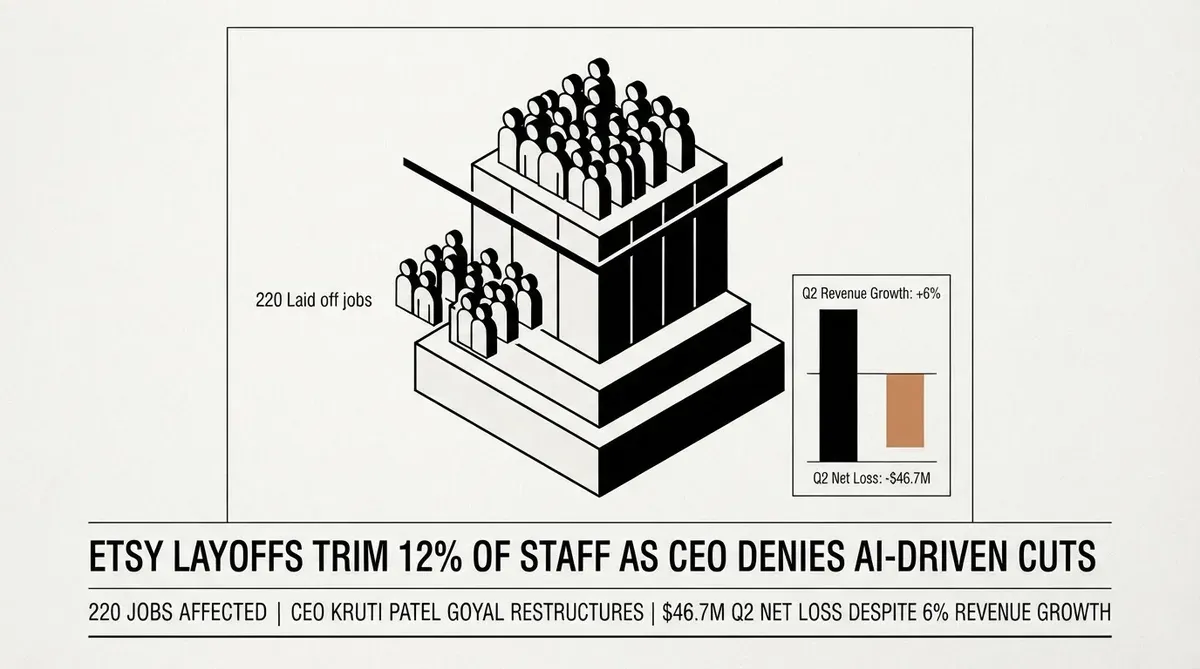
Etsy is cutting roughly 220 jobs, about 12% of its workforce, according to a securities filing from August 5. The filing says CEO Kruti Patel Goyal is moving the marketplace toward a leaner operating model, with faster coordination and speedier decision-making as the stated goals. The Etsy layoffs arrive alongside second-quarter results that showed a net loss of $46.7 million on revenue that grew 6% year over year, which puts the cost structure at the center of the story.
What the Restructuring Changes
Most of the affected positions are in product and engineering, the two functions that build and maintain the features buyers and sellers use every day, according to the filing. The shareholder letter says Etsy expects headcount to settle near 1,600 employees after the reduction, down from roughly 1,830 before the move. The same letter describes the plan as removing management layers without shrinking any single product line. In that letter, Goyal rejected the cost-cutting and AI-replacement explanations, framing the move as a structural change that leaves the organization flatter and faster.
That preemptive framing is itself a data point. Layoffs in an AI-heavy news cycle now trigger an immediate automation question, and companies have learned to answer it before it is asked. The shareholder letter answers it explicitly, and the sequencing is telling: the AI shopping push and the workforce reduction are moving through the company in the same period.
Etsy disclosed the plan through two channels: the August 5 securities filing and a shareholder letter laying out the reasoning. The dual disclosure is standard for a restructuring of this size, but the letter does additional work here because it is where the CEO explicitly separates the layoffs from the AI narrative.
Why the Etsy Layoffs Are Hard to Separate From AI
The timing is the problem. Etsy has said it is integrating artificial intelligence directly into the shopping experience, including a ChatGPT-powered app built for natural-language search. The idea is that shoppers describe what they want in plain language and get matched to relevant listings, a meaningful change from the keyword-driven search that has defined online marketplaces.
Here is the tension I keep coming back to. Saying workers were not replaced by AI is a narrow claim, and betting a growing share of the roadmap on AI is a different one; Etsy is doing both at once. No individual role may have been swapped for a model, but a 12% reduction concentrated in product and engineering changes what the company can build in the coming quarters. The ChatGPT shopping app becomes a larger bet carried by a smaller team.
The app matters strategically because it targets discovery, which is the core of marketplace economics. Search and discovery determine conversion, and conversion determines whether sellers stay. If natural-language shopping works as Etsy intends, it upgrades the discovery layer without adding inventory; if it stalls, the company has cut the teams best positioned to iterate on it.
There is also a signaling effect worth naming. When a CEO publicly denies an AI motive for layoffs, investors and the press are usually already asking whether AI is the driver. Etsy's answer is that the cuts are about structure rather than substitution: fewer layers, clearer ownership, quicker calls. That story is coherent internally, but externally the company is trimming the exact teams that would scale the AI features it is promoting. Seen that way, the Etsy layoffs signal a sequencing choice: the company is cutting the builders of its AI roadmap while keeping the roadmap itself.
Reading the Financials
The financial backdrop explains why the restructuring was necessary at all. Etsy reported a net loss of $46.7 million for the second quarter on revenue that grew 6% year over year. Revenue moving up while the bottom line moves down points squarely at the expense structure: the business is spending more than its growth is bringing in, and that gap is what a workforce reduction of this scale addresses, whatever label the company puts on it.
That, to me, is where the CEO's framing does not quite hold. Restructuring of this size is, in mechanical terms, cost reduction: cutting roughly one in eight employees changes the quarterly expense profile immediately, with the largest share of savings falling in the highest-paid functions. Saying the Etsy layoffs are not about cost-cutting is accurate only in the narrow sense that the stated purpose is organizational design, not a budget target.
Run the numbers and the pressure becomes visible. A 6% revenue gain alongside a $46.7 million net loss means the company is spending more to grow than the growth returns, and the gap has to close somewhere. The layoffs close part of it on the expense side, and the question is what closes the rest.
For sellers, the change is indirect but real. Product and engineering are the teams that ship search improvements, listing tools, and the AI shopping features Etsy is promoting, so a leaner build organization means those features move at a different pace. The goal stated in the filing is faster decision-making, which can offset part of that slowdown, but the two pressures pull in opposite directions, and the next earnings reports will show which one wins.
Flatter organizations also trade management layers for direct accountability. Decisions that previously moved up and down a chain of command get made closer to the work, shortening the loop between an idea and a shipped feature. That is the coordination and speed problem Etsy cited in the filing, and the plan deserves to be judged against that specific promise rather than against headcount alone.
The lesson for decision-makers watching the intersection of AI and commerce is about sequencing. Etsy is cutting jobs to change how the company operates, with AI treated as a separate growth lever. The two moves have different motives but a shared consequence: the AI shopping experience will be built, tuned, and scaled by the smaller product and engineering organization that just absorbed the cut. Features ship through teams, and the teams that build them just got smaller.
The concrete milestone to watch is Etsy's first quarterly report after the reorganization takes effect. It will show whether a smaller cost base moves the company toward profitability without slowing the AI features it is marketing to shoppers, and whether roughly 1,600 employees can sustain a revenue base that grew 6% in the prior quarter. Productivity per employee is the implicit bet of the whole plan.
Why This Matters
The Etsy layoffs put a number on a tension every marketplace operator now faces: how to fund AI investment while the core business is losing money on growing revenue. Etsy's answer is to keep the two stories separate, denying an AI motive while pushing AI-powered shopping forward. The next two quarters will show whether a smaller organization can deliver both the margin improvement and the features that are supposed to justify it.
AI-generated image.
Related Articles
- Patreon AI Layoffs: 20% Cut Amid Industry Transformation
- Tech Layoffs Surpass 142,000 as Firms Reallocate Capital to $715B AI Infrastructure
- Tech Layoffs AI Infrastructure Crisis: 140,000 Workers Cut for $725 Billion Bet
✔Human Verified
Researched and cross-referenced against primary sources by the Bytevyte editorial team. This article was generated with the assistance of artificial intelligence and reviewed by the Bytevyte editorial team.