
Galaxy SmartTag3 iPhone Support Arrives, Rival Androids Still Shut Out
Galaxy SmartTag3 iPhone support arrives at $29.99, matching AirTag, but Samsung still blocks Pixel and other non-Galaxy Android phones.
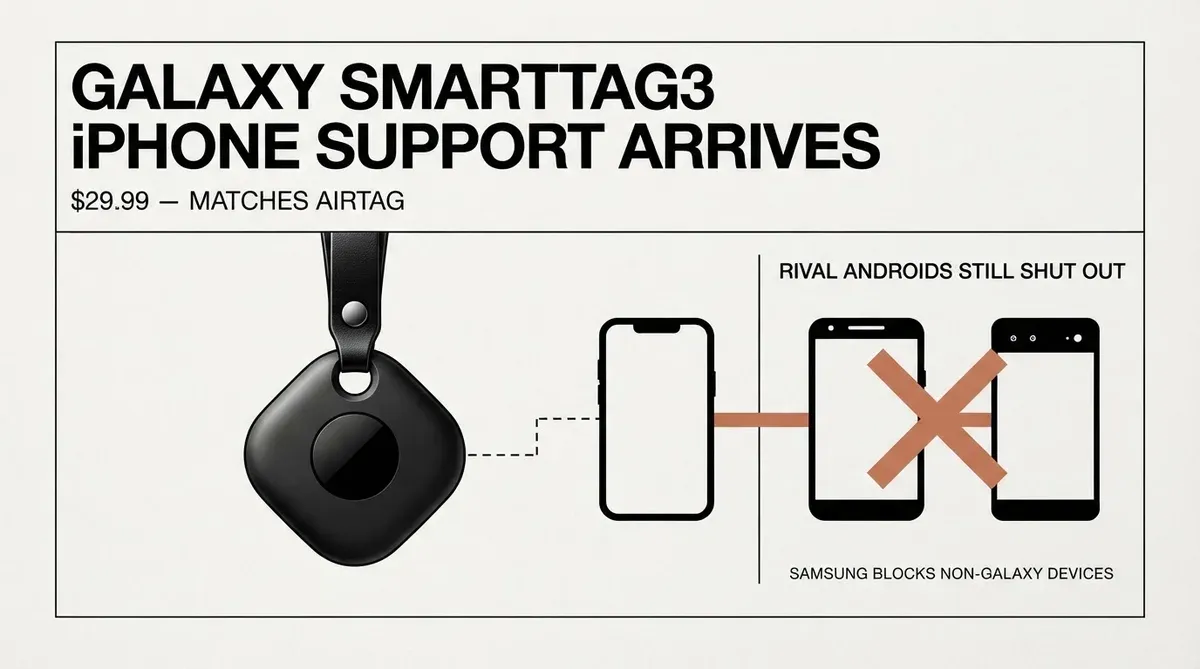
Samsung has opened its Galaxy SmartTag3 to iPhone owners, the first tracker in the line to work outside the company's own hardware. Galaxy SmartTag3 iPhone support runs through the SmartThings Find app, letting Apple users check a tag's location, share it and use Search Nearby. The tag comes in White and Black at $29.99 for a single unit or $99.99 for a four-pack, the same pricing Apple charges for AirTag.
The launch answers a complaint that has followed the SmartTag family for years: a $30 accessory tied to one brand of phone. The answer is partial. Samsung reserved the tracker's best features for its own devices and left every Android phone that is not a Galaxy outside the ecosystem.
What Galaxy SmartTag3 iPhone Support Actually Includes
Cross-platform access is narrower than the announcement implies. On iOS, users can view a tag's reported position, share that position with other people, and use Search Nearby to close the final few metres. For a mixed household with an iPhone and a Galaxy in the same drawer, those functions cover most of what a tracker does.
Three features stay behind. Compass View, which points an on-screen arrow toward the tag, needs a Galaxy phone with Ultra-Wideband or Bluetooth 6.0 Channel Sounding. Ring Phone, which makes the handset chime from the tag, and Left Behind Alert, which warns when a tagged bag is out of range, are also Galaxy-only. An iPhone owner gets a capable tracker; a Galaxy owner gets a better one from the same device.
The second limit is structural. iPhones can read the Galaxy Find Network but do not contribute to it. The network's reach depends on more than 900 million Galaxy devices acting as passive finding nodes, and an iPhone in the crowd adds nothing to that pool. Samsung gains from every iPhone that installs SmartThings, while the iPhone side of the arrangement gives nothing back.
The Android Gap Samsung Left Open
The Pixel 11 and Motorola handsets remain unsupported, and the SmartTag3 does not work with Google's Find My Device network. That decision is the sharpest part of the story. Samsung spent engineering effort to serve Apple customers while declining to serve buyers of competing Android phones, a group far closer to its own user base.
The logic is competitive rather than technical. Cross-OS support lets Samsung place hardware in homes it could not previously reach, and each iPhone installation pulls a user into the SmartThings app. Extending the same courtesy to Pixel owners would help Google's tracking network more than Samsung's, and Samsung has chosen not to.
That gap has a practical edge for buyers. Someone who moves from a Galaxy to a Pixel loses the tracker entirely, and a tag already attached to a suitcase becomes unusable rather than degraded. The same switch to an iPhone keeps the tag running at reduced function. Samsung's compatibility table makes the split explicit: the previous generation listed Galaxy devices only, while the new model lists Galaxy and iOS, with the feature caveats attached to the iOS column.
| Capability | Galaxy phones | iPhone | Non-Samsung Android |
|---|---|---|---|
| Locate and share tag | Yes | Yes | No |
| Search Nearby | Yes | Yes | No |
| Compass View | Yes | No | No |
| Ring Phone | Yes | No | No |
| Left Behind Alert | Yes | No | No |
| Feeds Galaxy Find Network | Yes | No | No |
| Works with Google Find My Device | No | No | No |
Smaller Body, Longer Battery
The hardware changes are substantial. Samsung cut the built-in mounting loop that defined the previous generation, which helped shrink the housing by 35 percent and reduce weight by 33 percent against the SmartTag2. The tracker keeps an IP67 rating, so brief immersion is survivable.
The smaller shell solves a specific annoyance. The SmartTag2's ring made it awkward to slip into a wallet or a child's backpack pocket, and a flatter, lighter tag fits those spaces without the extra bulk. Rain or a spilled drink will not end its life either.
Radios are the bigger upgrade. Bluetooth 6.0 Channel Sounding and Ultra-Wideband extend finding range to roughly 60 metres, about three times the previous reach, and sharpen close-range direction finding. Battery life is rated at up to 550 days on a replaceable button cell, stretching past 790 days in Power Saving Mode.
Software adds Place Notification for saved locations, Movement Detection, a seven-day Location History and NFC Lost Mode, which lets a finder tap the tag to see the owner's contact details. Samsung also positions the tag as a pet activity monitor, a use case that fits the 550-day battery claim.
Price, Timing and the AirTag Comparison
The SmartTag3 goes on sale in South Korea on October 7, 2026, with US availability in early November. Most other markets wait until 2027, a staggered rollout that leaves European and Indian buyers without the device through the holiday season. Pricing lands at $29.99 for one and $99.99 for four, matching AirTag rather than undercutting it.
Galaxy SmartTag3 iPhone support broadens the addressable market, but the $29.99 price keeps the comparison with AirTag direct. Samsung is not trying to win on cost, and it does not have to. For a family already inside the Galaxy ecosystem, the SmartTag3 is the only tracker that works with both the Android phones and the iPhones in the house. Apple's AirTag cannot offer that, and Google's network cannot either. The trade-off is a narrower feature set on iOS and a device that stops working the moment a household switches away from Galaxy.
Why this matters
The SmartTag3 shows how tracker competition has shifted from hardware to network access. Battery life and size are largely settled, and the deciding factor is whose finding network a household can join and at what level of access. Samsung has opened one door and kept two shut, betting that partial cross-platform support pulls iPhone users into SmartThings without handing rival Android makers anything. For buyers, the practical question is simple: if the house has a Galaxy phone, the SmartTag3 is the most flexible tracker on the shelf at $29.99, and if it does not, Galaxy SmartTag3 iPhone support offers a read-only seat on a network the tag cannot strengthen.
Sources
Samsung Galaxy SmartTag3 Makes It Easier to Keep Track of What ...
AI-generated image.
Related Articles
- Google Pixel Tag at $29: What Leaks Reveal About Google's AirTag Rival
- Weekly Tech Roundup: Apple, Samsung, and AI Redefine the Ecosystem Landscape
- Weekly Tech Roundup: Apple's Big Week and AI's Price Tag
✔Human Verified
Researched and cross-referenced against primary sources by the Bytevyte editorial team. This article was generated with the assistance of artificial intelligence and reviewed by the Bytevyte editorial team.