
Gemini 3.8 Flash and Flash Cyber land at flat prices as Google's release cadence quickens
Google's Gemini 3.8 Flash and Flash Cyber arrive as the third Flash release in six weeks, holding token prices flat while opening a gated agentic-security front.
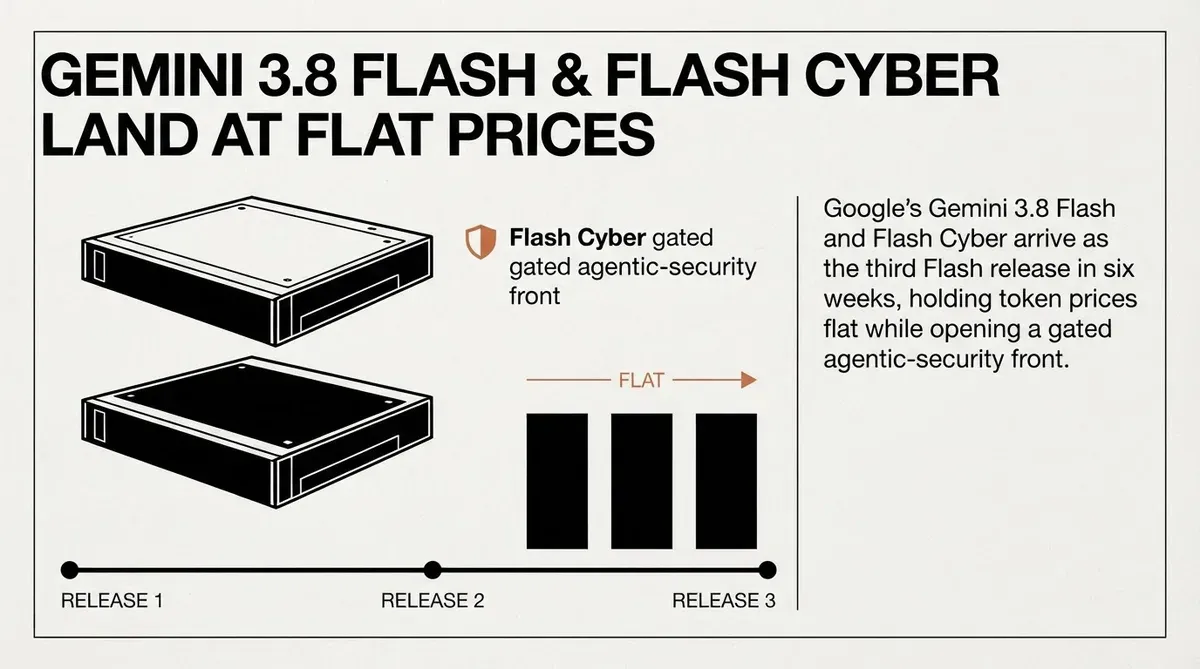
Google has released Gemini 3.8 Flash and a security-focused sibling, Gemini 3.8 Flash Cyber, three weeks after the previous Flash-tier model and as the third release in that family within six weeks. Both models, announced September 2, 2026, hold token pricing at the 3.7 Flash rate of $0.75 per million input tokens and $3.75 per million output tokens.
Google DeepMind describes the standard edition as its most capable workhorse model, citing gains over 3.7 Flash in software engineering, agentic task execution, and multi-step reasoning in specialized domains. On the DeepSWE v1.1 long-horizon software engineering benchmark, Google says the new model completes complex engineering problems end to end better than most larger frontier models at a fraction of their token cost. If independent testing confirms that result, it puts frontier-level engineering performance at workhorse pricing.
Both variants run on the same foundational intelligence. Long-running agentic loops that recursively evaluate and refine the model's output accelerate the two releases, and Google credits demanding training in cybersecurity with a large share of the gains. That mechanism explains the shape of this launch: a fast update clock for the volume tier paired with a gated entry into autonomous security work.
Three releases in six weeks at a frozen price
The cadence is the first half of the strategy. Gemini 3.6 Flash shipped in July at $1.50 per million input tokens and $7.50 per million output tokens, Gemini 3.7 Flash followed about three weeks later with prices cut in half, and Gemini 3.8 Flash arrives roughly three weeks after that with the rate card untouched. Google CEO Sundar Pichai set a target of close to monthly Flash releases during the company's second-quarter earnings call, and the shipping schedule has already run ahead of that pace.
Price and timing across the recent Flash line:
| Flash release | Timing | Price per million input / output tokens |
|---|---|---|
| Gemini 3.6 Flash | July 2026 | $1.50 / $7.50 |
| Gemini 3.7 Flash | August 2026, three weeks later | $0.75 / $3.75 |
| Gemini 3.8 Flash | September 2, 2026 | $0.75 / $3.75 |
Freezing the list price while moving the model forward is a quieter version of a price cut, and in some ways a stronger one. Developers already on the Flash API receive a better model at the token rate they pay today, with no contract renegotiation and no migration bill beyond testing. The effective price-performance curve improves every few weeks without a single discount announcement.
That pattern presses on rivals from two directions. Enterprise buyers weighing a larger, pricier frontier model against a documented DeepSWE result at workhorse prices get a simpler cost argument, and competing labs selling expensive reasoning tiers must either match Google's refresh pace or defend a growing quality gap while the price gap shrinks. For Google's own premium line, each strong Flash drop raises the question of what the top tier must add to justify its surcharge.
The cadence also raises switching costs without raising prices. An enterprise that leaves the Flash tier forfeits the next scheduled capability jump, and because improvements arrive every few weeks, the cost of porting to another vendor's model grows with each cycle. Volume pricing is the entry point; the release rhythm becomes the retention mechanism.
The improvement mechanism carries its own economics. Recursive agentic loops spend additional tokens during inference to check and refine answers, and holding the price steady implies Google has absorbed or offset that extra compute rather than billing customers for it. For workloads that run many loops per task, a flat rate keeps usage costs predictable while capability rises, which strengthens the case for building agentic products on this tier in the first place.
Gemini 3.8 Flash Cyber and the Fairwind gate
The second variant is Google's move into agentic security. Gemini 3.8 Flash Cyber is described as the company's most capable cybersecurity model, with frontier-level performance in vulnerability detection and automated patching, and it replaces the earlier 3.5 Flash Cyber line. The announcement is signed by Tulsee Doshi, senior director of product management, and Raluca Ada Popa, the Gemini security lead, a signal that security now sits inside the Gemini product structure rather than beside it.
Distribution is the sharper tell. Cyber access runs through a new Fairwind Program for trusted defenders instead of the public API catalog, a design that keeps a dual-use model inside Google's control. Organizations granted entry are trusted to use a capability that can find flaws and write fixes, and in principle locate exploitable weaknesses; that trust framing points first at government, defense, and critical-infrastructure security teams.
Security training improved the shared model, which follows from the reasoning the announcement implies. Vulnerability discovery is a long-horizon reasoning problem: the model must plan a search across code, hold hypotheses over many steps, test them, and revise. Those are the same skills software engineering and agentic tool use demand, which is why security work is less a side business for the Flash line than a training ground for the reasoning the whole family sells.
The gated route has costs for buyers. Organizations that want Cyber must pass Fairwind vetting rather than subscribe to an open endpoint, and the announcement leaves the program's eligibility criteria and pricing unstated. For regulated sectors that friction is familiar procurement reality, but it also means the security tier will spread more slowly than the general model, and early access will favor organizations already inside Google's trust orbit.
The two halves of this release converge in the agentic loop. The same machinery that refines a coding model's output during inference is what a security agent would use to iterate on a patch until it holds, which is why Google ships both variants from one base model instead of running separate efforts. Enterprises adopting the general Flash tier for engineering agents are effectively on the learning curve for agentic security; the evaluation practice and guardrails carry over.
What a three-week cycle changes for planners
For teams building on Flash, each release is a free upgrade on the rate card and a paid one in operations. Tool-call sequencing, output formatting, and long-context behavior can shift between versions, and agent pipelines are the most exposed to those changes because failures surface mid-workflow. The realistic planning cadence for agent-dependent software has moved from quarterly to roughly monthly, with regression testing as the true cost of staying current.
Security teams without Cyber access should still read the launch as a procurement signal. Autonomous vulnerability discovery and patching have moved from research demonstrations to a productized, gated offering, and buyers evaluating security agents should test them against real patching pipelines rather than vendor benchmarks. Discovery quality and fix reliability at scale are the metrics that will decide which agentic security tools enterprises adopt.
Why this matters
Google is using release velocity and flat pricing to reset expectations at the tier where enterprise agentic work is standardizing, and the Cyber variant opens a second competitive front in security that rivals have not yet matched with a comparable gated program. For buyers the consequences are a model cycle measured in weeks at unchanged token cost, with re-benchmarking as the real expense, and a Fairwind Program that will define how agentic security reaches the enterprise market.
Sources
Introducing Gemini 3.8 Flash and 3.8 Flash Cyber
Introducing Gemini 3.6 Flash, 3.5 Flash-Lite, and 3.5 Flash Cyber
AI-generated image.
Related Articles
- Agentic video understanding lands on Google's Gemini Flash, cutting token use up to 88%
- Half-Price Gemini 3.7 Flash Turns Model Race Into Cost War
- Gemini 3.5 Flash Native Computer Use: Google Targets Enterprise Agent Automation
✔Human Verified
Researched and cross-referenced against primary sources by the Bytevyte editorial team. This article was generated with the assistance of artificial intelligence and reviewed by the Bytevyte editorial team.