
Google Debuts Android 17 and June Pixel Drop Featuring Gemini Omni AI
Google launches Android 17 and the June 2026 Pixel Drop, featuring Gemini Omni AI, new multitasking Bubbles, and Pulse Loss Detection for Wear OS 7.
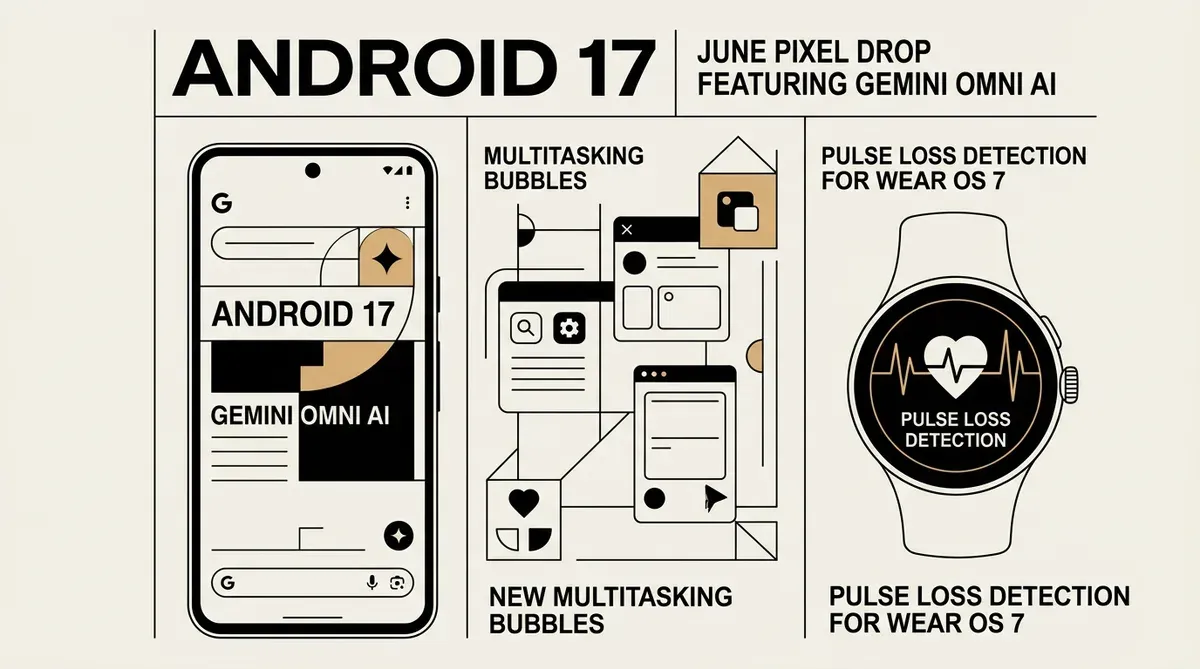
Google has officially released Android 17, introducing a suite of multitasking enhancements and security protocols alongside the June 2026 Pixel Drop. The update, which began rolling out to Pixel devices on June 16, 2026, centers on the new Gemini Omni AI model to power creative tools and real-time communication features across the mobile ecosystem.
The Android 17 operating system introduces a significant change to mobile multitasking through a feature called Bubbles. This tool allows users to transform any application into a floating window, facilitating more flexible split-screen configurations. Google designed this specifically to improve the experience on foldable devices, supporting a 50/50 split-screen layout that enables users to manage multiple active tasks simultaneously without switching between full-screen apps. This shift in window management is a direct response to the growing popularity of large-screen mobile hardware.
Enhanced Security and Creative Tools in Android 17
Security receives a major upgrade with the introduction of a biometric-based Mark as lost lock. This system prevents unauthorized access even if a device passcode is compromised, requiring biometric verification to unlock the handset once it has been flagged. On the performance side, the update includes refined background memory management. Google stated that these optimizations ensure AI-heavy applications run efficiently without causing excessive battery drain, maintaining system stability during resource-intensive tasks. This technical refinement is necessary to support the increased processing demands of on-device generative models.
The June 2026 Pixel Drop further integrates Gemini Omni into the Pixel creative suite. This multimodal AI allows users to generate high-fidelity music and video scripts using various input types. The platform now supports Lyria 3 Pro music generation, giving creators more sophisticated tools for audio production directly on their mobile devices. For users in Europe, Google is expanding the availability of the Edit with Ask Photos feature, bringing more advanced AI image manipulation tools to that market for the first time. These tools allow for complex photo edits through simple natural language requests.
Communication and safety features also see expansion in this release. The Voice Translate tool, which provides real-time call translation, is now available on the Pixel 10a. This feature is powered by the new AudioLM technology to ensure natural-sounding translations during live conversations. This expansion brings high-end AI capabilities to Google's more affordable hardware tier, narrowing the feature gap between the standard and Pro models. For wearable users, Google released Wear OS 7 alongside the mobile update, featuring Pulse Loss Detection. This safety tool can automatically contact emergency services and designated personal contacts if it no longer detects a wearer's pulse.
The update also includes Screen Reactions, a new utility that enables users to record their screen and their own face simultaneously. This is particularly useful for creators making tutorials or reaction videos. The rollout of Android 17 and the associated Pixel features is a shift toward agentic AI, providing a foundation for applications to act more proactively on behalf of the user. Owners of compatible Pixel devices can check for the update in their system settings as the phased deployment continues throughout the week. The arrival of these features on the Pixel 10 series and the Pixel 10a demonstrates Google's commitment to broad AI deployment across its entire hardware lineup.
Sources
Check out what's new in Android 17
June Pixel Drop: New features for creators, Gemini upgrades and more
AI-generated image.
Related Articles
- Google I/O 2026 Schedule: Android 17 and the Rise of AI Agents
- Google I/O 2026 Preview: Gemini Spark AI Agent and Android XR Glasses Leaked
- Google Previews Android 17 Beta 4 and Unified Aluminum OS Framework
✔Human Verified