
Google DeepMind Accelerator: Robotics Launches to Scale European Physical AI
Google DeepMind Accelerator: Robotics launches in London to support 15 European startups with Gemini models and AI expertise for physical AI development.
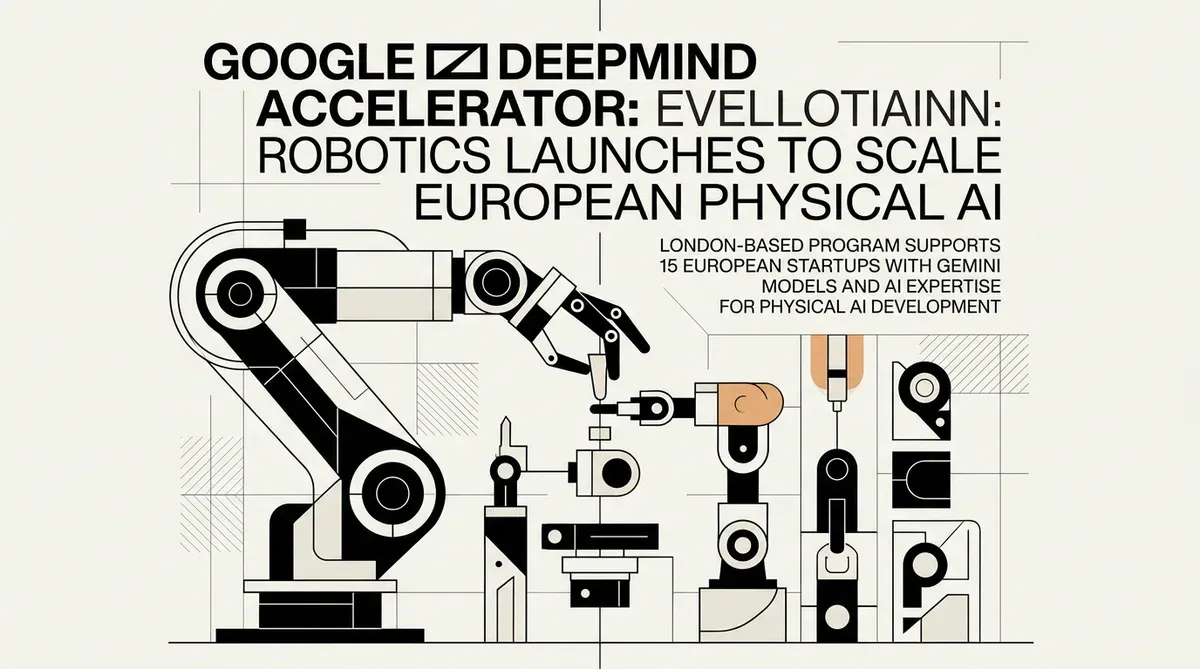
The Google DeepMind Accelerator: Robotics has officially launched in London, marking a significant expansion of physical AI efforts across Europe. This three-month mentorship program is designed to support 15 early-stage startups as they integrate advanced vision and action models into hardware products. The initiative arrives as the competition for embodied AI leadership intensifies between major technology firms and specialized robotics labs.
Led by Carolina Parada, Vice President of Robotics at Google DeepMind, the program provides selected participants with access to the company's full AI stack. This includes technical expertise and the Gemini robotics models, which are engineered to bridge the gap between digital reasoning and physical interaction. The cohort joining the London-based program this week is a diverse group from sectors including logistics, manufacturing, healthcare, and advanced navigation.
Strategic Support for European Robotics
By focusing on European startups, Google DeepMind is positioning itself as a central hub for the region's robotics ecosystem. The accelerator aims to help founders move beyond simulation and into real-world deployment. Startups such as 3D-Components AS from Norway and Acumino from Greece are among the first participants, highlighting the geographical breadth of the initiative.
The integration of large-scale AI models into physical systems is a complex technical hurdle. Google DeepMind intends to address this by offering direct mentorship on how to apply multimodal capabilities to robotic hardware. This approach allows startups to leverage pre-trained models that can understand complex environments and execute precise physical tasks, potentially reducing the time required for product development.
The launch of the Google DeepMind Accelerator: Robotics signals a shift in how AI giants engage with the hardware sector. Rather than focusing solely on internal research, the company is building an external network of partners that utilize its underlying technology. This strategy could establish the Gemini robotics models as a standard platform for the next generation of autonomous machines.
As of June 9, 2026, the first cohort has begun its residency in London. The progress of these 15 startups will likely serve as a benchmark for the commercial viability of generative AI in physical environments. Future milestones for the program include a demonstration phase where the startups will present their integrated hardware and software solutions to the broader industry.
While we strive for accuracy, bytevyte can make mistakes. Users are advised to verify all information independently. We accept no liability for errors or omissions.
Sources
Powering the future of robotics in Europe
AI-generated image.
Related Articles
- Google DeepMind Accelerator Debuts in Asia-Pacific to Tackle Climate Risks
- Lenovo and Imperial Launch Hub for Agentic AI Systems
- Google Debuts Gemini Robotics-ER 1.6 to Improve How Robots Navigate Physical Spaces
✔Human Verified