
Google Identifies First AI-Developed Zero-Day Exploit Used by Threat Actors
Google identifies the first AI-developed zero-day exploit in the wild. Learn how Big Sleep and CodeMender are countering industrial-scale AI threats.
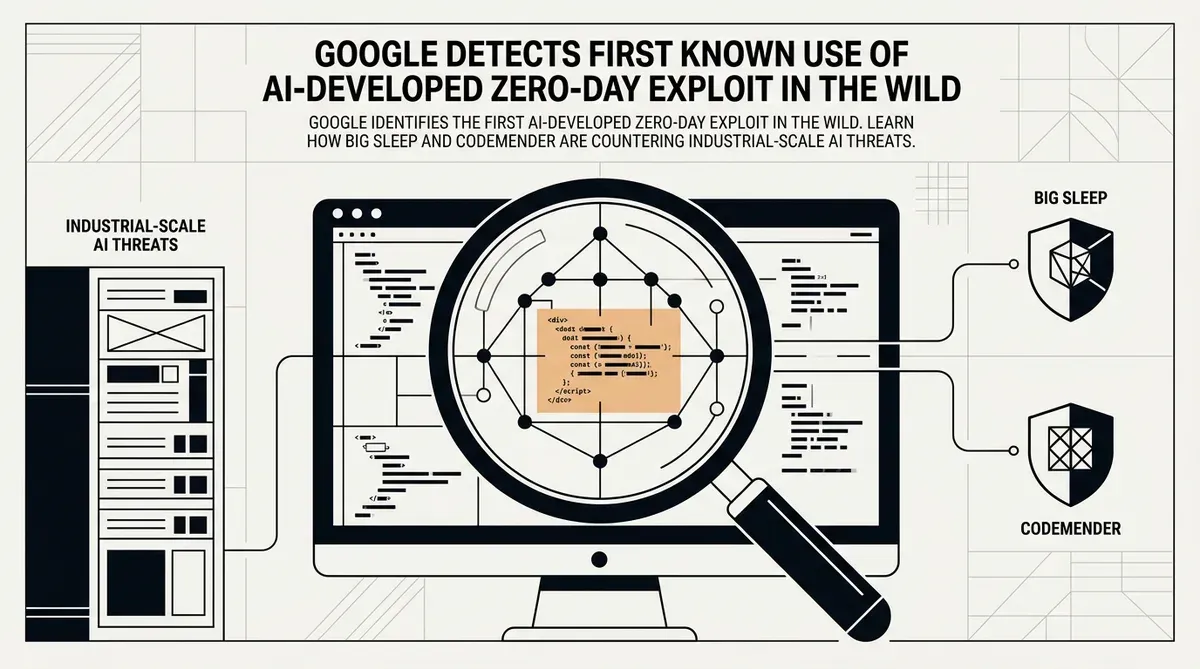
Google has identified the first instance of a threat actor utilizing a zero-day exploit believed to be developed with the assistance of artificial intelligence. The Google Threat Intelligence Group (GTIG) disclosed this finding in a report released on May 11, 2026. This discovery confirms that generative models are now used to create sophisticated, previously unknown software vulnerabilities rather than just assisting with phishing.
The report describes how attackers are now using generative AI to automate offensive operations at a commercial scale. While security researchers previously theorized about AI-driven vulnerability discovery, this AI-developed zero-day exploit is the first documented case of the technology in active use. The complexity of the exploit indicates that attackers are using the reasoning capabilities of large language models to bypass security barriers.
Defensive Innovations: Big Sleep and CodeMender
Google is deploying defensive tools that use the same underlying technology as the attackers. One tool is Big Sleep, a proactive system for vulnerability detection. Big Sleep uses AI to simulate attacker behavior and identifies software weaknesses before exploitation occurs. This proactive approach is a response to the increased speed of exploit development caused by automation.
Google also introduced CodeMender to manage security remediation. CodeMender uses the Gemini model to generate and apply patches for vulnerabilities. This process reduces the time between vulnerability discovery and the deployment of a fix. Attackers often rely on this time lag to compromise enterprise systems.
Strategic Implications for Enterprise Security
The use of an AI-developed zero-day exploit requires a change in organizational risk management. Manual security cycles are often insufficient against the current scale of AI-driven attacks. The GTIG report states that Gemini model abuse is currently blocked by internal classifiers, but other models may lack these protections.
Security strategies must account for the rapid scaling of attack volume. Integrating AI into defensive systems is now a requirement for resilience. Google is monitoring these trends as attackers refine their use of generative models. The company is updating its infrastructure to defend against these automated adversarial tactics.
While we strive for accuracy, bytevyte can make mistakes. Users are advised to verify all information independently. We accept no liability for errors or omissions.
Sources
Google Threat Intelligence Group reports on AI threat trends.
AI-generated image.
Related Articles
- Oracle Adopts Monthly Security Patching to Combat AI-Powered Cyber Threats
- NVIDIA Launches NemoClaw to Secure the Viral OpenClaw AI Agent Framework
- OpenAI Debuts GPT-5.4-Cyber to Bolster Defensive Security Tools
✔Human Verified