
Google TPU Lineup Grows With 8tx and 8i Max Chips
Google adds TPU 8tx and TPU 8i Max to its Google TPU lineup, with claimed 2.7x training and 80% inference price-performance gains over the prior generation.
Listen
Google has added two systems to its eighth-generation TPU portfolio, TPU 8tx and TPU 8i Max, bringing the number of TPU systems it has introduced in 2026 to four. The additions, announced on November 9, 2026, sit alongside TPU 8t and TPU 8i, which Google unveiled in April. The Google TPU lineup now spans large-scale training, real-time reasoning, confidential inference and long-context workloads, and it is the company's clearest move yet to sell custom silicon against Nvidia accelerators.
What Google added to the Google TPU lineup
TPU 8tx is built for secure, confidential inference, with hardware-level encryption for regulated customers. Google also positions it for small-scale training and claims 2x lower latency than TPU 8t. It pairs with 5th Gen AMD EPYC CPUs in its system configuration.
TPU 8i Max is aimed at jobs that need very long context and the most compute packed into each rack in the lineup. It is a dual-chip package that links two TPU 8i chips, with twice the SRAM and twice the HBM bandwidth of a single TPU 8i. Google's announcement post says the two new systems respond to customer requests for accelerators that can reason across very long contexts and for stronger encryption in regulated settings.
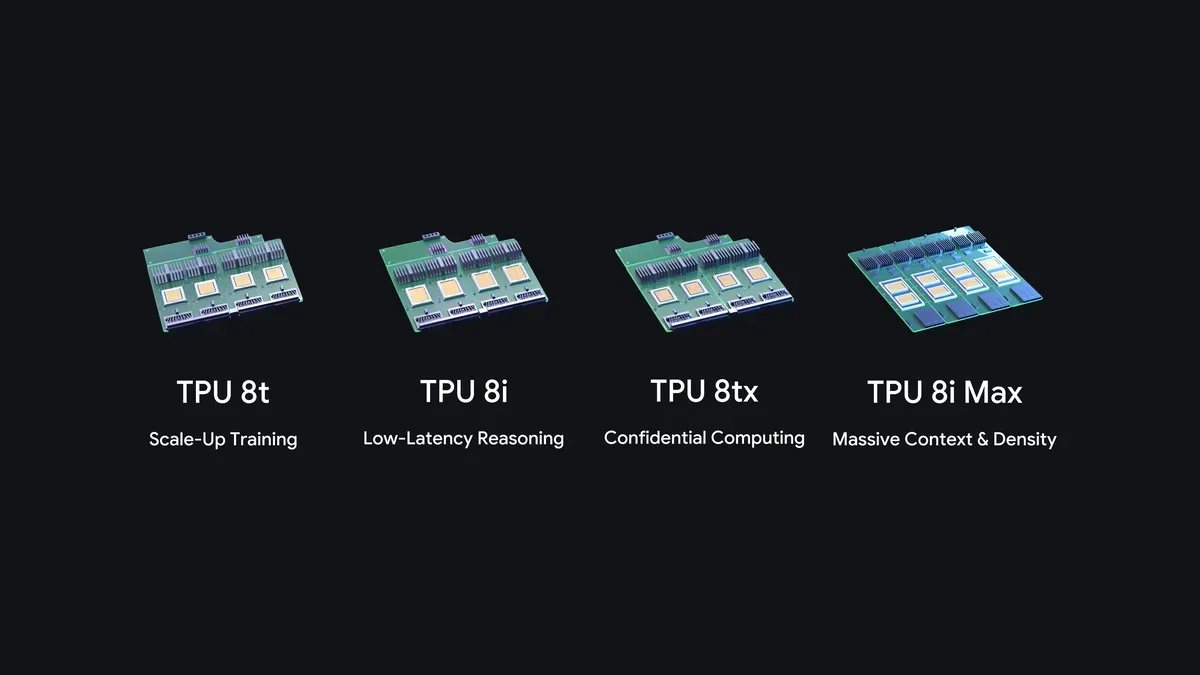
The earlier pair carries the performance baseline. Both figures compare against Google's own prior hardware.
Why the system approach changes the cost equation
Google separates a new chip from a new system. A chip requires a multi-year design and manufacturing cycle, while a system covers how compute, networking, storage and packaging are assembled around that chip. Google built its TPUs as modular blocks inside its AI Hypercomputer, so it can swap out how chips are packaged, how high-speed memory is attached, how optical links are routed and how security is handled without redesigning the silicon. That is how it delivered four systems in one year.
The customer base explains why this matters. Google says TPUs now serve nearly 100 customers, among them frontier labs, trading firms, retailers and universities, and that buyers can install TPUs straight into their own facilities. Once a chip leaves Google's own Gemini workloads and runs in customer facilities, its pricing has to compete on total cost of ownership, not only on internal efficiency. That shift is what gives the 80% price-performance claim commercial weight.
Competitive position and open questions
They do not report Nvidia's current pricing, its market share, or any change in its prices. The 80% and 2.7x figures are generational gains, measured against Google's previous TPU.
Availability is also incomplete. Google's post dates the announcement but does not give ship dates for TPU 8tx or TPU 8i Max. Secondary coverage summarized by Techmeme reportedly places TPU 8i Max's launch in 2027. The post also describes TPU 8tx's latency gain relative to TPU 8t without independent testing. Customers evaluating the systems will need Google's pricing and regional availability.
For infrastructure teams, the practical split is clear. Regulated workloads that need confidential inference map to TPU 8tx, while long-context serving maps to TPU 8i Max, and the decision depends on which of those workloads a team runs at scale. A TPU deployment inside a customer's own facility also brings power, cooling and site-level costs, and those costs will weigh on the total price of any deployment.
Google's four-system year is the strongest evidence yet that it intends to compete on custom hardware for outside buyers. The next checkpoints are the availability dates and pricing for TPU 8tx and TPU 8i Max, and any independent benchmark of the 80% inference claim against current Nvidia systems. Until those arrive, buyers should treat the generational gains as Google's own figures and test the systems against their own inference workloads before committing.
While we strive for accuracy and rigor, ByteVyte can make mistakes. Readers are advised to verify all information independently and conduct due diligence before making decisions based on this reporting. We accept no liability for errors, omissions, or decisions made in reliance on this content.
Sources
Our newest TPUs: 8tx and 8i Max, built for the agentic era
Related Articles
- Google Shifts to Agentic Gemini with TPU 8th Generation and $100 AI Ultra Tier
- Google Releases TorchTPU as Open Source, Testing Nvidia's PyTorch Default
- Intel and Google Cloud Boost AI Performance with Xeon 6 and Custom Silicon
✔Human Verified
Researched and cross-referenced against primary sources by the Bytevyte editorial team. This article was generated with the assistance of artificial intelligence and reviewed by the Bytevyte editorial team.