
In the Google AI Coding Race, Pichai Bets Everything on Gemini 4
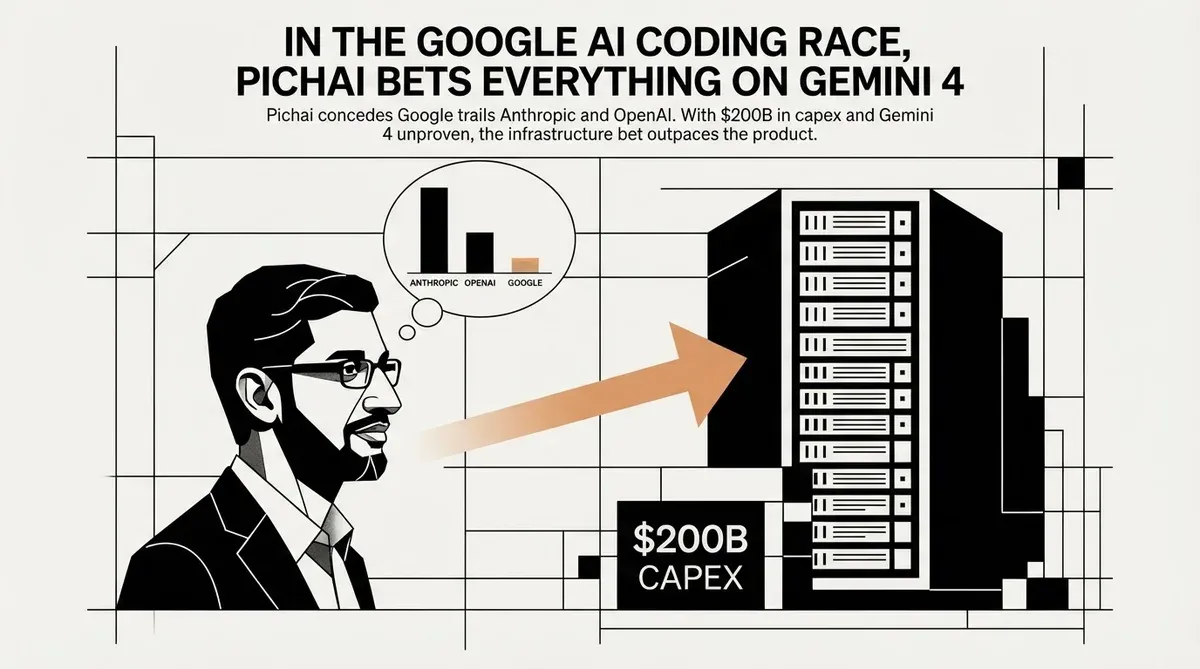
Sundar Pichai has acknowledged that Google trails Anthropic and OpenAI in coding and agentic programming, a rare public concession from a chief executive who has spent months defending the company's AI competitiveness. Speaking during Alphabet's second-quarter 2026 earnings call on July 21, Pichai pointed to Gemini 4, a model still in pre-training, as the company's primary vehicle for closing the gap in the Google AI coding race, which has become the industry's most lucrative capability.
The admission carries unusual weight because it comes from a CEO whose company has poured more money into AI infrastructure than any single competitor. Alphabet reported $119.8 billion in quarterly revenue, up 24 percent year over year, and projects between $195 billion and $205 billion in capital expenditure for the full year 2026. The Google AI coding race is not a side narrative for the company. It sits at the center of its ability to monetize artificial intelligence at enterprise scale. No other company is spending more to win it, and few have as much to lose by falling further behind.
Pichai's candor on this topic extends beyond the earnings call. In a Hard Fork podcast interview published in May 2026, he acknowledged that Google's models sit at the frontier on text, multimodality, voice, and reasoning, but conceded the company trails on the long-horizon coding tasks where Anthropic's Claude Code and OpenAI's Codex have established commanding leads. Agentic programming, the ability for an AI to autonomously manage complex, multi-step software development workflows, is exactly the segment where enterprise customers are willing to pay premium prices and where developer ecosystems form lasting allegiances.
The Delay That Exposed the Gap
Gemini 3.5 Pro, which was scheduled for release in June 2026, remains in partner testing after Google pushed the launch back by several weeks. Pichai described the deployment as a rolling process with partners rather than a single public launch event, signalling that the model is still not ready for broad release. The delay stems from coding performance issues that the model could not overcome before shipping. That makes the coding deficit not just a talking point but a concrete engineering problem that has already forced Google to reshuffle its product calendar.
The implication is sharp: the same coding weakness that Pichai acknowledged in abstract terms during the earnings call is the specific reason a marquee product missed its ship date. Gemini 3.5 Pro was positioned as the bridge between today's models and the next-generation architecture that Gemini 4 promises. With that bridge delayed, Google's product lineup for the second half of 2026 depends even more heavily on the Flash model family and on the hope that Gemini 4 arrives quickly enough to prevent further ecosystem leakage to competitors.
Cloud Revenue Surges While Models Struggle
The asymmetry in Google's AI performance is stark when the financial results are examined. Google Cloud generated $24.8 billion in revenue during Q2 2026, an 82 percent increase year over year. That is a meaningful acceleration from 63 percent growth in Q1 2026 and 48 percent growth in Q4 2025. Nearly 90 percent of Fortune 100 companies now use Gemini Enterprise in some capacity, and Google Cloud's growth rate is more than double the overall cloud market expansion.
The Gemini platform itself processes 22 billion API tokens per minute, and the Gemini app has reached 950 million monthly active users. These figures demonstrate that Google's distribution and infrastructure advantages are real and widening. The disconnect is that these strengths have not translated into model-level leadership in the coding domain where developer mindshare and enterprise procurement decisions increasingly converge. A developer using Claude Code or OpenAI Codex today is building workflows and institutional knowledge around those platforms, switching costs that grow with every month Google's models remain behind on the coding frontier.
Alphabet spent $44.9 billion on capital expenditures in the second quarter alone, representing 100 percent growth year over year. The company raised $49.6 billion by issuing stock in June and secured another $20.3 billion through senior unsecured notes, all earmarked for AI infrastructure expansion. On an annualized basis, the $195-205 billion capex forecast positions Google as the single largest AI infrastructure spender globally, surpassing even Microsoft and Amazon in committed capital for data centers, accelerators, and networking.
The Google AI Coding Race: Inside the Gemini 4 Bet
Pichai described Gemini 4 as the most ambitious base model training run in the company's history, using the word "ambitious" three times during the earnings call. The model is being designed and scaled with the explicit goal of competing at the next frontier. That means it is being built for a capability level that does not yet exist in production, not merely for matching what Claude 4 or GPT-5 can achieve today. Google is effectively trying to skip the current generation of competition and land at a future point where its architectural investments pay off in one leap.
The strategy carries inherent risk. Gemini 4 remains in pre-training with no confirmed release date. Pichai suggested that once the model starts shipping, users could expect releases at nearly a monthly cadence, implying a rapid iteration cycle similar to how OpenAI has rolled out GPT-series incremental improvements. But the timeline between now and that first release is an open question, and in the intervening period Anthropic and OpenAI continue to ship model updates at a pace that has already forced Google to reposition its own roadmap multiple times over the past year.
Pichai also emphasized the role of the Gemini Flash model line, which Google is deploying for cybersecurity, customer service, analytics, and enterprise software use cases. Flash models represent the pragmatic counterweight to the frontier bet. Smaller, faster, and cheaper to operate, they are designed to capture volume deployments even if they do not win headline benchmarks. The strategic tension is that Flash models generate revenue today while Gemini 4 is a promise about tomorrow. Investors are being asked to fund an infrastructure bill that supports both tracks simultaneously, with the payoff from the frontier bet still months away. The outcome of the Google AI coding race may hinge on whether that payoff arrives before developer loyalties are permanently locked into competing platforms.
Infrastructure vs. Product: Two Google Speeds
What makes the current moment structurally unusual is the divergence between Google's two AI businesses. The infrastructure trade selling compute, cloud services, and API access is working at a level that most competitors can only envy. Google Cloud's 82 percent growth rate, the $44.9 billion quarterly capex, and the nearly 90 percent Fortune 100 penetration all point to a machine that is firing on all cylinders at the hardware and platform layer.
The product trade building models that win on capability benchmarks and developer preference is faltering. The Gemini 3.5 Pro delay, the public acknowledgment of a coding deficit, and the reliance on an unshipped Gemini 4 all point to a product organization that is struggling to match the execution velocity of Anthropic and OpenAI. The two sides of the company are moving at different speeds, and the faster one is now heavily subsidizing the slower one through capital allocation that is fungible across both layers.
That dynamic is sustainable in the near term because the infrastructure business generates its own growth trajectory. But the longer Gemini 4 takes to ship, the more that coding use cases become locked into competitors' ecosystems. Enterprise workflows built on Claude Code or OpenAI Codex are not easily migrated to a late-arriving Gemini replacement. The switching costs include retrained developer teams, reworked pipelines, and the opportunity cost of not using the best available tool during the migration window.
Why This Matters
Google's position in the Google AI coding race will determine whether it captures the highest-value segment of the enterprise AI market or cedes it to Anthropic and OpenAI. The company's infrastructure advantage gives it time and financial runway that few competitors can match, but models, not GPUs, are where developer loyalty and enterprise procurement decisions are settling. If Gemini 4 delivers on its stated ambition, Google closes the gap in a single architectural generation. If the model slips further or underwhelms on the coding dimensions that matter most to enterprise buyers, the company risks turning its cloud business into a commodity provider that powers the applications of its more capable rivals.
AI-generated image.
Related Articles
- Google Gemini 3.5 Pro Delay Signals Deeper AI Troubles
- Google Custom AI Chip Gemini Development Targets Inference Cost Reduction
- Google Shifts to Agentic Gemini with TPU 8th Generation and $100 AI Ultra Tier
✔Human Verified
Researched and cross-referenced against primary sources by the Bytevyte editorial team.